Wednesday

July 30, 2007 [This Is England]

This Is England reminds us that working on Maggie's Farm is a back-breaker. Was then, still is, whether she sends you to the field down by the Falklands or outside of Brixton, or whether years later she gets one of her hands to truck you over to the hard-packed ground near Baghdad to dig up yellowcake like potatoes all day for years and get nothing but dust and the surging smell of chlorine.

But Tony Bee and George Dubya and Operation Sinbad are years away from Shaun, the boy in early-1980s England without a father but eager to find someone aside from his well-meaning mother—and he joins a band of Little Punk Rascals who shave his head and encourage the Doc Martin in him, all in good fun, kids on a spree—until the New Skinheads arrive, filled with fear and sick of it, so they try to foist it off on everyone else, a vision of the world as a ghetto of Wogs and Pakis and niggers that they just can't wait to corner and beat to death, their own lost hearts broken, their madness the kind that rats piled up in a little cage understand and turn into blind cannibalism, the taste of each other sickening, their hearts, once filled with ska-dee-lites, now sagging with the effort of pumping anemic pale nothing through flattened veins.

Young Shaun falls into this despair and almost eats his own heart in the lonely frenzy of the moment. He goes to the water like Antoine Doinel, the two of them cut and battered 400 times—but Shaun leaves something to sink under the waves: the Union Jack like a coffin-shroud shrugged off in disgust right before the body slips into the water, leaving Shaun alone but free, "on the beach" like the old movie about nuclear annihilation—except he isn't burning, he can still walk away, and thank God he does.


Friday

January 29, 2007 [Volver]

The colors in Volver are bright, as snappy as the little staccato kisses the women give each other in greeting and conspiracy, in hope and agreement. We first see them cleaning tombs in the wind, dead husbands' as well as their own, blinking dust away from eyes oddly bright and a little mad. It reminded me of García Márquez' "The Handsomest Drowned Man in the World," the women dressing him up, falling in love with him—their own husbands paling in comparison. Pedro Almodóvar also tells "a tale for children"—no, make that women, as he yet again asserts that our lives have been built not by Adam but despite him—maybe even built by Eve herself; and her daughters tend to band together against the wind—against the men who make them mad.

At the center is the lovely Penelope Cruz—and it's fun to watch the other women know it's her, commenting on her cleavage—and the camera, too, looking at her and admiring—although she can be a bit much, full of temper and rash words as she alternates between hurting and apologizing. Around her are women bound by the evil deeds of the men in their lives—and by the women who did not bond with them but have thwarted their hopes or ruined their memories with regrets.

But as they work hard—burying bodies, stealing restaurants, hiding ghosts—they regroup and close ranks, smiling warriors holding onto each other as they make their way down slippery slopes and steep upgrades and make me feel completely extraneous to their efforts to be safe and happy. No, they'll take care of that themselves and together; my only job is to watch in admiration and maybe a little jealous yearning—and not just for one bright flashing look from Penelope's Spanish eyes but also for the little world they cunningly make, with goodies stowed away in Tupperware and a loving grandma tucked beneath the bed in case I need a reassuring hug and a good half-dozen kisses.


Thursday

A Note from the Diary's Editor

I was shocked to hear of Roger Ebert's death. I hadn't visited his blog for a while, but earlier today I read on his Journal of his ambitious plans for his site, his show, his festival—his work. And then less than an hour ago I hear that he's gone. I will not attempt the right words; I simply want to express my deep sense of loss for someone who taught me much about the movies, particularly the need to admit that the movie doesn't occur only on the screen but in your head, and if it's of any worth it takes up residence in there and effects changes—in you, in the other movies you've seen, in the way you see other things. I am grateful for Mr. Ebert's help in realizing that, and I look forward to that fine day when I will sit with him—and Gene Siskel and Carlos Clarens and Orson Welles and Tarkovsky and so many more—and pass the popcorn and watch a great many great movies.

 God bless you, Roger Ebert. "The pain then is part of the happiness now."

Tuesday

January 22, 2007 [A Scanner Darkly]

"Flow my tears," the policeman said, his memory like a finger running along the blade—and how heavy the feeling was, poison in the system right before the pain, just a little less breath and a weight on my chest, and I find it—well, not difficult to move, just incidental to being right where I am.

And where am I? It seems small but free, like the high stool on which a Nowhere Man could sit—except I'm lying down, one leg dangling, the foot on the floor, the couch scratchy on my arms, my tee shirt bunching up beneath me, and the house quiet while the traffic shivers outside like small waves breaking.  And the TV keeps on, excited voices turned down but insistent, whittling at something until it becomes something else.  So I crack one then both eyes open and see the flat familiar shapes on the screen sliding a little like plate tectonics sped up—each million years a half-second, the jitter from era to era no longer discernible—and it's faces and cars and trees—and more faces, some dull, some shifty, all bearing down on whatever's in front of them—except some of them slip and shift forever into scrambled disguises, masks and altered tones until no one knows who's who.  An undercover world.

And not quite real, rotoscoped and morphed, cartoons.  Finally!  Some truth there on the screen, a cartoon at last about "D" for Death: hilarious on the way down, until it's all bugs and funny looks from bystanders, until they're all on the hit list, even Phil Dick himself—and they keep remembering to swallow and down they go until alone in the field the harvest peeks up, down there where the cornstalks meet the loam and I find the little paperback and read:

"What does a scanner see?  Into the head? Down into the heart?  Does it see into me?  Into us?  Clearly or darkly?  I hope it sees clearly because I can't any longer see into myself.  I see only murk.  I hope for everyone's sake the scanners do better, because if the scanner sees only darkly the way I do, I'm cursed and cursed again."

And now I'm no longer on that couch, I'm on my own and I see him bending down; it's a moment without murk, almost joy—certainly relief, certainly one little piece of what should be; and he plucks a present for his friends at Thanksgiving.

In an essay on Dick's novel, Frank C. Bertrand reminds me of something that M.H. Abrams asserts about the Romantics in his book Natural Supernaturalism:

"Whether a man shall live his old life or a new one, in a universe of death or of life, cut off and alien or affiliated and at home, in a state of servitude or genuine feeling ... all depends on his mind as it engages with the world in the act of perceiving."

I can see Dick's scanner, Arctor, a clear and cleanly drawn object flat and right there against the glass wall of my TV, losing his old life to live the new, making a little quavery sound like a Theremin approached that makes me smile at the spooky half-gift and almost-promise of freedom slipped into his sock.


Monday

January 7, 2007 [Children of Men]


 I think Children of Men was shot with digital cameras—it has that clean look, everything clear, each clod of earth arcing in unsmeared trajectory. I'm not sure, though—but that long sequence when they escape the farm, an unbroken shot—as so many of them are in this movie—of growing tension and light, from pre-dawn to day, for a while made me forget what the movie was about: The light was so perfect, like Millard Sheets' painting of a train station, all buttery gold and blue and serious blacks.  Again, if this was shot without film, Children of Men speaks well of the new medium.


The movie itself has its own clean darkness, the kind of tale John Brunner knew so well, the late-'60s-early-'70s dystopian despair of Stand on Zanzibar and The Sheep Look Up taken one step further, into a fable of a world where no more children are being born, the West sliding into casual fascism, the global community at last united by tragedy.

—But there is no "superordinate goal," no Independence Day Enemy from Space for us to rally against. Like something out of Cronenberg, this apocalypse comes from within, and the barren species begins a last long period of mourning.

—But unlike Brunner's methodical punishments, Children of Men moves toward hope, in the end more Star Trek than A Boy and His Dog. A child is born, and sacrifices are willingly made for it—yes, in fog and choppy waters, but out of the gloom decent hearts shine.  Along the way the movie (once more: beautifully) acts as a travelogue for The End, with Michael Caine's benign counter-culturalist and sundry jackbooted and babushka'd hindrances and helps. I'm glad that science fiction occasionally gets to be itself at the movies, something more than sparks and monsters.

Tuesday

October 10, 2006 [The Departed]

Scorsese looked toward Hong Kong and Infernal Affairs and saw exactly what he'd been aiming at--like Joe Pesci gunning us down at the end of Goodfellas: a plot that melts the good guys with the bad like Chang and Eng, the original Siamese Twins, a sight you'd pay to see--and, if you're built right, were sorry afterward. Because what are you looking at but happenstance and the effort afterward to deal with it--but oh man, it deals with you. Right off the bat, Nicholson's Frank Costello rolls off a nicely balanced Proverb of Hell when he tells us, "I didn't want to be a product of my environment; I wanted my environment to be a product of me"--and in that twist and curve he stamps the two sides of this movie's coin, flipped and somehow for a while standing on its edge.  From Mean Streets onward, Scorsese has known what he thinks of the Underworld--and he knows it's really two things: that some evil is real, and that some evil is ours. He asks himself, his characters, and us to pay for it and keep it and wait until we have to cash it in--the complicity that's the entrance fee to our humanity and the perdition that waits--that is, unless we knock the coin over and choose, make it heads or tails, rig the game so that, no matter the side we choose, in the end we own it like an Irish Catholic living in misery because he made a promise to stick it out.

I think Scorsese gives us a modern world of chance, like a priest offering a taste of Eternity--but that chance is old, Medieval at least, maybe more: the first sign of bad weather East of Eden, a lightning bolt from outer space bouncing down into Frank's cell phone: not just a product of the environment but the environment itself. The trick is to pick a side--no matter that one looks like the other, Chang and Eng--and hold on like that pit bull, Mark Wahlberg's Dignam (IN-dignant, more like it), who curses out the naughty world and cleans up afterwards.

Monday

September 12, 2006 [Hollywoodland]

I lean toward Hollywoodland in my declining years a little hard of hearing: I thought it was the sound of Philip Marlowe's shoes trudging along a mean street with a dead man--"heavier than broken hearts" as he says somewhere--tied to his ankle with a blue cape, Superman's.  Private eye Louis Simo (a man who could not fly like a bird, but in Adrien Brody's capable hands--and in his amazing profile--certainly seemed to be one) also leans toward the bad things to gaze into the middle distance where George Reeves, also weighted down by his Superman costume, strums his blue guitar and bids adios before accepting a final naked kiss punctuated by a splatter-pattern, over and over.

And the song he sings--the tune that comes out of Ben Affleck's affable but uncertain face--is straight out of Chinatown.  Simo (a name as silly as "Gittes") has also been a bit slow on the uptake, and taken chains to the face--not as bad as a slit nose, but close--and been beaten down by not only the tawdry details of the case but his own complicity in the mess he's stirred up. And Louis, like Nicholson's Jake, is sapped into sleep, rest for the weary at last--until the phone rings again and he winces and touches his wounds and slogs on.

But there's a difference between the two movies: for Hollywoodland, parenthood is not the croaking ecstasy of a sick old man, not the problem, but the solution: Simo watches his son burn his Superman costume, and to unlock the mystery of that failed adoration he follows Reeves into the dead man's cipher-blank life--where he finds Clark Kent--the costume that Bill discusses so eloquently in Kill Bill, Superman's disguise.  And Simo's pity for the hidden man is matched only by his own urge to have something more than a secret identity--the "private eye"--but to become a father to his son, and even a friend to the dead Reeves--maybe even his alter-ego, the two of them Clark Kents snatching the eyeglasses from their faces and trying to go home to someone who loves them, a child--or, for Reeves, a woman, Toni Mannix--Diane Lane once more channeling Gloria Grahame, tough but wise, who tells Reeves, "Nobody ever asks to be happy later"; but Reeves may have asked, and may have waited too long. Simo, patiently approaching his son little by little, seems willing to accept the wait--some reconciliation that bests poor Reeves' oblivion.

Tuesday

June 20, 2006 [Nacho Libre, The Three Burials of Melquiades Estrada]

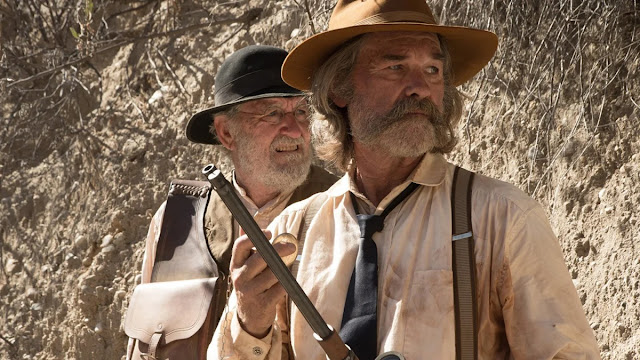
 Both Tommy Lee Jones' The Three Burials of Melquiades Estrada and Jared Hess' Nacho Libre indulge in the outre--and to similar ends, and by similar means.  Both movies are put together like a campfire reminiscence: sudden shifts in event and tone as one thing reminds you of another, and you linger and follow that trail--until another turn takes you straight into scrub and open spaces--before bringing you back to that one thing, that one person you cannot forget, who sits at the center, like Marlow in Heart of Darkness on the deck of the ship at the start, waiting to tell his own tale.  Of course, Jones' story is measured out with some weight, while Nacho Libre has the narrative drive of a Daffy Duck cartoon, all chasing and mugging and yelling and falling.

What a tale Jones tells, though, aided by Barry Pepper as the bull-moose knucklehead who shoots the titular thrice-buried Melquiades--who in turn forms the grisly third in their death-march. The movie is Texas-true: It begins as a puzzle and ends as a requiem, its editing laconic and terse, the visual equivalent of Jones'--or Gary Cooper's--voice.  And Jones' face as always makes him look like a weirdly bent straight arrow--and Barry Pepper is the perfect snake-bit greenhorn, his pall-bearing duties bringing him self-awareness and maybe the first real tears of his life.
Meanwhile, also in Mexico--but one soaked in the spin-art colors of a fireworks fiesta--Nacho Libre tells its own story of redemption and resolve.  But you have to look real hard to see it, way past Jack Black's husky outrages and Hess' deep affection for deadpan catastrophes.  We went for Marie's birthday, all of us in a row laughing--the only ones, filled with contrary delight as Jack Black insists he "knows a butt-load of crap about the Gospel" and more than ready to accept his José Jimenez accent and lucha libre aspirations.  And of course his partner Esqueleto, the one who believes only in "sigh-yence" and sneers, "I hate all the orphans in the world," but who musters enough faith to fling both of them across something that was a movie only in the technical sense--and in some other sense as well, some paranormal apprehension of a cockeyed inner life that happens just as you fall asleep--the vertiginous moment when you lurch as though you were falling and spring awake again, your stretchy pants straining to contain the energy needed to wrestle terminal foolishness for the sake of love, orphans, God, and a solid three-count.  I have no idea what Jones would think of this movie--oh, no more lying: I know exactly what he'd think--but the thing about going to a movie is that the other ones you've seen tend to talk during the feature, and no usher in the world can eject them.

Monday

May 27, 2006 [La Moustache, Pulse/Kairo]

About 15 years ago I shaved off my mustache--I'd had it for years--in fact, I was wearing it when I met Jean, so she'd never seen me without it, except in photographs.  But she had been off somewhere, and I was alone in the house, and thought that 1981--or whenever it was I shaved it off--was just far enough away from the glory days of the American mustache--OK, a mere half-decade--if that: many men continued to sport them, pure Burt Reynolds Envy, maybe Tom Selleck--or jeez, maybe even Ron Jeremy?  In any case, I suddenly decided that was that, and got rid of it. 

I can still recall rejoining Jean, seeing her across a parking lot, walking up to her--and as though she were one of Job's friends visiting him in the midst of his ashes and boils she saw my state from afar and cried out in dismay--and no How-are-you-honey-missed-yous for me; no, she went straight to, "Grow it back."  I did, and kept it longer than I should've, dutiful but dumb, and happy to say so.

Lucky me I did not make the attempt while living in the French movie La Moustache.  Marc also simply does it, no real hesitation, the little clipped hairs collecting in the little dish, scraped in the trash, we see it all--and no one notices--and more: Everyone insists he'd never had one. And even the photographs don't matter, the hairs collected from the dumpster and presented by a stinking, almost-raving man desperate to understand how something like that could not only be overlooked but erased--I mean, we've all made this change or that, and no one notices, sometimes not even when you point it out to them, not really--and we chalk it up to the strange shifting point-of-view of the self: After all, our haircuts and eyeglasses and so on are a presentation to others; good grooming is for everybody else--you can't see it, it's all on your face, on top of your head, dangling from your ears just out of sight.  You can look down at your clothes and your shoes, but your face and your head and all its this n that are little somethings for everybody else.  And how strange when they don't notice the change--but how natural, since in the end it's all on you, literally, and their job--to see it--is taken so lightly you may as well not bother.

But when they do notice--sort of: by asserting that it never was, that your relatively thick and dark moustache was a figment of your imagination, and you alarm them with your continued insistent fear that you had it, that they're plotting against you with a lie so facile that all it takes is one quick look at the photo album to dash it to hell--but no one looks, and Marc begins to give up trying--again: When they let you know that what was, never was, then what more could be lost?  And Marc finds out what that is, how much can be taken away as his old life slips into memory, then maybe nothing at all.

I already saw this happen, late last year in the Japanese movie Pulse, another nod to David Lynch (and at the edges Harold Pinter--but without the "comedy"); and it is certainly living in the same world as La Moustache, although the apocalypse of self is global in Pulse, and infinitely more computer-Gothic. In the French film, the loss of self does not lead to a dark smear on the wall but a new self; and the challenge is to allow the old self to trail off like an unfinished sentence and accept a new life--with the same wife; and Marc is more than willing to let everyone else go as long as he can keep Agnes--which makes sense to me, me and my own mustache that grew back as quickly as it could because Jean told us to and neither of us wanted to disappoint her.

Wednesday

January 10, 2006 [Munich]

Spielberg's hellish procedural, Munich, bounced me like an echo to In Cold Blood: Both of them "blast hair all over them walls"--and both make me wait, and wait, and wait, until I'm sick of waiting--and sick of myself for my impatience. Because after all what do I want but something awful: to see the murders and the murderers--but it is an old trap, an Oedipal one, in which we meet the enemy "and he is us."

But long before he feeds the appetite to see, Spielberg lays out nauseating dishes: poor Jim McCay back there in 1972 telling me as calmly as he could that just when you thought you could hope for the best you hear the worst.  And then the secret assassins that Israel sends to collect eyes for eyes, teeth for teeth: Their righteousness becomes cruelty, then thoughtless routine, like a career butcher doing his job over the dripping grate.  And Munich makes me peer down there below the butcher's feet, and it's an abyss with a reflection blackly rippling with just enough light to see myself.  As one of Munich's assassins notes, "All of this blood comes back to us."

And so then another echo-bounce: to Kubrick--or maybe a Hitchcock movie remade by Kubrick.  It's the cold hand refusing to let go of the back of my neck, forcing me to see--to give in to my desire to see--the details of execution, the careful preparations made and the tense, sad challenges faced by the--and which is it? Heroes? Villains? Whose movie has Spielberg made? His own? Kubrick's? Hitchcock's? Some devilish hybrid?  Maybe in the end it's more Spielberg than anyone, especially in the pity he invokes, so that the deaths are not just political but personal, not just inevitable but universal.
(And as I think back on the last half-decade, ever since A.I. Spielberg keeps finishing Kubrick movies--or remaking them as 9/11 movies, from Minority Report's fruitless urge to be safe to War of the Worlds' mad rush to devastation--to Munich's demand that we share a guilt that's as relentless as a corridor of blood we don't need the shine to see.)

Tuesday

October 3, 2005 [A History of Violence, Bowling for Columbine]

Why is it that the brother-gangster's house in A History of Violence reminds me of Eyes Wide Shut?

Is it the look, the quality of light, shared by William Hurt's study and the orgy-castle of Kubrick's picture?

Maybe it's their other-worldliness--Kubrick in England shooting a feverdream-NYC filled with Nighttown memory-spooks and dim-to-sparkly possibilities hiding in every dressing room and piano bar, and Cronenberg putting Aragorn in Anytown, USA, his cook's apron as incongruous next to his solid gritty good looks as an I'm-with-stupid tee shirt on a peacock.

Or it's the two husbands and their mile-high piles of lies, and the way they run from their wives and do awful things then come home and ask, Please pass the potatoes. At least in Eyes Wide Shut they know what "potatoes" is code for, and are ready right there in the toy store to dig some up and enjoy--while A History of Violence is a squirmy "no longer at ease" sheepish nudge back to the kitchen table--although both movies made me queasy.

--Oh ferchrissakes: Was it, come to think of it, Michael Moore who brought them together in my mind? Was Bowling for Columbine correct in its assertion that we've been scared of each other for so long that even love and sex and marriage and home are out to get us, waiting in the bushes to cut us deep and show us our own insides just long enough for us to wonder how that gory mess could've kept anything alive for as long as it did?
Cronenberg has made one more horror film--and I hope it's his last. Who was it, the critic in Canada when Cronenberg made Shivers--or maybe They Came from Within--who was so outraged by it?  Didn't he want people to see it because they'd paid for it--some Canadian public funding thing--and they should know how awful it was? I wish we'd all taken his advice; because like the narrator says in Futurama, "You've watched it! You can't unwatch it!"  Moore's movie seems less frightening, if only because Marilyn Manson asks such sensible questions.

Wednesday

July 3, 2005 [War of the Worlds]

For a minute there when the son in War of the Worlds freaks out and wants to go after the giant unstoppable aliens, I thought he'd lost his mind--or that his character had been reshaped to fit a plot-point.  But then I saw it, that look in his face, that urge to put his hands on the cause of all the misery in the world and wage war on it and feel it snap in his grip.  His sister screams at him as though she were falling a long way--little knowing how much farther she had to go--and for a while he stays.  Spielberg asks the entire planet to be the Twin Towers, then dares it not to run wild-eyed up the hill to face the certain death of justice.

Who is working as hard as Spielberg to energize movie frames while holding fast to Old Hollywood?  He even revisits the menacing rise of William Cameron Menzies' Invaders from Mars, where the underground aliens also wait to suck in Mom and Dad and all--but this time there's no overheated Space Cadet kid's dream for us to climb out of.  No, this time it's all real, no matter that we know how it's going to end.
War of the Worlds is a lot like Minority Report--and both are pretty shaky as SF but as uncaring as Ray Bradbury over the damage done--because Spielberg is more interested in watching Tom Cruise running so recklessly he outpaces the camera and asking us to catch up and try to keep up--and to peer through the lens with the director--in War of the Worlds broken windshields and mirrors and windows, ragged distorted apertures through which we see what's coming at us and what's gaining--like the fine joke of the sideview mirror in Jurassic Park telling us something we already know: objects are always closer than they appear, at least when Spielberg is going full tilt.

He's reached a point where all we need to do is watch--he's doing all the heavy lifting, and our job is simply to gasp as needed. Like Hitchcock, Spielberg just keeps making emotion-manufacturing machines--and we can complain about it all we like, but the warranty's still good and as long as you don't tamper with the factory specs it'll run smooth as pistons and relays, invisible weapons of mass destruction pushing you over the edge.

Monday

June 27, 2005 [Jan Svankmajer shorts]

I'd made the error of letting the children watch Jan Svankmajer's Faust a little while ago--and they've been haunting the house ever since, intoning, "Fauuuusssst-usss, Fauuuusssst-usss," with the kind of good humor only surrealism can engender: reckless, slightly menacing, almost wicked--but somehow innocent: the kind of sin only the sinless can commit. It would be dismaying in an adult, insane, even--then again, maybe that's Svankmajer's genius: an adult whose insanity is passed through a child's willingness to be frightened--by spook-houses and monster rallies, empty theaters and high balconies--where they hide, whispering, giggling a little, that child waiting for her entrance, like Alice--Svankmajer's Alice--going down the cellar to gather reluctant potatoes--streaming back into the bin, unwilling to be boiled. Smart potatoes: They know what kind of meal Svankmajer prepares, Breakfast-Lunch-Dinner, the next more hair-raising than the last; but all with love--Meat Love, to be sure, funny and scary all at once.

--And also somehow beautiful--Svankmajer, that is, that irreplaceable master puppeteer who knows what all the surrealists do about children--that they don't care about the weather, they'll play in the rain, let the thunder crash--oh, afraid to death of it, but squealing and pressing their hands against their ears and still darting on the soaked lawn like stop-motion clay imps whose souls are not for sale.

Thursday

June 18, 2005 [Batman Begins]

After the TV series, I had lost all hope that Batman would be the one DC superhero I could respect--and as I recollect, DC felt that loss and tried mightily--and, with Neal Adams, succeeded. I haven't looked at a Batman comic book for going on thirty years, but I still recall the sweep of the cape, the plunging V of his face--like Sam Spade, another Great Detective--the feeling of--can I call it "dynamic uncertainty" without sounding too cute?  Adams' Batman (often "the Batman"--oh, the mythological gravitas of that definite article) was often desperate, often straining to assert that justice was a real thing, not just a campy goof in tights but an Idea as elusive as it was necessary.

And while the Batman has since become the Dark Knight--tortuously reshaped under Frank Miller's crypto-fascist scalpel and partially revived by Tim Burton's camp expressionism--and has been tossed around some godawful "sequels" like a nerd in a high school locker room--those few Neal Adams panels in my head marked Batman's dogged refusal to be ruined.

Christopher Nolan, like Peter Jackson, produced some strange but compelling fruit before finding his own Ring of Power in the Batman.  And he takes his time about it: It seemed the movie was almost over before we heard the cape snap, saw it float like--yes, like Adams' version more than Miller's, born in 1940 but born again in the early '70s--somewhere in a desert ringed by snowy mountains, thirty years later.

--My thirty years, that is, that long time without a comic book in my hand--and lucky me: I cannot be distracted by the multiverse that has filled those decades, and the hot fan debates that I'm sure have drained all light from Batman's often-pupil-less eyes.  All I have in front of me is Nolan's Gotham and Christian Bale's Batman--the former an appropriately noir mausoleum, the latter a resurrected orphaned samurai wearing the suit like it was made for him in 1971, dark-blue comic-book shadows creasing it, the cape impractical with its spreadwing expanse--but here at last it makes sense: that Bob Kane panel more than half a century ago as Bruce sits in his study and wonders what he can conjure to instill fear into the criminal mind--and through an open window a bat flies. Do criminals suffer under an atavistic bat phobia?  Only Neal Adams and Batman Begins can make me think that they just might.

May 30, 2005 [Kontroll]

Kontroll is buried deep beneath Budapest, where the trains run in fluorescent melancholy--but the kontrollers checking tickets and the mad fools who ride the trains--and the killer who plays Death, hood and all--they burst out suddenly--and not in song, not always, but in kinetic action-movie chase-and-smash. The two worlds--one haloed in sluggish underwater-blue, the other hyperbang-zoom--fit the way all of us do in the underground: uneasily, but inevitably; no choice: we gotta go down there in the city to get somewhere else.

A few decades ago Jim and I were walking late at night in the city.  It was cold and drizzling, and for some perverse reason we figured we'd walk the subway tunnel.  So down we went, the passageway long and slanting down, then slanting up, so that we could never see too far ahead or behind us.  Did we talk about the possibility of imminent danger or did I only think it?  It was too long ago to remember.  But I'll never forget that straight upward-curving tiled path and a growing feeling that the Twilight Zone had been right after all, that some tunnels never end, they just become the rest of your life.

The existential Keystone Kops of Kontroll have little difficulty understanding that an underground life is entirely possible.  But the desire to escape, to walk into the light, as it were, becomes overwhelming.  I'm suddenly reminded of Plato and his Cave, an allegory for confused students that just may haunt this movie, where everyone's figured out how to play a completely ridiculous game, and the one guy who's smart enough to want out is, as far as everyone else is concerned, the real sucker.