Sunday

June 18, 1960 [The Apartment]

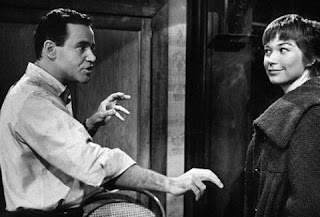
The Apartment’s C.C. Baxter (jazzy Jack Lemmon at it hammer and tongs, sneezing and fizzing, quick as a weasel--and acting like one, too, for a while that goes on almost too long) narrates for us, laying on numbers and data, UNIVAC with a problem: He’s a stooge for his bosses, letting them use his apartment to ruin women and his life. And all those facts and figures will not protect this insurance man from lasting liability.

Billy Wilder wrestles comedy to the ground and force-feeds it bitter defeat. Lemmon’s hyperbolic performance swoops down like Edison’s old rescuing eagle and plucks Shirley MacLaine’s suicidal Miss Kubelik from one frying-pan into another--with the fire waiting for this upwardly mobile couple to take the inevitable plunge--in more ways than one: They fall all the way down, plus fall in love.

And this love seems to save both of them--although the cost lingers. Still, Lemmon and MacLaine give us a glimmer of hope for the urban middle class, the thin plain suit and tasteful little outfit rumpled enough to mark them as not only survivors but maybe subvert-ers. The past decade has given us Americans--well, a pretty good share of us--more than we need--and convinced us we’ve earned it. The Apartment is made anxious by all this happy talk--while the world grows larger than any cozy flat or happy suburban home can manage. It’s waiting--actually, it’s not; it’s right here: the Negro Movement rises in flames from a Baptist church while the Iron Curtain flutters, a bit of a tease from Khrushchev, watching American underpants in Can-Can. And it all can’t fit in the same space without something giving way.

So, despite their final escape into each other, Lemmon is right to be nervous, and MacLaine might be on to something as she considers a cracked mirror and comments that she likes it because it makes her look the way she feels.

May 19, 1960 [Hiroshima mon amour]

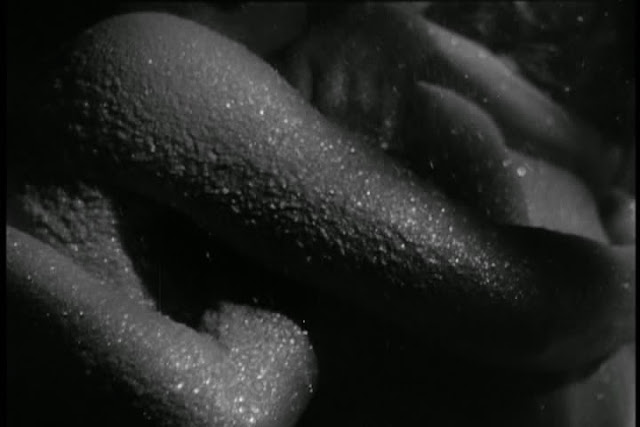
In Hiroshima mon amour Alain Resnais dismantles the last fifteen years, picks through the pieces, finds only two people more or less intact, and walks them through Hiroshima in a daze of memory and amnesia, disjunction and commingling--OK, the old ploy, the convenient dualities game; but for God's sake what else is left? Global schizophrenia is driving us all mad--no, that's not right: If we have schizophrenia, we're already nuts, and should not be trusted with the sharp objects of analysis and explanation, let alone apologetics.

--So Resnais works with what we can trust, that which is contrary. The French actress finds herself drawn to Hiroshima--its radioactive dust clinging to her skin until she is back in Nevers--a sad play on words, French to English--the Loire beautiful, and Bernadette buried there, the one who wanted to love more than live. And when the actress loved, it was a German soldier, so she was shaved and tossed in the cellar, where she lived on saltpeter and despairing love--and hate. And her lover today is a Japanese architect--building things, you see, in his home town, where the tourists go to weep. They are both from cities famous for their tombs--so why not go mad?

I'm glad I haven't seen Resnais' film on the concentration camps--and should I be ashamed for that? In Hiroshima mon amour the city goes from sunshine to retiring midnight and beyond, the restaurant all but deserted, the sound turned low on everything. I wanted it to end there, with words unspoken, the calm night modest, turning her head away from us, her shoulder soft in the dim light. But oh no: We must remember every step of our descent, and pass that moment when we wonder if we're mad--to the point where we forget we wondered, and can't tell.

December 15, 1959 [The Human Condition I]

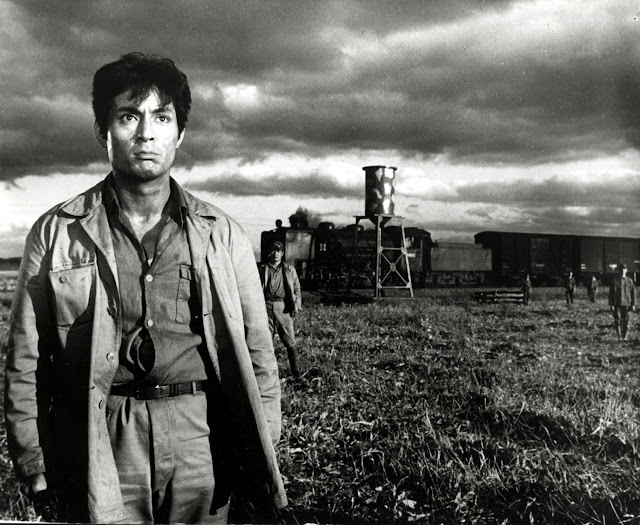
Masaki Kobayashi's The Human Condition relentlessly demands that its socialist/humanitarian hero, Kaji, ask his conscience how it can go on living during wartime--in China, where his fellow Japanese run a slave-labor mine--no, not "his fellow Japanese": Kaji himself, the good man pretending he is there to ensure that "humanity" is not merely a generic term but a quality, like mercy, like compassion, that droppeth slow--but in his hands steady--or so he hopes.

But this is a lie. He does not want to fight, and so is exempted from military service if he agrees to oversee the mine--but of course the military follows him, their need for raw materials trumping his weak hand--and kindness is weakness here: Just look at the actor Tatsuya Nakadai open Kaji's eyes always round in shock or fear, with mouth set in grim and bitter scorn, his best efforts nothing more than black grease slathered on the war machine--more like pinball, the game simple: How close can he get to his ideals without defeat?

Not at all, it turns out. As this installment of a multi-part film ends, we know Kaji's real job is to watch himself--along with his wife, loyal to him and thus also doomed--drawn under with the other torturers, enslavers, bullies. And to his credit, his eyes stay wide open--incredulous, yes, but taking it all in, beginning to learn all about that human condition he suffers from.

Friday

November 19, 1959 [The 400 Blows]

The boy Antoine in The 400 Blows is essentially abandoned by parents who are almost children themselves, a fun-loving, petulant stepfather and a mother long weary of motherhood. This abandonment is not deliberate or even entirely conscious, but it allows him to enter a life of careless, minor crime--more important, a miniature underworld without adults as an anti-Romantic Huck Finn whose Mississippi is the vicissitudes of city life without a direction home. And while Huck had the force of the river, and of Jim's moral compass, to mark his way, Antoine flees indiscriminately, wandering through a nervous, gray, and ultimately unconcerned Paris, until he too arrives at water's edge; for him, though, it is merely an unresolved shape in the distance, his childhood slipping beneath the surface.

Antoine seems "bad" in an unattractive way--unlike the earlier pranksters, "little rascals" who formed "our gang" and enjoyed noisy vacations from parents and school. Antoine will not or can not recognize he is just fooling around; for him, his crimes and the resultant reform school lie on him like his skin. And nothing comes of it but an almost absurdist journey-quest away from nothing in particular and toward the same. He is like that Anglo-Saxon Wanderer who begins "sorry-hearted," and "must for a long time row along the waterways, the ice-cold sea, tread the paths of exile. Events always go as they must!" And Antoine also stands on the beach, his gaze, anxious yet blank, boring into the end of his childhood. Barely a teenager, his foot had slid, and the abyss into which he called did not call back.

Wednesday

November 11, 1959 [Shadows]

One John Cassavetes--I saw him just a few weeks ago as Johnny Staccato in the T.V. series of the same name, jazzy detective stuff--has made a movie--and again he plays it like jazz, an improvisation called Shadows, Negro and Caucasian cool kats-n-kittens wandering around as city folk will do, staring at statues and each other, kidding the Clydes who are earnest but timid when it comes to an America without a Whites-Only door.

Sometimes his game little troupe didn’t quite carry it, but Cassavetes loves them, and New York, so we forgive the missteps and frayed edges--the opening alone worth it, loud music, everybody talking at once in the crowded room, cigarette smoke billowing like waves, the lights bright, the night out there grainy and rich--black and white again, one next to the other.

So where are the Shadows? The credits tell us the picture is “Presented by Jean Shepherd’s Night People”--and there they are, in the shadows--we barely catch a glimpse of them as we hop on the train or cram into the subway or coffee shop--or movie theater, going about our business while they go about theirs, sunglasses and worn-out wool coats loose in the early winter wind.

Cassavetes has done a good thing here, stowing away a snapshot of these shadows, before the new decade begins and we move on like Americans: not looking back, eager to clear the table and start all over again--but the sentimentalist in me will be happy to keep those shadows in mind, their tired smiles and softly snapping fingers a little blurry in a black and white movie.

August 1, 1959 [The Tingler]

NOTE: This posting is appearing as part of Forgotten Classic of Yesteryear's 1950s monster movie blogathon. Visit and enjoy!


The monsters in low-grade movies like to bite--and it appears their reach is growing, if William Castle is to be believed: There he was, providing a prologue to The Tingler, helpfully reminding us, “a scream at the right time may save your life.”

The Tingler itself is a kind of animate spinal column, a shiny-black chittering centipede yanked out of a mute woman who'd died of fright without screaming--and it's the scream that kills the Tingler; if you don't let loose with a good one, the thing clamps down and cracks your backbone like a walnut.

Ridiculous--but don’t tell that to my son, who was in a frenzy to see this picture--Mr. Castle having worked his advance charm, a true carnival huckster, giving us everything we’d hoped for before the movie even started. So Pete was more than ready to be scared to death--and Vincent Price was more than willing to accommodate, a cynical scientist sick of his hotsy-totsy wife and sneering at everybody, treating us like lab animals. And so Pete was right, the picture was frightening: a movie about the impassive nastiness one finds at times only in the movies--there’s even a scene in which the Tingler gets loose in a theater, and Price looks right at you and entreats you to start screaming, while the Tingler noses around the feet of the moviegoers. And most of the kids and teenagers pitched in--some louder, more honestly hysterical than others.

So what if Vincent Price has a pencil mustache and uses a bit too much oil in his voice, and the Tingler itself is pulled jerkily on a string. There is something about a movie like this, as we watch Castle’s ruthless little imagination at work, the blood-red color sequence discomfiting, the casual cruelty grimy on the screen--that nudges the Tingler a little further into my head (down my spine?) than I wanted it to--my son sitting next to me, clutching my forearm and passing along a little whimpering shock.

Monday

July 13, 1959 [Touchez pas au grisbi]

French filmmakers seem to love American movies as much as we do--maybe more, especially crime movies, re-imagining them and showing me things I otherwise might not have paid much attention to--like the abundance of older--or older-looking--actors as tough-guy leading men, whether as crooks or dicks--and the level of calm professionalism required of such figures, once you rise above the snarling Scarface/Mike Hammer types.

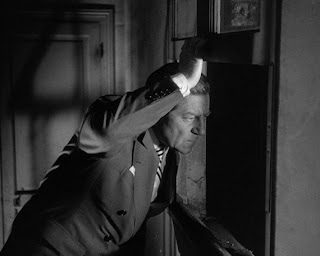
Jean Gabin is the king of this, and Touchez pas au grisbi becomes a precise experiment in cross-pollination, a new bloom with a too-cool gunpowder bouquet and blue steel petals. Grisbi feels like The Treasure of the Sierra Madre and The Maltese Falcon in its brutal attention to failure, while ironically praising the virtues of friendship and loyalty. Gabin's Max, a ready-to-retire criminal, is forced to risk everything to save his longtime friend/partner in crime, whose urge to impress a showgirl makes him slip info about a stash of gold bars they'd heisted, Max's pension fund. The resultant kidnappings, beatings/torturings, and general mayhem, while exciting in themselves, are played out with a casual hipness that seems weirdly American--but particularly French.

The opening scene, in which the gamblers and crooks hang out in "their" restaurant--a party of outsiders is summarily sent across the street--shows us Max's gracious cool hard at work, keeping everyone happy, maintaining appearances, biding his time until the gold's cold enough to fence. His unflagging loyalty to his foolish friend is, of course, itself foolish, but to play it any other way would dismantle the point of all that cool: Not simply to gather the loot, but to hold it off, a means to a fuller end.

When other crooks want it for themselves, the code kicks in again: How could they touch it when Max himself won't? Max knows it is paid for in bloody loss, like the Mexican mountain of greed that overmastered Bogart and company, as well as the black bird, the "stuff that dreams are made of.” Again, Jacques Becker's movie knows the value of loot, and the price paid for loyalty. In the end, those gold bars are nothing to Max beside his friend. As Sam Spade says, "Don't be too sure I'm as crooked as I'm supposed to be." Almost two decades later--and an ocean away--Max tenders the same warning, and woe to any mug who gives it the drift.

April 2, 1959 [Some Like It Hot]

Billy Wilder finally answers the question, How far will a man follow Marilyn Monroe? All the way out of his skin, it appears, as Tony Curtis and Jack Lemmon, ostensibly fleeing the aftermath of the St. Valentine’s Day Massacre, dress up like Uncle Milty and hightail it down to Florida with an all-girl band, Marilyn blowing little happy-pouty kisses all along the line.

Along the way, Joe E. Brown falls in love with Lemmon--or is it the other way around?--while Curtis falls for Monroe--or for himself, becoming Cary Grant with a yacht--the four of them at (ahem) cross-dress purposes, the whole process of satisfaction inverted and dismantled.

Listen: Joe E. Brown has the dough, and is easy to get along with; and Marilyn’s round bottom flicks in perfect Jackson Pollock curves, difficult but irresistible to follow, and she’s a real pal--and neither of them is averse to a little subterfuge--OK: a lot--in an affair of the heart (or wherever it’s located in a Wilder comedy); but I get the funny feeling the movie doesn’t really care who anybody is as much as what they want. We’re assured “nobody’s perfect”--which gives everybody all the leeway they need to don and doff whatever disguises gets them from one end of their desires to the other.

January 7, 1959 [Bell, Book and Candle, Vertigo]

Jimmy Stewart has been blind-sided by Kim Novak twice over the past year--in Vertigo first, now Bell, Book and Candle. And who can blame him? Novak looks at you like a cat's ghost--then through you, seeing all the little pockmarks, hearing your bones creak, touching the little bald spot that will grow. And all the while that smile, those almond eyes--crazy in both pictures, somehow, and passing it along to Stewart.

Lucky for him the second time around is pretty light stuff. Novak is a witch, a precise little New York coffee-house night person--and yes she is, and tries to get Stewart in on it--but then she wants to straighten up, be a day person, give up witching and jazz and settle down.

I'm suddenly reminded of something, from Mad magazine no less, Jean Shepherd laying it out for us:
EVERY ONE OF US, I don't care who he is, has a certain amount of "Night People" in him. Because, no matter how many refrigerators you buy from Betty Furness, no matter how many "custom" suits you buy, no matter how many cars with fins you buy, you're still an individual.

And I'll say this: Once a guy starts thinking, once a guy starts laughing at the things he once thought were very real, once he starts laughing at T.V. commercials, once he starts getting a boot out of movie trailers, once he begins to realize that just because a movie is wider or higher or longer doesn't make it a better movie, once a guy starts doing that, he's making the transition from "Day People" to "Night People."

And once this happens, he can never go back!
And that's Stewart's fear--in both pictures, now that I think of it--the anxiety of the high place, the girl slipping along the periphery that he has to chase. He'd rather settle down and get off the ladder, stroke his chin and get to work, than give in to the contrariness it takes to stop kidding himself.

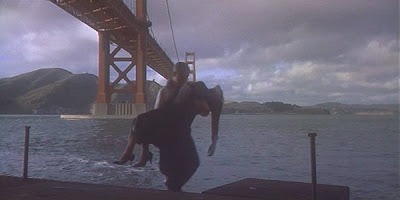
I don't know; maybe that isn't the "message"--but what do I know. Me and Betty Furness have had some long heart-to-hearts, and I'm as ready to buy a refrigerator as the next guy--as ready as Willie Loman to believe a good one is a well advertised one--but maybe instead I should listen to the voice at night, the cat's voice, Kim Novak a dream, a spell. This is the other way, up at midnight, in by dawn, streetlights magically going out, one by one--while the Golden Gate bridge glows in the fog and the redwoods stand quiet as the Moon.

Thursday

December 12, 1958 [Fiend Without a Face]

I found Fiend without a Face hidden in a beaten-down little joint, last stop for minor notions and damaged goods--and the picture does have a few dents in it, and sags a little--but those faceless fiends make a thumping squish, like an invisible dream-giant, and the victims grab at their napes and widen their eyes and scream and scream--a real horror show, part nuclear jitters, part brain power gone amok--the mad scientist making the monster happen just by thinking about it, more or less.

And the best part is that we're fooled into figuring that the budget was so low we'd never see the monster--and then we do, and how: a shiny brood of tentacled brains, spinal column curving behind like an inchworm, sliding along the ground, up tree trunks--then flying, improbable bats that clamp down on their victims and suck out their brains and spines. And these brain-eating brains are definitely soft as brains: The nuclear flyboys shoot 'em up nicely, each one gushing pudding-thick black goo, sickening and satisfying--what other fate would one wish for such things? Thank God I didn't take the kids--but of course the little voice inside (the one that knows the contradictory passions of childhood) whispers they should have seen it; who was I to deny them what dreams may come?