Thursday

June 1, 1928 [Konets Sankt-Peterburga/The End of St. Petersburg]

Vsevolod Pudovkin drags us away from the actors in his film and toward everything else, until performance becomes image: The actor attempts a character, but the film creates it--by juxtaposing each human moment with a cloud, a hill, a waving grain-field, a row of windmills (their massive blades cutting above the character’s head--the huge sky dominating--the individual all but hidden at the bottom of the frame); again, everything else coming alive, town and country included, insinuating distance from the human as solitary thing.

But then he draws toward them, the single persons in his collective world, and their grimy farmer-peasant faces fill the screen, famished, exhausted--and then in the city, fed up with the mammoth factory, in a St. Petersburg that looks like Lang’s Metropolis without the clean lines and smooth passages. Here, it’s all twisted--the camera telling us so, angling itself high and low, almost Expressionist in its vertiginous excesses. The Capitalist villains are fat and jowly, barking like bulldogs, while the workers go about the stern work of strike, resistance, and revolution.

And as Pudovkin pairs the dramatic with the imagistic, each narrative event has its concrete counterpoint, haystacks and plows to city-canyons and statues--haughty and impassive, waiting to be toppled, if anyone dares. And of course they do--again, the force of revolt expressed as juxtaposition, one image tumbled after another, guiding--no, forcing--us to acquiesce.

He is almost a bully, rubbing our noses in his meaning, but Pudovkin understands that cinema has always run toward us as a sequence of images; his desire is to give that sequencing a clear, revelatory--revolutionary--purpose. The inter-relatedness of the images is undeniable: all is parallel to all, literally brought to eye-level, a true Marxist solution to seeing: gradually forming the “classless eye,” enlisting everything in the dialectic of change. And any image that refuses to see its connection to the others is "made impossible," rapidly subsumed into the Big Picture--beautiful on the screen, but more than a little unsettling as one walks out into the street, where each of us moves in sequences of our own, not nearly as clear of purpose as Pudovkin's sure advance of sky-to-peasant-to-field-to-city-to-factory-to--what? The end of tyranny? The beginning of another? I wonder how inevitable is the science of seeing, and whether we ever look in the right direction.

June 12, 1928 [The Lodger]

Just an hour or two after seeing The Lodger, and almost all that’s left in my mind is a series of half-imagined, partially obscured, insinuating images--moments scattered with simple but secretive logic. It seemed to want to lead us somewhere; and while this was no experiment in film-narrative but a simple mystery-story, each person, building, machine--even the quality of the light, pooled or laid across the frame like bright bars--conspired to draw us not toward the solution but into uncertainty.

And why not, with murder at the heart of it, in the end not so much a plot as an understanding resisted. Oh, we all want enlightenment about everything--but not about untimely, violent death--here, “the avenger,” tossed on newspaper headlines like dirt on a coffin.

Maybe because it’s a British film, and the rhythms of their lives are not as clear as we’d like. --But that’s not it; something else disrupts clarity: all those close-up faces, grimacing, fearful--even smiles dropping--“golden curls to-night” interrupting the images on the screen, repeated words--a warning, a promise. And the golden-curled girls pause, stare at the threat, laugh it off--but someone has to get it, we’ve been promised.

The director, Alfred Hitchcock, seems excited to be in control of everything:

The lodger paces, and the people below look up at the ceiling and the swaying chandelier--and the ceiling becomes transparent so that we can watch him pace.

The lodger approaches the girl for a kiss, and his white face looms, fills the screen like spilled milk.

The suspicious suitor stares at the dirt at his feet, and sees his suspicions parade by.

Time and again, whatever is needed, happens, the sequence of images obedient to the obsessions of the characters--and, it seems, the director, who urges our suspicions--then punishes more than rewards us for doing as we’re told. All he wants is our undivided attention, so he can satisfy and sicken us with murder--even giggling a bit, the strange man in the back who laughs while everyone else in the theater sniffs away tears. He loves to make us wait, and draws out the moment--almost until we think we’re watching a different picture--but not for long, the threat hanging always, like a rubber bat in a Dark Ride, part jest, part unwholesome preoccupation--Oh, look at the monster! we exclaim, glancing in the fun-house mirror.

This is the thing Hitchcock built, a seeming window that, the closer we get, closes, irises toward the white-faced lodger, the sudden victim--innocent after all, the wrong man accused, his darkness masking sorrow, not guilt--and so the lens advances upon us, the angry mob stuck in our seats, unable to turn away from our false conclusions that, again, the film insists we make--as transgressions.

Wednesday

May 23, 1928 [Steamboat Bill, Jr.]

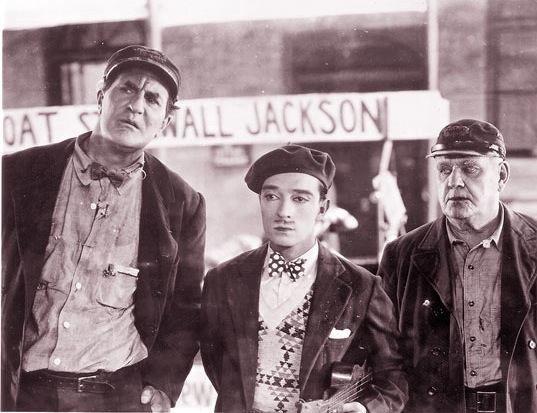
Almost twenty years later, Buster Keaton is still a saphead--except on a steamboat he endangers only river traffic, not the stock market. Still, he remains phenomenally out-of-place (that mustache is not so much a nod to Chaplin as it is a sideways exclamation point)--and so determined that only love can prevent total catastrophe--although one could argue that love is as much to blame as his own foppishness. I leave such ruminations to the unmarried and the unwise; let us lay all blame not on the lady but Keaton’s hard and empty head.

The only act of Nature the film could produce to match Keaton’s epic fool is a hurricane--not the first time strong winds have buffeted screen clowns, but here alarmingly convincing; and Keaton is all but bested--all but to be sure, since not even the strongest wind blows hard enough to topple the Stone Face. He’s the third little pig’s house, impenetrable--but somehow innocent of the necessary hubris one would assume necessary to stand up to hurricanes--or wolves. (That brick-house pig always seemed a bit smug to me.) No, Keaton remains simply there, more stoic than stern, his true-love passions final as a driven spike, firm and matter-of-fact. I admire his temerity--but more so his solemn eyes, staring down all foes like a midday sun--not bright, though: simply unwavering, cloudless and clear. Even at the moment when the house falls upon him--reminding me of the Lumières Démolition d'un mur--except without the magic rescue of the film being run backwards--Keaton is spared merely by an open window and his own immobility. A hero for the slight and the slender--with iron in reserve, as anemic as he may at first seem.

(I glance at the mixed metaphors above, and wince. But Keaton is “metaphysical,” like a John Donne poem, the dominant conceit of his existence so contorted it twists like a (playful) snake in my hand. All I can do is spout contradictions at his elusive, rubber-reinforced frame.)

Tuesday

December 28, 1927 [Dog Heaven]

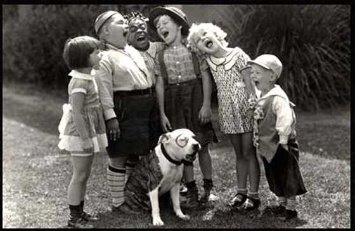
Our littlest awoke crying. She had dreamed that our dog, Patty, had died. My wife consoled her, directing a scolding look at me--which I deserved: I’d taken the children to the movies, and Dog Heaven was on the bill. It was a strange one, involving the dog, Pete--a genuine thespian, completely convincing as a dog--and his despair over the loss of his master’s love. I felt as if it were the 1890s again, with water-sprinkler jokes and a “burlesque” suicide. But to see dear Pete dangling from a noose was more than a little off-putting. And the picture was scattered with “adult” elements, from vamping moppets to canine drunkenness. Amusing, but, it appears, not for some children.

And perhaps not every adult, either. The love story, the derelict pooches, the goodbye-cruel-world cruelties--these are all missteps. Only the few childhood evocations rang true for me: the delight and mess of knocking about the neighborhood, digging casually in the dirt, carting around the smaller children, the easy tears and easier expressions of love, hugging the dog, happy to be cut off from the adult world. The more Roach focuses on such things, the better his Rascals will get. Children always draw inwards a bit around adults; unobserved, they riot and cry and splash and stare, dreaming of plenty--but counting pennies--wandering vacant lots and alleys and woodpiles, little creatures that scatter when the bigger ones blunder too near. This is the movie I want to see; the rest shows no love for the actual heart of the world down there at knee-level.

December 20, 1927 [London After Midnight, The Unknown]

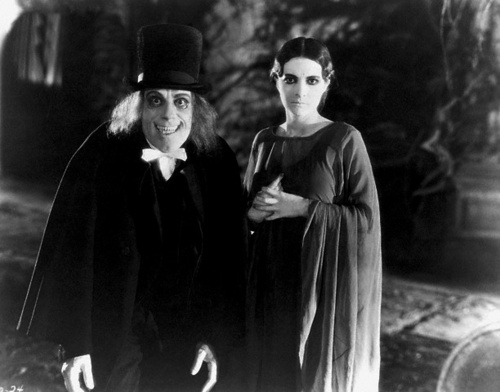
Chaney’s thousand faces begin with the first: his own--but it too is a mask, heavy-planed and square, as solemn and thick as bars of lead fitted to hold him in place. And the mask waits to be remolded, deferring to the camera.

This masks-within-masks is so deeply constituted in his career that the characters he plays, play along, in turn wearing masks, keeping secrets. The Phantom seems to epitomize this, but this year the Chaney Double Mask has become even more unsettling. Just last night he hunched down--not atop Notre Dame, but in London, his face gleefully startled by itself, the eyes bulging, the grin enormous--with twin rows of little pointed rat’s teeth--long hair tangled, tall hat mocking his low-slung frame. And somewhere beneath that is a Professor, a hypnotist--and yes the metaphor is easy, but attractive, the two masks holding our attention with eyes jutting from the sockets, a mad ruse in a silly film--but perhaps not as silly as we’d like, the longer we look into his eyes.

The Unknown lets us peek beneath the masks--and we’re bitten in the attempt. The armless knife-thrower and sharp-shooter leans his brick-like frame against the girl--Joan Crawford as Nanon, who feels safe with Alonzo--yes of course, for you see she has an hysterical fear of men’s arms.

The ironies of all this thump like dancing elephants--but the outlandishness of the plot begins to move in disorienting eddies: Alonzo is not actually armless, while the strong man who wants to encircle Nanon with his sinewy arms is an honest suitor--and so her choice is punished, as Alonzo kills her father--his arms freed from their painful corset, unwrapped with unsettling tenderness by Cojo, Alonzo’s diminutive, fawning assistant--and Alonzo attempts to ensure her love by having his arms amputated--the mask creeping like poison away from Chaney’s face. The Chaney Double Mask no longer merely disguises but decomposes: The mad Alonzo plots revenge (Chaney’s laughing, crying face is a wonder to behold, as he hears that Nanon has overcome her fear of men’s arms and is going to marry the strong man), and attempts to disrupt the strong man’s act--arms bound to horses, who gallop on treadmills--more fearful separation.

We have entered another strange Tod Browning country--and along the way crawled down to a deeper layer of Chaney’s masks, which turn outward like the instinct for self-protection--but with such violence the last-minute rescue seems the only recourse, everything moving so quickly at the end, all the warped psychology of the plot tearing at the faces--the masks?--and leaving nothing but panic and outrage.

I can’t imagine Chaney and Browning going further than this--oh of course I can; but I hope they won’t.

October 10, 1927 [The Jazz Singer]

Here, in the privacy of my diary, I shall confess to a shameful act: Al Jolson brought a tear to my eye. As the picture shifted from silence to song, convulsive as a wind-up toy on its last legs--and as Jolson capered and twittered, part chattering squirrel, part shameless self-promoter, his blackface delivery as subtle as the Charleston, as demure as a flapper's legs--and as the audience cheered and sang along, calling to the heedless screen for encores--in the midst of this noisy debut of the Vitaphone, Jolson knelt, not in cynical sentiment, but in something like tenderness, his talent subdued in the name of the "Kol Nidre," the song-prayer that begins Yom Kippur, the Jews' Day of Atonement. His father can not fulfill his duties as Cantor, and in the end, after an almost comic tug-of-war between Jazz and Judaism, Jolson bows to his father and sings. My own father gone more years than I'd like, this simple moment, spurred by Jolson's surprisingly solemn delivery, spread a sad warmth in my chest, and I blinked like a lost child.

This morning I asked Mr. K--, a Jewish tailor in our neighborhood, the significance of the song. He explained it as a plea to be forgiven for all rash vows, easily made but difficult to keep, that we make to God in our pride. And I thought of the promises I had made and broken, how the vow becomes a lie--and how the expression of regret and the hope for mercy in the Jewish song was as beautiful as a promise kept, and I paused there in his shop, looking away from him, breathing quietly for a moment.

How can I live with this, I ask with a smile, this debt to Al Jolson--the fool who, singing one song, seeks and receives forgiveness?