Thursday

March 7, 1996 [My Neighbor Totoro]

I cringe as I write, “My Neighbor Totoro is magical”—but here the cliche works: the movie conjures, performs a number of satisfying tricks. And the first of these is to place the mother in danger without alarm--away at the hospital, an undisclosed illness creating the need for the father and children to move to farmlands--and woodlands, a beautiful harmony of trim fields and sprawling wilderness.  The mother herself, we can tell, is in no real distress: She is quiet, perhaps even a little weak, but still kind and beautiful; illness has not made her sharp or haggard.  And the movie is not thoughtless in setting her aside, but loving toward her, inviting the children to miss her with optimistic melancholy.

This first magic trick gets the children into Totoro’s neighborhood--the big stuffed animal, a thousand times more wonderful to discover than hordes of Hasbro-ready Ewoks or numbing Smurfs, and infinitely more exotic--although they snooze and snore like wind-tunnel pugs, their bland, watching faces seeming to take in the children as though those small things are barely there--as though it is the children who are the half-hidden sprites, the fleeting figures at the periphery.

That is the second magic trick: to allow children themselves to be magicians, like Alice who could shrink and grow.  But these Japanese girls don’t need to contort themselves. Their curiosity is the spell that sends them to the other side, and their open hearts are rewarded with the third magic trick: the love of the Totoros themselves, more than happy to let the girls snuggle and bounce on their deep-pile tummies, to ride in the catbus--a little scary, as so much good magic is, but just enough to make the stomach flutter a little in anticipation of the next little plunge--not too steep, not menacing at all.  More like Alice again, stepping through the looking-glass without effort.

They call the director, Hayao Miyazaki, the Japanese Disney.  But his touch seems more fatherly, more understanding of children, like Chaplin--or, once more, Carroll.  In the end, My Neighbor Totoro doesn’t play by Disney’s rules, but invents its own mythology of contact and acceptance, of surrender to both the supernatural and the natural, the trees and tunnels of undergrowth as magical as the big fluffy monsters--and of course they are: Ask any child where she would like to go, and stay.  She may not be able to express it clearly until you take her to see this movie--where she’ll point up at the screen and make the dust bunnies scatter as she shouts, There! At the edge of that field where the nice grandma gathers vegetables, where the giant tree shades endless paths where small things walk just ahead and look over their shoulders to make sure I’m following.

Wednesday

January 9, 1996 [Twelve Monkeys]


Bruce Willis’ time-traveling lost soul sticks his head out the car window and breathes air he believes has no poison in it and listens to a song on the radio with such eyes-closed bliss that he made me ashamed not to do the same every day--even though his own days melt and warp as Terry Gilliam in Twelve Monkeys peels back the skull-flap of Time Bandits so that the reptilian brain can do its necessary work: survival at any cost, at any time.

I saw Chris Marker’s La Jetée on TV a number of years ago--PBS, probably, back in the ‘70s when you could see so many Janus films you felt as though the Cinématèque Française had turned up like a bookmobile outside your door.  Twelve Monkeys captures the sad suspension of Marker's still images and draws them along a ground-down Philadelphia that sees one shining moment--the giraffes on the bridge near 30th Street Station--before it falls into wet wind and darkness--and maybe one more bright light, at least for a while: Brad Pitt in the loony bin, super snappy in his manic glee, seeing Something catching up with him and giggling at the look on Its face as It gets ready to gobble him up.

The movie feels bad for making its characters lose so much--but that’s what happens when you draw a circle, the graphite leaving a powder-burn spray as the pencil curves right back where it started and tells us that the start and the end meet one day--every day, maybe, and we should keep our eye on both just long enough to share the sadness of the little boy and the dying man, separated no more by the straight lying timeline.

Tuesday

December 31, 1995 [Restoration]


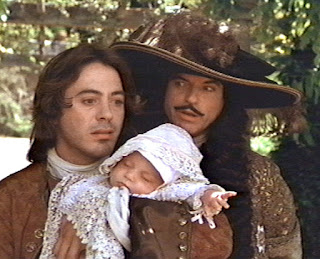
What a face Robert Downey Jr. has: charming, anxious, deadpan, melancholy, pensive, boyish, rueful, and on and on--and all at once.  I read a little gossip, see a little Entertainment Tonight, and know his reputation: another party boy raising his eyebrows at a square world that isn’t invited on the ride.  So far, it’s a part of the charm and a piece of the rue.

Restoration, then, sneaks in a little irony for him--and he puts on his wig and feathers and ruffles and wades into what may be his own needs.  But the picture’s more than that: It looks back at Hollywood’s Golden Age and sees much to restore there as well, and gets pretty charming itself with its contrivances and resolutions, rewards and losses.  It earns ours tears, but it knows it should--and I’m more than happy to comply, if only because it loves so much the world it’s making, and wants to do what it can for the people in it.  They made a humane movie, and Downey molds most of the terrain of that world, his eyes slow to blink as he appropriates the middle distance like no one else, claiming that suspended, uncertain space with a firm gaze--even while his grip grows unsteady and he looks away once or twice as he feels himself falling.

Monday

November 22, 1995 [Toy Story]


The bookcase of our old secretary desk, its glass-paned double doors locked with a skeleton key, acts as a family childhood museum--small things mostly, slender picture-books and staring dolls, dusty tiny figurines and gyroscopes, a three-inch-long cannon and a Chinese puzzle box, a Magic Pitcher left over from Pete’s backyard illusionist days, a Wham-O Air Blaster; plus familiar faces--Popeye, Mickey--mixed in with the long-gone or all-but-forgotten--Maggie and Jiggs, Skeezix.  A few Matchbox cars stand nose-first, their interiors dark, while a porcelain Peter Rabbit crouches, Farmer McGregor no doubt approaching.

I wandered over to look at it after seeing Toy Story--and knew that for every small thing kept safe, sitting in our living room so they could still see us, ten more are long gone, some of them dismantled or even firecracker’d--like the poor toys of the movie’s evil Sid next door--the old-time Bad Boy, Huckleberry Finn with a mean streak--and he’s as much in us as is our hero, Andy, who covets with an open heart.

And while this computer-cartoon is as dazzling as anything I’ve seen in this new Golden Age of animation, those two boys seem the most important, giving the toys their character, deciding their fates, showing us what to do with the little object we hold in our growing hand, while the toy stays small--but not young: in the end dust and rust and frozen clockworks will keep them still even when we’re not looking.  Andy doesn’t know that yet, which makes him the toys’ best friend and most reliable curator of his jumbled bedroom archive-in-progress.

Saturday

May 7, 1995 [Picture Bride]


Toshiro Mifune suddenly arrives in Picture Bride to run a silent film in a sugar cane field and narrate the excitement on the makeshift screen.  He is an artificial samurai in a genuine war: between men and women, between labor and management, between lies intended to help and the truth that hurts and heals.  All of these big ideas occur in fields and by the ocean--both of them big, to be sure, but nothing like the cities and factories of other workers, where there’s little room to run and find.  Here in Hawaii it’s all green and blue and blue-green, with ghosts singing and water tumbling down.

Rio comes all the way from Japan to meet her husband for the first time--his photograph, though, is only a memento of his youth, while his actual self proves a trial. 

But like so many farm tales in the movies, there is something noble stirring in the waving fields, a sense of heroism against the rages of nature and men, and a tender touch for lost children and the souls of the departed.  Riyo does not want to stay--but she also doesn’t go.  Instead, she stands up and gets to work and finds nobility without anyone’s help.  It’s like The Grapes of Wrath without the long final stare into nothing--because no matter what, the mornings are bright, if you get up early enough to see them.  And if you’re as good as Rio at work and love, you find the strength to dance.

Thursday

January 30, 1995 [Before Sunrise]

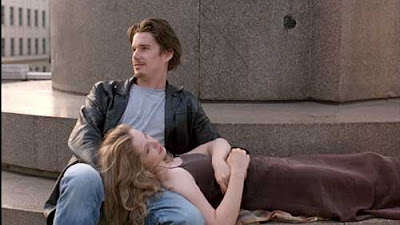
Am I supposed to see F.W. Murnau peeking out between the frames, his Sunrise all those years ago shining along the edge of his flowing camera, the Man and the Wife rowing far from the Other Woman? Maybe--if only because the young couple in Before Sunrise have not yet doubted each other--despite the man's insecurity masked as cynicism, his unwillingness to be fooled by life mostly bluster--sad, sometimes, if only because the woman offers such a moment to him, such a rare whim--more like genius, inspired by her own urge to move forward into an adventurous stroll all night long.

They talk about nothing and everything, of course, and fool at each others' sleeves and the napes of their necks, children left on their own but not afraid, drawing together like Hansel and Gretel without any witches. And yes I thought of those long walks Jean and I took ourselves when we were new to each other, finding out secrets and making admissions without shame, laughing at nothing at all and quiet just long enough to remember what to say. Murnau's lovers curl hands in murderous fever or fear; here Richard Linklater lets them take the long way home without regrets--their own loss invented almost as a game, a dare to fall in love in no time at all.