Tuesday

December 15, 1994 [Blue, White, Red]

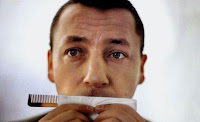
I managed to catch the final film in Krysztof Kieslowski's "colors" trilogy, Red.  The first one was last year--December as well, I think.  Each of them seems like winter or autumn movies, some chill creeping in that threatens to turn love into something else: a ghost-double that looks like love but may be nothing but straw and feathers--or something worse, something soft and yielding, still warm, as though it had been alive just before touching it, but gone now.

That's my memory of White earlier this year, last winter. The little Polish man (reminding me of Polanski, maybe in The Tenant right before he goes mad--or is he possessed?) crammed into the stolen trunk, beaten but unbowed, seeming to seek vengeance on the woman he couldn't satisfy--but really it was love, a cold and slick-ice thing sweating and freezing; then calm and cool, trapping her like a fly he will never eat, just visit down there in the web getting dusty from prison silt drifting down on her, his at last.

Blue, though: an act of dedication and liberation, art and love and memory and guilt and fulfillment, a crowded movie with the loved ones dead but the song remains--cupped in her hand, maybe too gently--and taken from her; but that doesn't last, she knows what she owns, and she broke my heart in love for her because she ran away so well, erasing everything--except herself; that she carries with her, and her grieving, living self haunts her until she sees the ghost--so that she can remember, draw the notes on the staff she has erased--another ghost, a melody that makes the both of us cry at the end, but in some kind of joy.

But these two serve as prelude to Red, the one I think I'll hold closest.  The peeping-Tom judge hunches down and waits for dark; but the young woman will not let him be--will not let him be alone, that is, and she and the mended dog pry open his secrets and shame, and finally love breaks open like a small box worked and worked in your hands until the catch gives and spills everything out, sinking to the floor like the ferry in the Channel at the end--and who survives?  Everyone from the three Colors, while the judge gets to be the last to cry over the fact of love, hard and cold and beautiful and necessary.

I'm not sure if I can watch a love story again--or remember the ones I love, all the way back--without the French flag fluttering away in the background--snapping sometimes, the cold wind leaving splinters of ice along the edge--but, sentimental fool that I am, also bathed in unusual sunlight, the kind of weather you don't expect on the English Channel as the engines smoke and a few lucky survivors blink at news cameras so that we can count them--lucky, I think.

October 20, 1994 [Grave of the Fireflies]

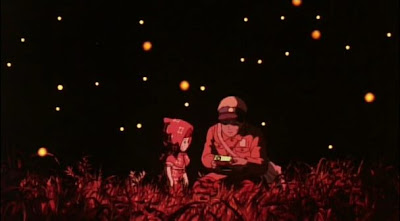
Seeing the edge-of-town landscape in Grave of the Fireflies so quietly beautiful, so full of promise for any child alone and waiting, I expected a Totoro to show up any moment, one of Miyazaki's round and solemn sweethearts, to take the child's hand so softly nothing but love could be possible.

But the children here are dead--yes, slipping away in the firefly-haunted train, happy at last; but still gone, starved to death after the firebombing, mother dead too--never making it to the comforting hospital, ready for happy visits--and father as well, sunk by the Allies for the Emperor and the rice-paper Empire burning swiftly. 

I have seen the newsreels, the documents of bodies--Auschwitz, Hiroshima, Dresden, Pearl Harbor, Bataan.  But here in a cartoon the little girl giggles and clutches her older brother---his face toward her bright and willing, firm and decisive--and then he turns away, and he is also a child, not even sure they're starving--not wanting to be sure, why would he?  Children are supposed to put up with anything--and maybe they don't know it, but they do, the strongest people in the world, the toughest and most resilient--and the grownups know it, too; why else would we batter at them as though we were hammering gold?--ah, what a lie.  We do all this to them because they don't complain, at least not much; instead, they slip away, out there to the hole in the hill where they set up a holiday camp by the water and pee where they like and cram down the rice--until it's gone and the little girl starves, slowly, while her brother watches, and then he gets to burn her up in one more fire and slink away to the train station where he can at last slump over and let go.

The little box he held with no more fruit drops inside but only ashes is tossed out the door and lands in the grass and spills out a few bits, some fireflies gathering to make a very little light.