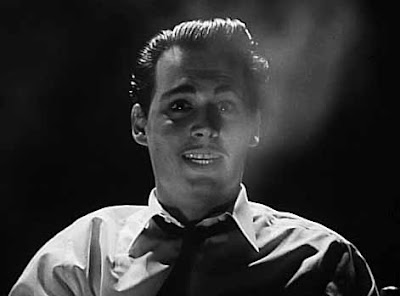
Before I can think about Ed Wood the movie, I must turn to Phil Hardy's science fiction movie encyclopedia, memorable because he says what must be said about a movie like Plan 9 from Outer Space: "It literally 'says' nothing, it has no characters, no story, no direction, no whatever"--this after frowning at those who "too often celebrate" it as the worst science fiction film ever. But it's the kicker at the end that makes Hardy so smart: "it's a completely unstructured dream produced with no interference from the conscious mind at all."
Did Tim Burton and Johnny Depp read those words before grabbing piles of black & white film to run some light through it? Depp widens his eyes and plugs forward, one terrible shot after another dutifully poured like thin oatmeal into the camera, where it somehow becomes something Ed Wood called a movie. Depp gives Wood a boundless enthusiasm for, even a kind of tender consideration of, the act of movie-making--but without any ability at all, not one little bit. Hardy insists that Plan 9 expresses the "deep-seated fear of being taken over from within" without any artifice--read: ability to structure and shoot and edit and so on a movie--and thus "bizarrely shows how insubstantial such fears are in isolation." Wood does not engage us with his "barely watchable film"--and Hardy knows that it is "fitting" that it should be unwatchable--and Burton's movie refrains from laughing too much at Wood's dream rustling down there, deep deep down there in a camera obscura Wood's conscious mind has never seen. Thanks to Hardy and Burton and Depp, I have come to see my own thoughtlessness in the movies, my own gaping stare, owning nothing, smiling like an idiot at the dim lighting and indistinct movement, or solemn as I stand with the man in the angora sweater by Bela Lugosi's coffin, waiting for the old dopefiend to rise and sneer at Karloff.
Tuesday
Monday
July 15, 1994 [Forrest Gump]
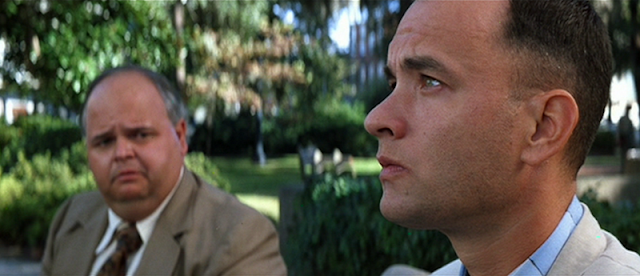
Tom Hanks has been eclipsed as our Beloved Everyman by Forrest Gump--and that's not so much an irony as an inevitability, the trajectory of both his and Forrest Gump's director's careers, a strange brew of sugar and brine, offering throwaway fluff one year and lead-pipe bludgeonings the next. And out pops a movie that makes every heart swell in its final fifteen minutes--but earlier hammers away at the American Dream, a series of victories--on battle- and playing-fields, Great Plains open spaces and Gulf Coast waters--all landing randomly in the lap of a moron.
--And I mean that, as Broadway Danny Rose would say, with all due respect. As Forrest makes his way through the second half of the 20th century, he discovers that everything he lacks is given to him, as long as he's willing to keep running. It's as though Being There had been remade by Harper Lee on a dare: "Betcha can't turn Mortimer Snerd into Childe Rowland." Because Forrest does brave many monsters, turns and turns and forges on--and always the Childe, never growing up all the way, the last finally first.
It's the best fantasy I've seen in years, Epic in an old-fashioned way--especially for the viewer, who changes as the journey goes on, even if Forrest doesn't. Hanks never betrays Gump, never makes him to be less or more than he is. It's a blank performance gently colored with the honest ink of a cartoon character, like Zemeckis' Roger Rabbit and friends, as affable an American as Marty McFly stumbling backwards through unyielding years, bullies and jerks at every turn. I'm starting to think of It's a Wonderful Life, where another innocent is ground almost all the way down, until he figures out he's rich--which is, as Forrest notes, good: "One less thing."
--And I mean that, as Broadway Danny Rose would say, with all due respect. As Forrest makes his way through the second half of the 20th century, he discovers that everything he lacks is given to him, as long as he's willing to keep running. It's as though Being There had been remade by Harper Lee on a dare: "Betcha can't turn Mortimer Snerd into Childe Rowland." Because Forrest does brave many monsters, turns and turns and forges on--and always the Childe, never growing up all the way, the last finally first.
It's the best fantasy I've seen in years, Epic in an old-fashioned way--especially for the viewer, who changes as the journey goes on, even if Forrest doesn't. Hanks never betrays Gump, never makes him to be less or more than he is. It's a blank performance gently colored with the honest ink of a cartoon character, like Zemeckis' Roger Rabbit and friends, as affable an American as Marty McFly stumbling backwards through unyielding years, bullies and jerks at every turn. I'm starting to think of It's a Wonderful Life, where another innocent is ground almost all the way down, until he figures out he's rich--which is, as Forrest notes, good: "One less thing."
Thursday
April 24, 1994 [Crumb]
I like reading and listening to Robert Hughes as much as the next amateur art-lover, but I had to grin--not too mockingly, not without some sympathy--at his confrontation with the piece of information that Robert Crumb masturbates to his own cartoons. Hughes had been doing a good job of placing Crumb in some context, as it were, with much praise--which I understand, given my own (and the general) strong responses to Crumb: a kind of in-joke nostalgia for a gone West Coast inhabited by hipsters but memorialized by nerds. But Hughes seemed suddenly at a loss for words--definitely not his usual state--until he recovered by blurting out something about Picasso doing likewise (a claim that seems as likely for that shrewd Blue Cubist as it does the obsessively cross-hatching Crumb).
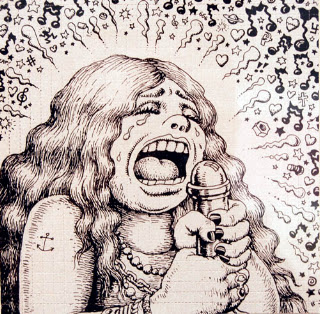
I can't blame Hughes: the movie Crumb can be as skin-crawly as some of Crumb's drawings. And it's funny, because Crumb is nearly cute, a winking almost-rascal we forgive as easily as we've turned double-ironic Mr. Natural into pickup mudflaps and snickered at the Cat who likes gettin' it on with the chicks. At this point, Crumb is as old-timey-kooky as Janis Joplin, a brandname we can trust.
--Sort of: Crumb stares pretty long and hard at the weirdness, Crumb's Leon Redbone vibe resembling nothing like a routine, his outsider family barely hanging on to solid ground. But is this such a surprise? Aren't those dense drawings--thick and meaty with thighs and bellies, little nubs and protuberances poking along the surface of too-tight sweaters and baggy trousers--solid reminders that Crumb doesn't want to have anything to do with us? He just wants to keep drawing, whether we dig it or not--even though we do, with some regret (as it should be when one "appreciates" art: It asks for much, and takes without asking the things we try to hold on to).
I have found myself thinking strange thoughts while looking at a Crumb drawing. He finds me where I hide, and crawls in there with me and shows me something he's stolen from his father's dresser drawer. I get it, but for a minute I'm not sure I want it. But he smiles and smiles, not like Fritz but the Chesire Cat, his big square teeth lined up beneath a lounge-lizard mustache that might crawl away any moment. So I look down at what he's brought me, and then promise myself, liar that I am, to look only once more.
I can't blame Hughes: the movie Crumb can be as skin-crawly as some of Crumb's drawings. And it's funny, because Crumb is nearly cute, a winking almost-rascal we forgive as easily as we've turned double-ironic Mr. Natural into pickup mudflaps and snickered at the Cat who likes gettin' it on with the chicks. At this point, Crumb is as old-timey-kooky as Janis Joplin, a brandname we can trust.
--Sort of: Crumb stares pretty long and hard at the weirdness, Crumb's Leon Redbone vibe resembling nothing like a routine, his outsider family barely hanging on to solid ground. But is this such a surprise? Aren't those dense drawings--thick and meaty with thighs and bellies, little nubs and protuberances poking along the surface of too-tight sweaters and baggy trousers--solid reminders that Crumb doesn't want to have anything to do with us? He just wants to keep drawing, whether we dig it or not--even though we do, with some regret (as it should be when one "appreciates" art: It asks for much, and takes without asking the things we try to hold on to).
I have found myself thinking strange thoughts while looking at a Crumb drawing. He finds me where I hide, and crawls in there with me and shows me something he's stolen from his father's dresser drawer. I get it, but for a minute I'm not sure I want it. But he smiles and smiles, not like Fritz but the Chesire Cat, his big square teeth lined up beneath a lounge-lizard mustache that might crawl away any moment. So I look down at what he's brought me, and then promise myself, liar that I am, to look only once more.
Tuesday
December 26, 1993 [Shadowlands]
Joy and Jack Lewis leave the Shadowlands at last, the uncertain, in-between place--and if not "at last," at least for a moment, there in the Golden Valley come alive from inside the picture that hung on his nursery wall, one childish thing he was smart not to put away; and they kiss like lovers, wet from spring rain while clouds glide across the green like memories hurrying to join the present--and she tells him that the pain later is part of the happiness now--but he turns his head, once more like a little boy, because who wants to hear that? Who wants to suffer?
--Lewis did, once upon a time, as though Narnia didn't stand for anything except an idea: He told the ladies' clubs that suffering is a wonderful gift from God, and we should be thankful that He wants us to grow up, love and be loved. And then of course he's surprised by Joy--not on a hill but in a Valley, with Shadows. And it makes his face screw up like passion--the kind whose release is forsaken death.
--But his student's father says we read to know that we are not alone, so I read that look on Lewis' face and my own follows--and I understand when he says that he prays because he can't help himself, that it changes him, not God, because the change waits, like the pain later--and later, last of all, Lewis tells us that he chooses suffering, that the pain now is part of the happiness then--and saying that, telling it to us directly, he flips time on its head and reminds me of a promise: that "happiness then" may mean that pain does rouse us--as any problem does, any that needs solving. And I surprise those I love by suddenly leaving the typewriter and hugging them up like a goofy bear, foolish tears welling in my eyes as I turn away from them and make a joke and take off, wandering outside just in time to hear a bird rustle in a bush nearby and shake a branch as it shifts to get a better look at me.
--Lewis did, once upon a time, as though Narnia didn't stand for anything except an idea: He told the ladies' clubs that suffering is a wonderful gift from God, and we should be thankful that He wants us to grow up, love and be loved. And then of course he's surprised by Joy--not on a hill but in a Valley, with Shadows. And it makes his face screw up like passion--the kind whose release is forsaken death.
--But his student's father says we read to know that we are not alone, so I read that look on Lewis' face and my own follows--and I understand when he says that he prays because he can't help himself, that it changes him, not God, because the change waits, like the pain later--and later, last of all, Lewis tells us that he chooses suffering, that the pain now is part of the happiness then--and saying that, telling it to us directly, he flips time on its head and reminds me of a promise: that "happiness then" may mean that pain does rouse us--as any problem does, any that needs solving. And I surprise those I love by suddenly leaving the typewriter and hugging them up like a goofy bear, foolish tears welling in my eyes as I turn away from them and make a joke and take off, wandering outside just in time to hear a bird rustle in a bush nearby and shake a branch as it shifts to get a better look at me.
Subscribe to:
Posts (Atom)