Saturday

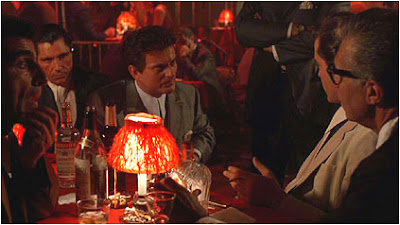
September 24, 1990 [Goodfellas]

As monumental as Raging Bull is, Scorsese once more finds the energy for Goodfellas and gathers up all that Italian desperate surrender to brutal old dreams and shapes something like a farce, an hysterical laugh somewhere down the block, maybe a scream, hard to tell--but who's going to go down the dark street to see?

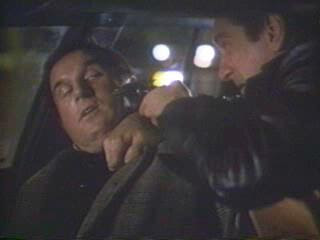
--Scorsese and all of us watching Goodfellas, apparently--and happy to go and check it out, evil tossed off like buddy-buddy rank-outs on the stoop. I was perfectly happy--until Tommy in the nightclub wonders if he's here to amuse Henry, how is he funny, what's so FUCKIN funny about him. And suddenly it was as though every horror film I'd ever seen turned into a Munsters episode, mild-mannered and silly, because that happened to me once at the hands of an Italian tough guy who kept everyone around him off-balance. Like the narrator in Jim Thompson's The Killer Inside Me, he spoke in empty, almost-jeering cliches and grinned and squeezed your shoulder--hard--while he told you what a great guy you were. And when I finally let down my guard and joined in the fun and told him what a crazy sunuvabitch he was he drew up short and flattened his eyes and set his mouth into a thin slot and asked me if I thought there was something wrong with him, if I thought he was crazy. He was, and I could smell the craziness coming out with his breath--and I froze, and I know my face tried not to register any fear, but he saw it and opened his mouth a little like he was going to take a bite out of that fear--and turned up the corners and gave me a smile as friendly as a heat-stroked wolf and laughed and wagged his finger at me, really had me going, gotta learn to take a joke. I let out my breath as slowly and quietly as I could, and kept my distance.

I hadn't seen him in a long time until Joe Pesci brought him up, one of those stories from your past you hope everyone's forgotten--but here it was, and I didn't relax for the rest of the picture, not even after Tommy got it inna-back-a-da-head.

Thursday

February 26, 1990 [Cinema Paradiso, Amarcord]

Is it fair to compare Cinema Paradiso with Amarcord? Maybe it's because I've watched Fellini's movie so often that it's begun to feel as though I'm remembering my own, not his, childhood. Or that the fog in Amarcord loses its menace and rolls on me like a blanket in a long-gone bed, the ceiling low and window small, the room cold but not clammy, the early morning light asking me to sleep just a little longer. For all its extravagances, even almost-cynicism, Amarcord plays its little Nino Rota music with calm insistence, urging me to let the big ships pass on and to return to the wedding-party, rain or no rain.

Cinema Paradiso does not have that particular magic, but there are moments that surprised me into chest-thumping yearning. I wanted to be with them in the projection booth as they reflected the movie out of the theater and onto the housefront so that everyone could enjoy--no, be in--the movie, even the angry tenant at the balcony. And I wanted Alfredo to be my father--if only so that I could save him, as did little Toto, and earn that pride and sorrow. And I wanted to do what both movies asked--remember and regret--until I realized I do remember, and I do regret--but try not to stand still and cry like a child, because no hand appears and holds mine to remind me of my address; like the grandpop in Amarcord I have to find my own way home.

Tuesday

January 28, 1990 [War Requiem]

Sometimes, when I want to remind myself that the Middle Ages echo as though sound had no dying-point, no eventual muffling as the waves crash against one rock, then on to another, without lessening--again, when I want to see those days as clear as a flare at night, I read Wilfred Owen, his alliterative pleas and proclamations as old as the muddy ruts where soldiers have lain forever.

In "The End," he wonders if any wounds will heal after World War I:
Shall Life renew these bodies? Of a truth,
All death will he annul, all tears assuage?--
Or fill these void veins full again with youth,
And wash, with an immortal water, age?
Of course not:
When I do ask white Age, he saith not so:
"My head hangs weighed with snow."
And when I hearken to the Earth, she saith:
"My fiery heart shrinks, aching. It is death.
Mine ancient scars shall not be glorified,
Nor my titanic tears, the seas, be dried."
This is necessary--Benjamin Britten thought so when he composed War Requiem--and so does Derek Jarman with his visual music film, respectful and beautiful, but certain that the end is the end, and that nothing remains.

--except the urge to hold a hand against the will to war, the awful certainty that every generation has to take its turn--yes, some more than others; but why, with so few of us princes, are we Machiavellian in our certainty that we must always be thinking of war, preparing for our turn? The first World War is Medieval in its refusal not to die out: Its brutal sloppiness has been repeated over and over, and my heart shrinks like the Earth as we move closer to one another--and not in cozy affection, but like creatures caught in a small space with our breaths hot in each others' faces.

Saturday

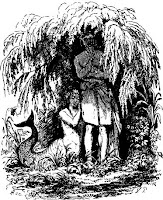
November 21, 1989 [The Little Mermaid]

I have an old copy of Hans Christian Andersen fairy tales, and I’m pretty sure the children have been read “The Little Mermaid”; and somewhere in their heads--forgotten, I think--I hope--lie hidden the sad details, the Mermaid having to watch the prince marry another, the pain like knives in her new legs, the melting into air--where she waits for centuries to go at last to Heaven. What prices Andersen makes her pay, the melodrama exacting its morality.

--all of which is lost amid Disney’s assertion of its old self in a movie as bright as the tunes everyone gets to sing, the victories won, the laughter drowning all temporary sorrow. Disney finds its voice like a puzzle-box easily opened and spilling all kinds of happiness--a talent the studio had for years, despite the huntsman commanded to kill the little girl, the mother dead or chained, the bad little boy braying with his donkey’s voice--Gothic flourishes necessary to make the good times better. And I want to scoff--thinking of Andersen’s mermaid, broken and patient--but Sebastian is so cool, and the Prince is just enough of a goof, and the songs are as good as the Golden Age, wishing upon a star and pink elephants on parade. And the toys, you can’t forget the toys, slipped into Happy Meals and piled under Christmas trees--soon, soon. The Happiest Place on Earth rises up like Atlantis in irresistible primary colors.

October 16, 1989 [Crimes and Misdemeanors]

We came home from seeing Crimes and Misdemeanors to find life imitating art. We were in the kitchen making some Sanka, and Jean felt a draft and went to the back door, parted the little curtain and saw that the glass on the door was missing. I went out to the back porch--tentatively--the porch light was on, and I was an easy target--and leaning against the house was the missing pane of glass, intact and innocuous, as though it had just slipped away for a moment to catch a smoke in the chilly evening.

We called the police, who wandered around, scribbled a little, left. I improvised a window with aluminum foil and duct tape and pulled out the Smith-Corona to write this.

Martin Landau’s revered physician can’t take Angelica Huston any more and lets Jerry Orbach kill her while Sam Waterston goes blind, his yarmulke still in place. Meanwhile, Woody Allen’s documentarian has to endure a self-absorbed--and more successful--Alan Alda, while Allen’s preferred subject, a professor of philosophy who insists we are the sum of our moral choices and must love in the face of an indifferent universe, commits suicide.

Evil profits--even forgetting its own evil after a while, the profit itself melting into a comfortable life, and Allen’s wit fades to murmurs, and happiness dances in blind melancholy. I’ll never know who so expertly removed the glass from my back door, set it with care against the house for me to find, then left without taking anything. We probably scared him off when we came home; and we have lots of bushes and trees in the back yard where he could have hidden and watched me come out and look down at the pane of glass and peer around for him. I had stood there in silence long enough for both of us to get a good look--although the porchlight’s weak circle of light ended not far from where I stood beneath it.

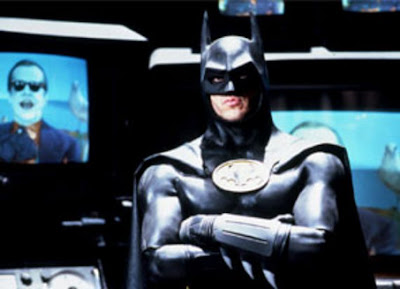
June 24, 1989 [Batman]

Michael Keaton as Batman seemed as improbable as John Wayne as Genghis Khan--but there is something about Keaton’s mouth jutting out of the bottom of that Neal Adams-ish mask--the ear-points high, somehow threatening--that erases Mr. Mom and Johnny Dangerously and even Beetlejuice. Keaton and Tim Burton go poking around in Stately Wayne Manor and find Bruce as alone as Charles Foster Kane in front of the big fireplace and brooding like Michael Corleone--but this time over the sins of others, his voice calm, his eyes blank--while those lips purse as he gets ready, his motions as sure and precise as you want them to be--as he is compelled to make them, given the position he’s put himself into: to be a comic book hero without pleasure, Frank Miller’s Dark Knight one step away from Arkham Asylum.

And of course there’s the other casting hurdle: Jack Nicholson as The Joker--but Jack makes it easy for us, willing as he is to be a creep--like his other Jack in The Shining--funny in a horrible kind of way, a real ham, his homicidal voice trailing along in the fadeout, unwilling to give up center stage. Together, they remind us that costumed superheroes look better in our heads than on the page--and climb right up in there, myth-making despite the silly antics and inevitable banter, Batman’s uninflected proclamations as resonant as The Joker’s lookit-me! cackle, surprising me with my own willingness to take them seriously.

Batman had always been my favorite--he’d survived the campy sendup of the TV show, and gave himself plenty of time in the next twenty years to harden his muscles and firm up his jawline. Like the other great bat, Dracula, he lives best by night--and does just fine in a movie that is unembarrassed by grown men in tights.

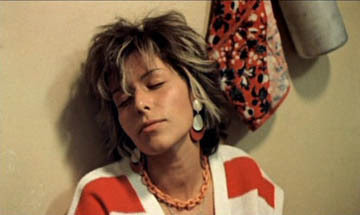
April 30, 1989 [Little Vera]

It seems that over in the Soviet Union, Gorbachev accidentally made a movie, Little Vera, that sums up every nasty surprise glasnost could ever spring on him. Vera's been accepted to college, but all she wants to do is party hearty, dress up, and rip-it-up-shake-it-up-go-go with her boyfriend. Their lives are ugly: factories make a clanking din and spew flat oily clouds, the young men fight and drink--and so do the parents, half in a stupor most of the time--when the mother isn't breaking her back at her seemingly endless work. Just like an American teen, Vera lowers her fed-up, sullen eyes and scoffs at the "Good Housekeeping" book her aunt sends her--Vera has more on her mind that cooking and cleaning--which, again, her mother pursues doggedly, endlessly. To call this movie "bleak" misses the point: it is a kind of meltdown, a social Chernobyl ironically fueled by the sludge left over from Stalinist economic blows and exhausting global policies.

But that's politics; Little Vera's apocalypse-now explodes in the cramped kitchen, food boiling away, a knife handy. It was hard work to watch it, a movie that seemed much longer than it was. My only consolation was that I wasn't living in that family--although they weren't far off, just a few slumps away from my own sloppy tendencies. It was the scariest Cold War shot fired by a gun held in unsteady hands that looked familiar, with music that seemed as cheesy as any teen comedy's. The synthesizers buzzed and the machines rattled while the noisy neighbors--right next door, I think--shouted at each other on and on, nothing shutting them up all night.

Friday

November 11, 1988 [Hotel Terminus]

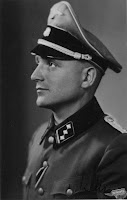
I watched Hotel Terminus, but all I could see was Charles Manson with a swastika carved into his forehead--which must've made Klaus Barbie grin, seeing the poor dupe pretending to be evil--when what you really need to be, Barbie informs us, is cool as a cucumber and willing to keep talking over all protests, cries and whimpers.

Max Ophuls continues to interrogate France and the rest of us--just in time, too, everybody still alive, memories fresh enough to prevaricate--but Ophuls is almost as good as Barbie at making them talk--certainly with less fuss, no need to clean up afterwards. But the closer he got to Barbie, the clearer was Manson's face, "just another sucker on the vine," making Nazis as romantic as Blakean demons fitted out with cool wings and darting tongues, snazzy as an early-'70s album cover--or the side of a van airbrushed with a sexy devil clutching a Frank Frazetta babe, riding rolling thunder and eternal diabolical delight. Meanwhile, the real Nazis hide like embezzling bank clerks, amused at how easy it is to puff up every Manson they need as a prop and fall guy, swindling them with their own self-importance.

It's Hannah Arendt's "banality of evil" with a sideshow--but at the end of the interrogation, Ophuls finds in one woman's memory Madame Bontout--a name so remarkable it seems fabricated--who tried to save a little girl from Barbie's grasp. It's the movie's only hope, despite the firm guilty verdict.

The film--is it a film? So long and scattered, so angry and desperate, so cool and thorough? It seems more about Ophuls hoping to reach a conclusion, ready to lay out the sprawling evidence of the French problem of the War, his hand fanning thousands of documents like an impenetrable hand of cards, the game itself still being played all around the world. So maybe it isn't a film but a series of memories and warnings, exhausted and exhausting--while Barbie fades into the jungle down there, calm in his cell like Norman Bates.

Tuesday

October 25, 1988 [Things Change]

The '80s have been good to Don Ameche--and not just in that corner of showbiz where the Love Boat takes old actors to Fantasy Island, where McCloud and Quincy, M.E. team up to investigate their demise. No, from Trading Places--and just the other month in Coming to America--to the big surprise of Cocoon, Don and his mustache have enjoyed themselves immensely.

But who would've thought that it would take David Mamet and Shel Silverstein to figure out exactly what to do with Don: make him a Don, kind of, a whatsa-matta-for-you Eye-talyen shine-a-da-choose old man escorted around Mametville by the mayor of that strange city, Joe Mantegna, who knows exactly how to deliver a Mamet line: as though such simple words had never been spoken before, so you repeat them sometimes just to make sure they're real--with increased conviction, knowing that the next line waits for the same steady exploration and conquest. Inevitably, Ameche's shoe-shining gentleman reminded me of my father's father, with his cardigan and shirt buttoned up, even without a tie, neat and trim and gentle--but he knew what he knew, and what he knew most is that things change.

With that in mind, it's no surprise that the firmest conclusion is a shrug, the Sicilian heroism--Mamet-ian, too, in a hard-boiled kind of way--that accepts defeat and exile without any fuss, like an old hand at Tahoe betting it all, losing, and smiling through.

Monday

August 15, 1988 [The Last Temptation of Christ]

Sharon, matter-of-fact Catholic that she is, said that the only problem with The Last Temptation of Christ is that it says it's about Christ. Any other name, she insists, would have smelled sweeter.

I understand her point--I can even imagine the movie, a miracle-making, troubled Paracletian fire-starter who balks at martyrdom until he accepts himself and his fate--despite the errors that will be made in his memory, the politics of God smearing the words he'd written in blood on the cup he drank from.

And Mark says it works perfectly well as a metaphor for the life of an artist--Scorsese himself, most likely, a Promethean complaint stretched like wings drying in the desert sun, waiting to fly far from the pain of giving.

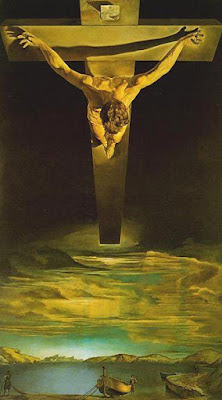
But when Willem Dafoe, calling himself "Jesus," is asked in the desert whether he loves humanity, he replies that he feels sorry for us--and is told that may be enough. And the temple split in two, and all that pleading, scowling search for justice fell in a sweeping wall of dust, and Dafoe took his heart out of his chest and held it out in mercy; and that is infinitely--literally infinitely--better than justice, which winds like a quick snake in and out of holes in the sand. Justice is a reward, mercy is a gift. Scorsese does not do justice to Jesus, but he shows more mercy than most have thought necessary, and gives him back to himself, the sorrow of the forsaken mingled with a kind of love I do not understand, but desire.

July 23, 1988 [Midnight Run]

Exhausted, maybe, from his mighty labors over the previous fifteen years or so--from Johnny Boy to Travis Bickle to young Vito Corleone to Michael hunting deer to Rupert Pupkin to Jake LaMotta--with Satan and Tuttle and Al Capone on the side--De Niro seems ready to settle down a little--a little. I was worried that Midnight Run was just going to be Planes, Trains and Automobiles with guns and cursing--and in some ways it is; but the closer comparison is the hate-love between the leads. Like Steve Martin and John Candy, De Niro and Charles Grodin would seem not just mismatched but out of kilter, non-meshing gears turning and turning. Both pairs know this, though, and use it in such a satisfying way that it was easy to forget how opposed the actors are--because that's the point, of course.

My favorite moment occurs when De Niro's bounty hunter describes on the phone the awful damage he's going to do to Grodin's mob accountant--who's standing right there, aghast. But, even as he snarls into the phone, De Niro pulls a face that reassures Grodin that he means none of it, that all is well. It's funny, but we're only partially relieved: De Niro is, after all, De Niro--he even smokes as though he's the one giving the cigarettes cancer--and he plays with this unease for most of the picture. For his part, Grodin is bland to the verge of smugness--which is his strength, a kind of clueless superiority, an oxymoron he's carried with him since The Heartbreak Kid, his face still wincing over Cybill Shepherd. It seems as though De Niro's Jack Walsh knows this, and is itching to pound the little jerk on sheer principle.

Somehow, though, Grodin is more than a straight-faced pest--and De Niro does much more than take a break from his more excruciating roles--until Midnight Run becomes one of those movies I know some day I'll dream about, find myself out in the desert or bathed in lite-brite Vegas, flummoxed and desperate, wanting to punch someone I'm somehow certain I like.

Thursday

July 18, 1988 [Die Hard]

I'd had enough of Bruce Willis long ago in Moonlighting: I couldn't shake the feeling that he was riding on Bill Murray's coattails--the American cool wiseguy jerk, the smug pest you tried your best not to like, the seat-of-his-pants friend/lover improvising as he goes along. Bill I liked; Bruce made me uneasy--maybe it's because Bill winked at us, knew he was playing a self-satisfied frat boy--which skewered the jerk, while Bruce seemed more aggressive, almost daring us to get the joke more than he did.

Or maybe it was just because he was bothering Cybill Shepherd. Knock it off, chief.

But something happened--to me, maybe, but definitely to Bruce. Just like his rock star alter ego Bruno, Willis once more attempts parody in Die Hard, yanking the cool cat action hero's tail, at once rolling his eyes that he's in a big-budget bang-bang-em-up and wincing from how much it hurts to be at the heart of such a movie, all that shattered glass and sudden drops, gun-butts and haymakers to the jaw. The longer the movie went on, the wearier John became, wincing and limping, a wreck barely on his feet--powered, of course, by the jet fuel of a summer blockbuster, but as torn up as the Hulk's wardrobe after he gets angry.

With one movie Willis saves himself from terminal cute and shoulders past the bigger boys--and not just Stallone and Schwarzenegger, but the tough guys of yore, Mitchum and Lancaster, who took a beating but kept their hats on straight--until somehow Willis reaches a popcorn-matinee approximation of Brando in On the Waterfront, who literally loses his shirt before winning. Yes, there's a hint of Rocky Balboa in Bruce's bloody-but-unbowed stance--but in Die Hard there's little at stake inside, just fireballs all around. I'll admit that the postmodern cowboy impatient with European villains and cracking wise every five minutes got on my nerves a little; but I'm willing to turn a deaf ear as long as Bruce admits it hurts to laugh.