Tuesday

August 14, 1981 [An American Werewolf in London, The Howling]

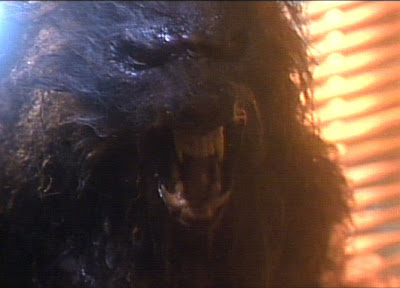
The happy singing-dancing guy on TV who asks us if we want to be a Pepper is stretched in agony until he becomes a big bad American Werewolf in London. Like those California self-helpers in The Howling a few years ago, English moors vacationer David Naughton just wants to take it easy--but the ghost of Lon Chaney jiggers them all to hell, and even a man who is pure in heart and so on--except now it’s one horrible hair at a time, teeth growing like painful roots up, not down--and somewhere in there Freud shows up, and the wolf gets sexy, firelight dancing in a get-in-touch-with-your-REAL-self woodland bop--or a flickering See You Next Wednesday, the skin flick poor David watches, sort of--distracted as he is by the rotting corpses of his victims--and that porn title stuck in my head, opening a little memory-drawer--and of course: It’s the last words Frank’s parents say to him in 2001, their birthday greeting sent into outer space: “See you next Wednesday”--but, John Landis snarls, it aint happenin, kid--and those Golden Oldies on the soundtrack play him off, dead in the alley, “Blue Moon” doo-wopping away--while in The Howling the nice news lady gets to howl on-camera as a cutely coiffed Thing. Some fun.

June 20, 1981 [Raiders of the Lost Ark, Clash of the Titans]

Is it too late for a matinee? Both Raiders of the Lost Ark and Clash of the Titans would have been perfectly at home on any Saturday afternoon thirty years ago--the latter picture more so, another Ray Harryhausen animated monster rally, looking just like Jason and the Argonauts or The 7th Voyage of Sinbad--then again, Harryhausen hasn’t ever left us--two “Sinbad” movies in the last decade.

And Spielberg is certainly keeping his eye on Harryhausen’s world--but also on the old serials, not to mention Zorro, Secret of the Incas--Charlton Heston with his own hat--or Valley of the Kings. The list goes on, but that’s not the point. Like Ray Bradbury, Harryhausen and Spielberg refuse to grow up--just look at the hysteria of Raiders’ finale, Nazis getting it with all the glee of boys playing backyard War. Better yet: the chases defying all laws of physics and anatomy, Indy bobbing like a cork on stormy waves.

What’s missing is the sense of menace--mostly sexual--of the old vamp-inspired adventures: Queen of Atlantis, and even Ursula Andress in She. But Spielberg knows that such dangers will not fit into his fearless twelve-chapter recreation--aside from Indy’s whip--and that easy smile Harrison Ford has sculpted, a little something for the ladies.

But I’m not complaining. Both Spielberg and Harryhausen understand that the best magic tricks end with a bang--and Harryhausen adds an almost academic attention to the details of classical mythology, as he has in the past--but here, with odd superstar cameos, the gods of acting--Olivier, Claire Bloom, Maggie Smith--and there she is again, Ursula Andress as, of course, Aphrodite--looking down through their special effects at all-American Harry Hamlin as Perseus, almost shoved off-camera by those stop-action creatures and wonderments, one after another.

And standing behind the curtain is George Lucas, whose Star Wars mind brushes aside adulthood--not thoughtlessly, or in anxious denial; just determined to remake the movies he loves, including his own. Fortunately, there’s great fun to be had--and, I will admit with some relief, a sense that, despite all the stormy New Waves of the past twenty years--anomie and nihilism meeting like fronts, clearing the deck--some little paper boats keep sailing.

Wednesday

April 3, 1980 [Atlantic City]

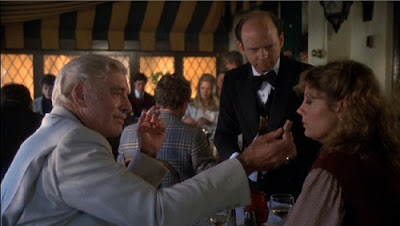
It was Jean's birthday today, and we saw Atlantic City--but I wish we were there in that beat-up old town, sitting near Burt Lancaster and Susan Sarandon in the Knife and Fork, sniffing the wine cork and grinning. It's not too often I can use the word "bittersweet" without cringing, but Louis Malle's fond observance of one wreck and another plays both sides, at once sentimental and severe.

Lancaster carries Malle's tone like he was born to it--and here, at the middle-end of a long career, Burt proves it's true: No one has such a face--handsome and bright, weary and weathered; no one has his bearing, solid and light; and no one has mastered a fall like that old acrobat, his chin up, his eyes hard but goddammit still twinkling. And that voice: still clipped and assertive--and trailing off into a private conversation with itself--oh, I can pile on the oxymoron all night; what matters is that Burt Lancaster has managed to remain a movie star while actually acting, and he takes Atlantic City into Lou's imagined past with calm assurance--"You should've seen the Atlantic Ocean back then," he reminisces. Even geology bends its knee as he passes.

But this performance occurs in a picture that, as Chrissie the spaced-out pregnant sister announces, doesn't "believe in gravity." It ends with a wrecking ball doing its work while Susan Sarandon--lately a real straight trooper in a real bent movie, The Rocky Horror Picture Show--motors off into her own imaginary world, Monaco and "that Kelly girl," two Hollywood fairytale princesses at the casino, their French as perfect as their makeup and hair.

It's sad, but Malle doesn't sneer. He gives everybody the ending we want them to have, and saunters along the boardwalk--which I know so well, from Peanut World and Convention Hall to that big Cutty Sark sign--all that's missing is a jitney chugging along the Monopoly streets, Indiana and Michigan, Atlantic and Pacific--little buses tooling past the casinos without a second glance.

Tuesday

February 21, 1981 [The Last Metro]

François Truffaut's The Last Metro ends like Blazing Saddles--in reverse: his characters enter the fictional world of the play they have been staging. This is not their fault: Truffaut has not given them a "real" world in which to be characters, but a Casablanca-styled 1940s--a world on the brink of action against tyranny that the occupied French cinema had no chance to film. But Truffaut does, in an almost-un-ironic simulation of Technicolor, Catherine Deneuve as gorgeous as Ingrid Bergman, her two loves vying--while love itself, along with the world, hangs in the balance, a Golden Age movie poster come to self-conscious life. Actual French films during the war had to eviscerate any "Jewishness" and looked to fantasy and melodrama; The Last Metro takes hold of that and re-imagines Anne Frank as a Jewish director hiding in his own theater, ghost-directing a play while converting his life into a performance, "a little life rounded with a sleep"--but, like Casablanca, no sleep yet: They survive, perhaps triumph--still waiting for The End, but confident.

It's this optimism--punctuated by the enthusiastic announcer whose newsreels and historical summaries give the movie a Citizen Kane-like winking gusto--that stays with me, the assertion that life imitates art--while art gives life meaning, two hours at a time. Gérard Depardieu as the lead--in both the film and the play-within-the-film--is charming and passionate, pursuing one woman fruitlessly--she too is acting, even though not an actress--while falling a little for his co-star. His smiles for them and his seething rage against the Nazis fuel that optimism: Anyone can tell good from evil, and should. together, the troupe reminds me that a little thing like a play--a movie--does not need to do more than it should--but that "should" is a real word.

Wednesday

January 17, 1981 [Scanners]


David Cronenberg must be destroyed.

Scanners rushes along the electric wires of our heads, and the resulting wet BOOM is only fair, given the urge to figure out our own brains in order to do what we want with others’. And Cronenberg shows us what a messy business business is, mind-control SF mumbo-jumbo smoke-screening a sinister Canadian fit, grossing us out by turning the inside outside--a Thalidomide Bride of Frankenstein married to the Psychotronic Man, willing you to die, monster, die.

December 21, 1980 [Raging Bull]

In Raging Bull, De Niro plants himself square in the middle of the frame, his chin down, his eyes looking at me. “You never got me down, Ray,” he says, and it is a faint sound he makes drowning--his little hands at his side and his sunken chest expanding, bloating, as he runs the microphone along the girl’s dress, his big nose sticking where it shouldn’t--until he is blind in the hole--not an animal, he insists, not that guy, but he drives those little hands into the wall, and he squeals and grunts in the dark half of the screen.

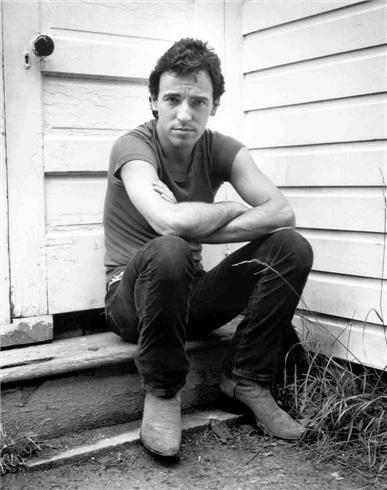
Springsteen sings, “You’re born with nothing, and better off that way; soon as you got something they send someone to try and take it away.” And “nothing is forgotten or forgiven when it’s your last time around. I got stuff running round my head that I just can’t live down”--until you’re “left running burned and blind, chasing something in the night.”

I could quote him all night, listening to those songs, writing down the words, trying to get them to find some purchase under the lid, pry open Raging Bull. But all I can do is take slow and shallow breaths and think of Jake in the mirror, trying to quote stuff himself, insisting he’s the boss, he’s the boss, he’s the boss, he’s the boss--and Springsteen again, singing about that little girl with wrinkles around her eyes sitting on the porch of her daddy’s house, all her pretty dreams torn, staring “off alone into the night with the eyes of one who hates for just being born.”

But I can’t hate Jake, in Scorsese’s beautiful revelation, black and white and full of sound and fury--but Raging Bull signifies something: I was blind, and now I see. What else can I hope for, but to look at myself in the face, try to let go, and be forgiven.

November 19, 1980 [Gates of Heaven, Heaven's Gate]

For a minute I was confused: Hadn't I already seen Heaven's Gate? Why did it sound familiar?--and then it rose up: Gates of Heaven, the pet cemetery documentary--where did I see it? Did I see it? My memory of it was warped at first, fragments of false bravado and anxious uncertainty, slightly crazy people speaking calmly about rendering dead animals, burying others--but more than that:

At the end of chapter four of The Origin of Species, Darwin brings up the analogy of the tree of life. And my children put together construction-paper family trees in school. My grandmother had a knick-knack, a small silver tree with tiny family photos hanging from the branches, grandparents at the top, their three children lower down. I was happy to see them all lined up, pendant from the tarnished silver. Like Darwin's tree: beautiful and reassuring that certain animals enjoy "a protected station" and thrive like a low, straggling branch that should have withered but lives on.

Gates of Heaven's director, Errol Morris, seems to have watched Andy Warhol, then went further, deeper than the amateur and the accidental, the stumbling, lurching, leering kitsch manufactured in The Factory, where Warhol charted the intersection of the ingenious and the disingenuous along a barely navigable course. Morris, though, holds still his subjects and leaves them be in an isolated space, where all they have is themselves. He frames them in self-consciously centered poses, almost as if they're being booked on suspicion (of being silly or crazy or simply stoned)--or they sit low in the frame, with the sky or a wall of cacti rising above their rock-still hunched forms, unconscious parodies of themselves.

Morris' subjects are not interviewed; instead, they deliver monologues, often uncomfortably prompted to continue speaking by Morris' stubborn silence--a refusal to fill any dead air himself--while the camera relentlessly rolls. And we become co-conspirators in a plot against the movie's subjects--or perhaps, in watching them unreel their sometimes-agonizing attempts to make sense, we become their protectors--or better yet, allies, insisting they be given their due, and even realizing the truth of their convictions, and the extent to which we share the mourners' commitment to making their animals more equal than others. Their love is expressed unselfconsciously, as they memorialize their pets and in the next breath discuss their fur coats and platters of meat ruined by the smells of exhumation and rendering. "A protected station," indeed: Becoming a pet removes one from the struggle for existence in a fundamental way; owning a pet allows for a blissful, albeit partial, ignorance of one's shortcomings, while simultaneously providing an opportunity to generate an ideal in the form of the pet.

I remember a sequence of shots of dog and cat headstones. None of the memorials are dopey or campy or morbid; all of them are simple and unashamed in their affection for the pets. I found myself noticing the birth-death dates; many of the pets lived only two or three years, and yet they are accorded their due. Naturally, this never entirely stops being weird, but in that lingering sequence of shots, Morris seems to acknowledge the honesty of the pet-owners' love; any ironic wink is replaced by a respectful glance toward those little animals at rest.

--But that was not Heaven's Gate. For that I went to New York and caught the premiere, and felt the audience drift away, the golden hours of the film--it shines like a memorial at sunset in every frame--weighing on them. When it was over, they left quickly, as if the movie were asking for a handout.

But I sat and watched the credits, and let Morris' dead pets wander in, both movies memorializing something. Cimino's movie, though, disdains the aesthetics of irony, opting instead for gargantuan headstones for every lost soul--the irony is all in the plot, the immigrants burnt down like a prairie fire, the invention of open range free enterprise brutally effective. And maybe the irony goes further than history but to the movie itself, a Big Picture everyone hates, its leisurely stroll and unblinking gaze almost unendurable--but somehow I loved it, I could feel Hollywood's knees buckling under the weight of it, their own history too much like the range wars on screen to make anyone comfortable, including the audience--not that anyone cared. Then again, neither does the movie: Like Bertolucci's 1900, Heaven's Gate cannot stop growing, delivering under the tree the bitter eulogy that continues long after the last mourner has gone home to a hot meal and a warm bed.

Tuesday

May 29, 1980 [The Shining]

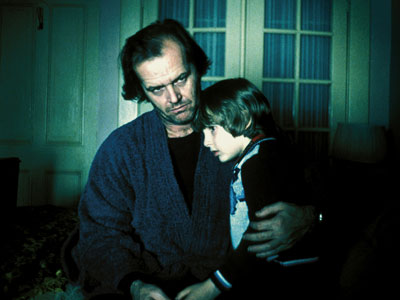
Fran, my helpful cynic, insists that everything in The Shining is straight out of Jack Torrance’s head—and if it isn’t, then it’s not as good a picture as it could’ve been, because who cares about another ghost/possession movie? True enough: The Changeling worked just fine, George C. Scott recoiling in horror from a bouncing ball, the quietest terror since Oliver Onions’ “The Beckoning Fair One” brushed her ghostly hair in the dark at the beginning of the century. Do we really need any more ghosts? Aren’t the ones that rise from the anguish of failed marriages and loves lost enough?

Kubrick disagrees, sort of--and he may be right, especially when he has Jack Nicholson and Shelley Duvall (still my favorite imaginary girlfriend, a post-Mod Maxfield Parrish sprite come to life)--with Scatman Crothers also shining, Chico and the Man somewhere off in the distance, of no help while the snow piles up.
This movie, which refuses so stubbornly to play by the rules, may be Kubrick’s masterpiece--if I can somehow forget 2001. The sheer effort to load every moment with doppelgangers must have been nerve-wracking, from characters to events to colors to sounds, a charnel-house harmony as perfect as the original “symphony of terror,” Murnau’s Nosferatu. I’ve gone back to see it three times already, just to make sure I wasn’t being my usual self, a sucker for the Gothic--and I am, but something else is happening here, the kind of domestic bad craziness that The Amityville Horror fooled around with last year; but The Shining denies its own genre:

--Wendy getting to shine and seeing cheesy William Castle skeletons and split-skull creepies;

--Jack never hiding from us, no BOO! To make us jump;

--the blackouts climaxing on nothing;

--the mood tensing like a panic-stricken muscle--but there’s always time for a peanut butter sandwich;

--and, while Jack is a monster, as my observant friend Jim pointed out, Jack’s evil is Hannah-Arendt banal, a petulant schoolteacher following orders. If it weren’t for that fire-ax--and OK, the haunted hotel itself--Jack would be just another loser giving in to bad habits and worse jokes.

Kubrick takes us all the way to his ubiquitous bathroom where personal stuff is voided in public. Even poor Dave in 2001 has to stand next to a toilet and watch himself become something else in the Ornate Room with porcelain fixtures. And yes, the Monster is us--which means that the corridor of blood (and wasn’t that a Karloff picture?) is something we’ve made, the haunted house we build, and into which we lock everyone we fear has let us down, so that we can “correct” them.

In the end, The Shining leaves me with nothing but a drunk, Nicholson playing Torrance three dirty sheets to the wind through most of the picture, wounded pride and rage and resentment, scared to death and scary as hell--leading to that last moment, the slow approach to the photo from 1929, Torrance grinning with no pleasure--I'm reminded of Wilfred Owens' "Dulce et Decorum Est," the gassed soldier with "his hanging face, like a devil's sick of sin." There it is: the fallen alcoholic whose "higher power" is the drink itself--and it traps him in the maze, with a frozen resolve never to change.

February 19, 1980 [Wise Blood]

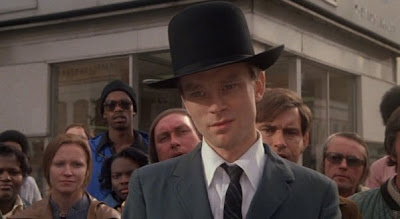
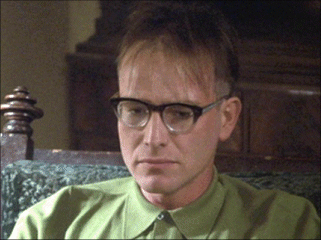
Hazel Motes in Wise Blood is caught putting stones in his shoes and wrapping barbed wire around his chest. His landlady tells him, “It’s not natural,” and he disagrees--so she counters with, “Well, it’s not normal. It’s like one of them gory stories, it’s something people have quit doing--like boiling in oil or being a saint or walling up cats.” But he tells her, “I’m not clean”--and so he keeps on doing it, “into the dark tunnel where he had disappeared.”

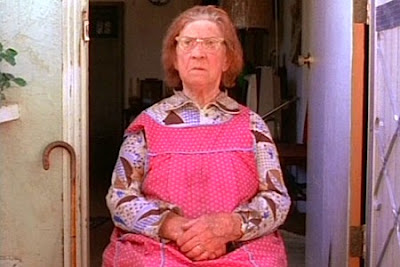
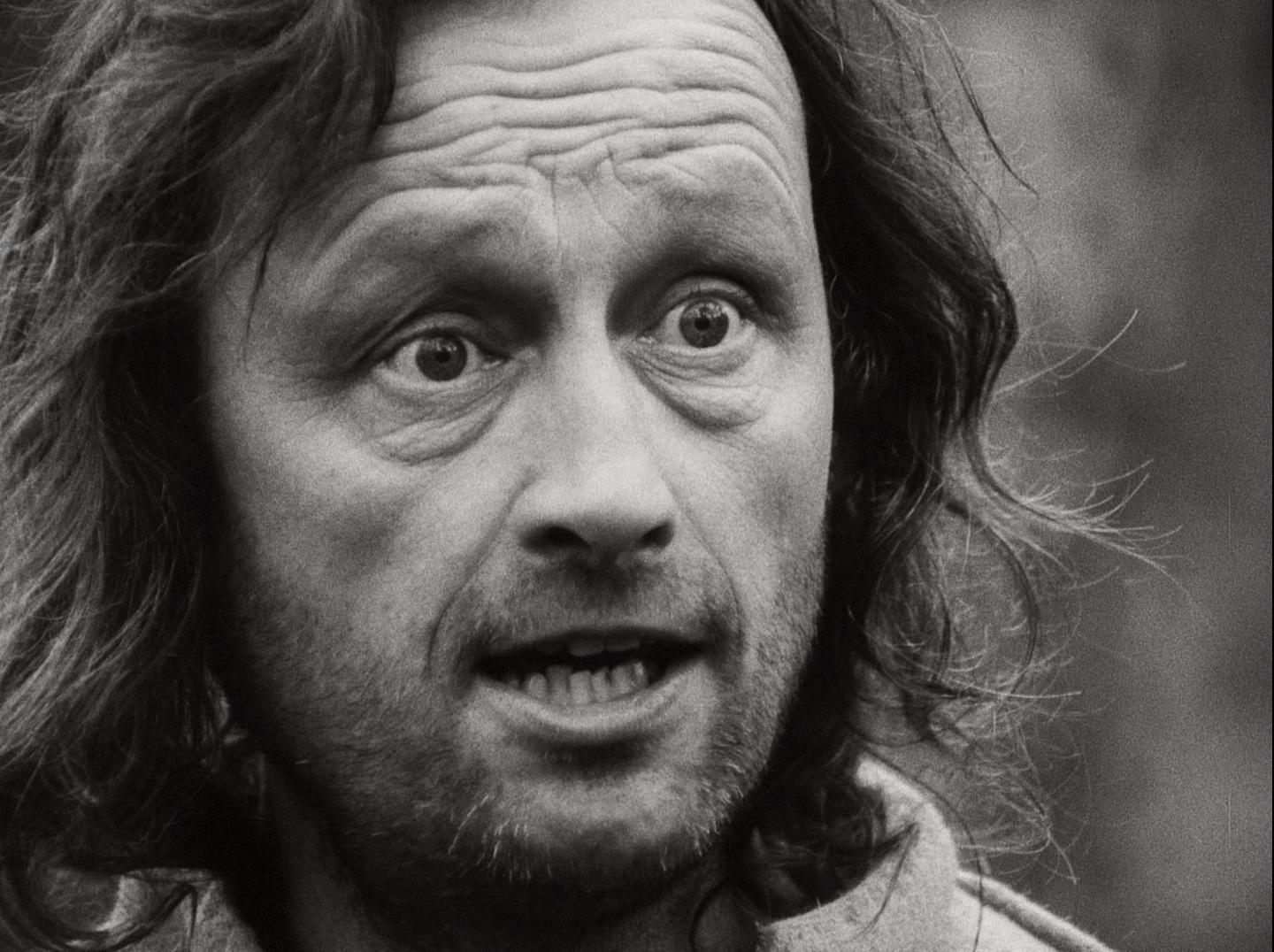
John Huston’s movie, a gory story of something people keep doing, burns a clean hole straight through the book, piercing it, opening a way through it--and even though I'm convinced that the movie version of a book--or play, or anything--has no responsibility to the source, thank God that Brad Dourif as Hazel Motes thinks otherwise. We all want to laud him as Billy in One Flew Over the Cuckoo’s Nest, but he does something monumental here--I cannot overstate it--as though he had lifted an entire world--O’Connor’s--oh, maybe it’s mine, maybe all of ours--and bears it, keeps it spinning.

Motes is pursued by a Hound of Heaven, and runs blindly into sainthood--that is, he disappears into his own refusal, until it becomes a kind of lust, deadly holy. And Dourif lets us see it, his eyes more than haunted--possessed, as though God had become a devil that needs driving out. And as funny as it gets--and Huston knows O’Connor’s sense of humor--Dourif hunches his skull down into his shoulders and stares us down, quiets our nervous laughter, and wrings unexpected pity from us, watching crazy Hazel blind to the light.

December 23, 1979 [Being There]

This decade is finally over--a dark mess not even Jimmy Carter's smile can clean--and boy howdy don't we know it, ready to bring in Ronald Reagan to make it all better, an actor whose quiet confidence in 20 Mule Team Borax guarantees an end to these Death Valley days.

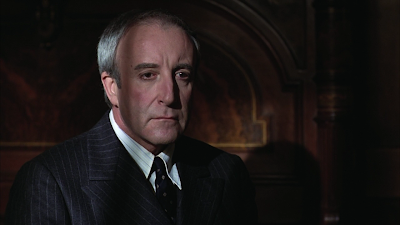
Peter Sellers is also quiet in Being There, his Gardener empty where it counts, a clean slate everyone else writes on--but he remains clean--as clean as Borax--no, cleaner, Sellers refusing to laugh at Chance, gentle and deliberate in every movement--especially the last, the one everyone wants to talk about, the walk on the water. But that's incidental: It's the fools I remember, eager to find any brand that's New and Improved to explain everything--with metaphors, please, anything at all; we'll fill in blanks as we go along.

--And once more: Sellers' own blankness ends up beautiful, the only thing I can trust, that "malaise" that Carter pointed out heavy enough to keep me in my seat. Sellers has said that he thought of Stan Laurel as he worked on his character, and that's a great comfort: If we need another fine mess cleaned, I'd rather it were Stan's squeaky tears than anything hauled out of Death Valley.

Monday

August 23, 1979 [Apocalypse Now ]

Francis Ford Coppola’s Apocalypse Now is based on Heart of Darkness--and Martin Sheen understands what that means--although his version of Conrad’s Buddha-like Marlow, Capt. Willard, is a bit less serene--but just as watchful, his eyes rising above the bloody-orange waters, the other soldiers understood only as shapes--some in affecting, anguished postures, but in the end simply horrors--the head thrown in Willard’s lap, his screams of no matter.

Just ask Brando, whose Kurtz also understands Conrad’s book, the New Man, serene himself in his crisp uniform, deciding at last to “exterminate the brutes”--I mean, “Drop the bomb.” Because they all become brutes, Charlie and grunts, good guys mashed into a pulp with the bad. But it’s more than moral miasma--Coppola announces it as an apocalypse in the present tense, bringing the war back home--and not the “home” of The Deer Hunter, the Pennsylvania mountains looming over the steel mills, all of it somehow reassuring, no matter how terrible their lives have to be. No, Coppola won’t let us go home--he’s too busy burning it down, boiling it grey, like all that prime rib that chef mourns--just before the tiger, burning bright, reminds him that this is the end, and all that’s left is hysteria driving him back to the boat.

August 3, 1979 [Winstanley]

Winstanley is filmed like a documentary, but has the feel of an earnest school play--and I write that without condescension. Its actors seem not so much acting as posing, standing just so--but without proclamation, without raised chin and unblinking eye. It's as though they knew they were in history--"Diggers" all, the early Christian communists of England, taking the Gospel at its Word and trying hard to free themselves from the emerging false freedom of free trade. Gerrard Winstanley wandered among the hedgerows and copses, along the treeline and into the dales--and every inch of ground that he saw he knew came from God, and that it was our common home.

It's a shame to think of him as "brave"--does it take courage to know the truth? Is one heroic in the certainty that 2+2=4? Gandhi said that the law of love worked like the law of gravity, "whether we accept it or not." The "True Levellers" also knew their facts, and wanted simply to claim their due, work on it and make something. The movie knows this, too, and time-travels to a black-and-white pageant with the sound of real wind in the microphones and a pale and luminous English light on Winstanley's upturned face.

June 1, 1979 [Alien]

The trailer for Alien gives us a simple physics lesson: “In space no one can hear you scream.” The sick-green egg throbbed--and yes, screamed--like the quick-cut victims fleeing in strobe-lit panic.

What, though, is Alien? Ask H.R. Giger, he of the twisted bio-mechanics, all grey and black, shining with excretions and posing like a fashion model, cold as Milton’s Hell and cool as an Emerson, Lake & Palmer album cover. His Thing grows in the narrowing corridors of this haunted house in space--while the sex-metaphors work their way down our throats, like that rolled-up magazine wielded by Ian Holm, straight out of Harold Pinter’s The Homecoming--the “comedy of menace” tossed into outer space, dead and alone and spinning in his head like thanatos.

The last little Indian, Ripley, is cute in her panties but not just candy: She moves toward the alien to get a better look, ready to do what it takes--like John Wayne staring down some tinhorn--except here it’s glop-dripping mouths inside of mouths--a sexualized version of those ‘50s Things, Black Scorpions and Crab Monsters, an evil Cesarean birth with noise and steam and wet clanking chains symphonic as it approaches.

I’ll stop making much of Alien--but my sister, a grown woman, went with me to see it, and afterwards she insisted I search the car before she got in. I grinned and teased her--still, there I was, poking around in the trunk and a little worried.

Friday

May 27, 1979 [Night of the Living Dead, Dawn of the Dead]

I know a young man who thinks about George Romero's zombies all the time. Whenever he enters a room, a little careful part of his brain has him scope out all entrances and exits. He doesn't like to be alone, and facing a door or ground-level window makes things only marginally better. Outdoors isn't so bad, but there needs to be a lot of open space; even then, he keeps in mind that Romero's first victims were in a big cemetery, and could see Doom coming a long way off. When he confessed this fear to me we were talking about movies--not Romero’s, but something in my wide-eyed rush of words about whatever it was I couldn’t stop blathering about provided him an opening to tell me of his fear. One madman to another.

At first, I almost congratulated him. After all, here we are in a time when we've slopped around in every evil, twice, and come up grinning, everybody a smut aficionado--no matter if it’s sex smut or shoot-em-up smut or True Confession smut--a time ripe for Gonzo truths and Freudian fairy-tales, Thompson and Bettelheim staring down the slavering jaws of the Were-Nixon dreaming as it waits for Little Red Riding Hood. You'd assume that nothing could faze anybody under thirty any more. I thought it was good to see a little atavistic fear still tinkling the ivories of someone’s spine. Of course, though, the more that young zombie-phobe talked, the worse I felt for him. This fear dogged him silently in the underbrush of his life, always out of sight but never out of mind.

I have nothing new to say here, except to acknowledge how thoroughly George Romero understands the terror of evil--not just Hannah Arendt’s “banality,” all those wolf’s-head accountants tabulating Jewish ashes, one by one million, but the small dread that grows, the suspicion that everyone’s either dead or back--and wanting you dead. And this dread is in the rooms we sit in and the scenery we move through, and it comes at us, its shambling, E.C. horror comics/Karloff as The Mummy gait laughably slow--but so darn inexorable, like plate tectonics, so that you cannot escape the object of dread: consumption. In Romero's zombie movies, evil may be silly or slimy, but it is always as close as the dinner table or the shopping center, the personal and social feeding grounds. So when that young man admitted he was always thinking of zombies, he was just seeing Romero's version of the Post-Everything Age. In Flannery O'Connor's Wise Blood--and I read John Huston is making a movie of that little fallen creature--Hazel Motes founds the "Church Without Christ," where "the blind don't see, the lame can't walk, and the dead stay that way." I wish Romero would convert, and leave that poor young man alone.

February 27, 1979 [The Deer Hunter]

The Wise Man in Eliot’s “Journey of the Magi” tells us right away
A cold coming we had of it,
Just the worst time of the year
For a journey, and such a journey:
The ways deep and the weather sharp,
The very dead of winter.
--And the late-winter wind rushes along the house, The Deer Hunter refusing to leave, De Niro’s eyes wide as he tries to find a way out, the one-shot man insisting, “This is this”--but how could he know that Nicky would leave them, his own eyes seeing something a thousand yards away: a bullet, like the one in the Weber opera, like the old folk tale, magical--no, cursed--veering and circling, the enemy unscathed, the young men dead or broken.

The final scene, the survivors singing “God Bless America”--but John Cazale, whose character stayed at home with his own little gun, did not survive: he’s gone already, the last victim of the ‘70s, this Little Decade That Couldn’t--that final scene will be much discussed, much maligned. But I cried, free at last of false hopes and fears. Who am I to lay on them anything more? The least I can do is leave them alone, let them mourn. I don’t want anything from them, and have little to give myself. They loved each other while the old world, in “the very dead of winter,” passed beneath their hurrying, lost feet. The movie’s horrors are also much discussed, much maligned. But again: Such stuff is what it is: “This is this.” And that is not merely convenient ambiguity, but the lesson of the circuitous journey of that cursed bullet, finding its own mark, no matter which way the gun points.

February 19, 1979 [Quintet]

The weather was sharp today, as though the air were made of innumerable, microscopic icicles, pricking my face for a millisecond before melting on my cheek--and I took that thin icy skin with me into the theater to see Robert Altman's Quintet, which warmed me up not at all, the science fiction ice age frosting even the lens as it watches Paul Newman step into the end of the world: first a bang, then a whimper.

I'd read that Altman used the old Expo '67 grounds up in Montreal, the decaying hommage to "Man and His World" hosed down until it looks like a sepulcher whited on the inside, the cold as real as the one I'd left outside, the fatal game of Quintet played because there's nothing else to do while waiting for the end.

I sat there and couldn't get out of my head Kobo Abe's novel Inter Ice Age 4. I'd seen the film version of his Woman in the Dunes, but barely knew of him--then about five years ago happened on his SF novel through the Science Fiction Book Club, cheaply made--but cheap enough to risk. And it made Vonnegut look like a calm and sober fellow, its ideas as sharp and dazzling as icicles, its own version of a watery end all ocean, no ice. Altman stays true to his central conceit: Everyone slows down, even Newman, the only hero we can pick, half-befuddled by the indirect suicide of a game he learns like building a fire: a necessity before anything. But Abe's book kept nudging me, knowing we might not make it to Quintet, that our own Inter Ice Age has been going on long enough to warm everything but our hearts. I was almost glad to rejoin the winter outside--but as I sit here, I know where Abe's novel sits on my shelf, its predicting-computer only the start of the last thaw.

Thursday

December 20, 1978 [Superman]

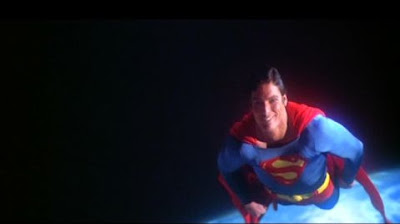
The ad campaign promised, “You’ll believe a man can fly!” And that's good enough for Superman--despite the alien appearance of Marlon Brandon as his father, lurching around the dying Krypton like a Pharaoh still alive in his pyramid, perhaps the movie’s most startling special effect--and Gene Hackman somehow fooling everybody into thinking he’s the Lex Luthor we wanted--although Valerie Perrine is certainly the sidekick of the year; but they did not distract me, much, from Christopher Reeve--and the strange irony of his name, with poor George Reeves trapped in his suit in the ‘50s, having to deny invulnerability so he could tear out of it--not to mention Steve Reeves holding up his bearded chin in Italian Hercules pictures--where will this muscled fraternity end?

Anyway: I did believe a man could fly. Reeve captures Superman's charming blandness, with a little self-satisfied smile to let us know he’s enjoying the effects of a yellow sun, doling out the right measure of love for Lois Lane--Margot Kidder also getting it--the gag, that is: letting Lois be just tough enough to plunk herself into a rescue-ready situation. But again: the flying. Finally fun to watch, no squinting needed, the bizarre physics of up-up-and-away as nonchalant as making the whole planet time travel just for Lois’ sake--and go right ahead, pal, spin it like a top, because at the end he flies toward us, and looks right in our eyes, and gives us one of those amused, reassuring smiles all for ourselves--and OK, I smiled back at good old Superman easy in his own skin, devoid of the anguish of a Silver Surfer or puny Peter Parker, just happy to be here.

October 28, 1978 [Halloween]

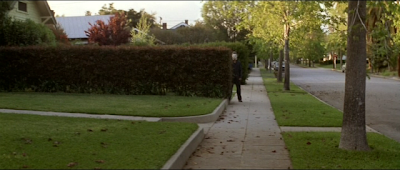
How much simpler can Halloween get? A masked murderer--straight out of Georges Franju’s Les yeux sans visage or Mario Bava’s Blood and Black Lace--indestructible, impossible to understand, with foolhardy teenagers at the ready.

The director, John Carpenter, shows surprising restraint, considering the treatment such a plot (the term more or less a convenience) has received internationally, drenched in blood, bright and garish, Clockwork Oranges without intellectual distancing. And at the center is one Jamie Lee Curtis, the good suburban girl pursued, her pretty eyes stretched wide open in last-gasp terror, her long frame spilling around the house like the high school athlete her character must certainly be, basketball or track, anything that demands quickness--until the monster, Michael Myers (his name so nicely bland), corners her in the bedroom closet, flimsy slats bursting, hangers rattling, the camera flying around in there--and we all get to run from him, a basic impulse that Carpenter works like a surgeon, anesthesia forgotten but the skills sharp.

And of course the monster, tumbling into the back yard, just goes away--no comforting “The End” for us; it’s too late for that, here at a point in American life when nothing seems to matter as much as the assertion of the self--and Jamie Lee Curtis’ Laurie is forced to become Tom Wolfe’s Me Generation make-it-happen babe rolling around on the carpet at the est seminar primal-screaming about her hemorrhoids. In his essay, Wolfe writes about “encounter sessions”: “often wild events. Such aggression! such sobs! tears! moans, hysteria, vile recriminations, shocking revelations, such explosions of hostility between husbands and wives, such mud balls of profanity from previously mousy mommies and workadaddies, such red-mad attacks!” He adds, “only physical assault was prohibited.” John Carpenter simply removes that last safety measure, and we get the perfect horror film for our times.

November 11, 1978 [Magic]

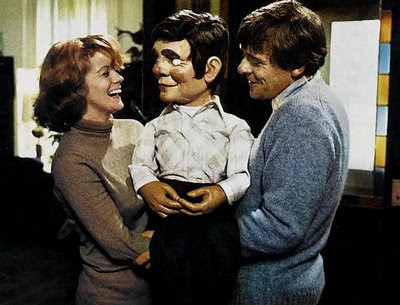
Anthony Hopkins in Magic churns up Karloffian pathos with a whisper-to-hysteria vocal register, like Richard Harris caught midway between this sporting life and Camelot, all to sustain one long nervous in extremis situation: Corky the mad ventriloquist eaten up by his cold, sly double, Fats, his stare-down disdain and squawking rages exhausting Corky, sending him to the bare trees of his hometown where in isolation he can settle into inevitable ruin--the whole goop poured like Creepy Crawlers into a don’t-touch hotplate.

And then there’s Ann-Margret as Peggy Ann Snow, forgodsake: the original kitten with a whip, almost in another movie, looking back with confidence at the fact that she was the prettiest girl in school, all done with Bye-Bye-Birdie teeny-bopper squeals and Tommy’s-Mommy Oedipal wigouts. If movies are dreams, and dreams are wish-fulfillment, this one comes without metaphor, symbol, or sign, just flat-out unfiltered longing. No matter how awkward or foolish the movie became, those scenes of Corky and Peggy in love (despite the homicidal wooden baby-makes-three) reminded me how temporarily soothing a movie can be, even if the real wish is to not-be.

Wednesday

August 3, 1978 [National Lampoon’s Animal House]

While Saturday Night Live’s cast carries on a grandly grimy tradition--sharp as Mr. Mike spikes inserted into the eyes of Tony Orlando and Dawn--Animal House feels more like the Lampoon’s magazine and radio show--and no wonder, given the overlap of writers, performers, and bits--mostly straight out of their high school yearbook parody.

It’s a rough ride with these folks. They meticulously recreate the past--here, early '60s college culture--simply to take it apart then reassemble it so that the jokes can fit in. It works, of course--especially John Belushi’s silent-comedy expressiveness, his cartoon-physics trajectories--skittering around the cafeteria, boner-propelling from ladders, swashbuckling across the Main St. Armageddon. But the college stuff has a sharper bite: the evil fraternity--“Please sir! (whack!) May I have another!”--the stifling pink and hairspray-encrusted platinum of the sorority, the venal Dean Vernon Wormer intoning, “No more fun of any kind!”--and that’s the real target here, not any socio-political villain--after all, all they want is to work on their golf game and drink. The Delta boys are tomorrow’s privileged class--but before they get there (and the freeze-frame epilogues tell us they certainly will some day, divorces and politics, gynecology and parts unknown) they just want to toe-GAH, toe-GAH, toe-GAH.

Like the magazine, the movie has decided that we’re all assholes; it’s just that some of us know it. In the end, it’s more than a little cynical--but irony is the Lampoon’s constant diet, setting the tone for the American Things to Come, self-awareness not a California-Dreamin’ bliss-in but an opportunity to snicker at lesser breeds. Somewhere in there is a kind of snobbery, but we’re having too much fun to notice.

November 26, 1977 [Close Encounters of the Third Kind]

Jerry refuses to see Close Encounters of the Third Kind--on principle: He disdains a movie that asks people to search elsewhere for hope and fulfillment, rather than in their own lives. This is also the guy who’d rather listen to Yes than Bruce Springsteen--“Why eat hamburger when I can have a steak?” A nice guy, but suffering from a blind spot: Someone who thinks Siddartha is one of the best books of the 20th century has a funny idea of what makes for a good steak.

Now, I like Yes--went with my Close Encounters-hating friend to see them tell Tales from Topographic Oceans--and have read with great pleasure Hesse’s book about the Buddha--but I also could not take my eyes away from Close Encounters, from that first moment when Spielberg jumpstarts us with a burst of light and music, to the gumball/pinball spaceships, the unfolding mystery in Roy Neary’s head--Richard Dreyfuss once more in deep waters with Spielberg (and this time the boat’s plenty big)--and Melinda Dillon’s panicked mom, and the little boy who runs toward the monster like a kid on Christmas morning bolting down the stairs--and even François Truffaut showing up, the strangest visitor of all, a gentle reminder that Jerry is wrong, that this is a story about finding something in one’s life, down deep where indefinite shapes elude our grasp--unless we’re scary lucky, and they take definite shape, in mashed potatoes or charcoal sketches--or gigantic science fair projects, big papier-mâché mountains in the living room. It was dismaying to see Neary fly away from everyone, little by little, to outer space--the kind of upheaval only reckless hope can fix, with or without special effects.

I won’t argue with my friend; I can only record my own hypnosis, not wanting the picture to end, wanting its humor and terror, joy and wonder to go on for just a little more, just a while longer, like a kid who doesn’t want to go to sleep.