Tuesday

August 13, 1977 [Suspiria]

I had a few used paper napkins in my hand and pushed them past the little swiveling lid of the kitchen waste-can--and plunged my fingers into something dank and grainy, cold and clinging. I drew out my hand in disgust: coffee grounds was all, but for a moment there it was nothing but corruption, coating my good hand and turning it into something else.

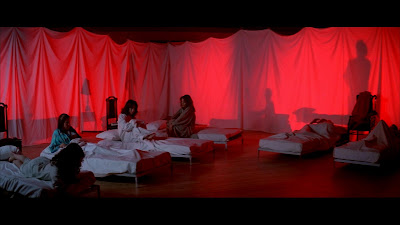
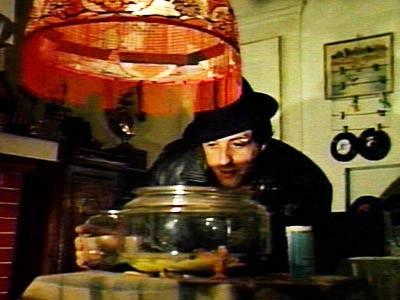
Suspiria is almost a Hitchcock movie, but it's also a big neon mess, bright and shrieking like violins in a wood chipper--or violinists, the whole string section pushed in. The director, Dario Argento, has done this at least one other time: The Bird with the Crystal Plumage, Tony Musante--pretty good as a TV cop over the last few years--also caught in an Italian-opera/acid-rock thriller, Vertigo without the pretty City by the Bay. But in Suspiria it's a Gothic Happening in a dancing-school run by secret witches with really sharp objects and bugs and one unhinged dog. The plots of both films don't seem to make sense--but is that because they're edited with that chipper, or just because? I was too jangled by all the fog and filth to keep up--just sat there and let the young girls get it, screaming in ultra-cool saturated colors, mostly reds.

It's as if the horror movie has nothing left but nasty shocks and style, like a nice soft glove with something wet inside.

Monday

May 30, 1977 [Star Wars]

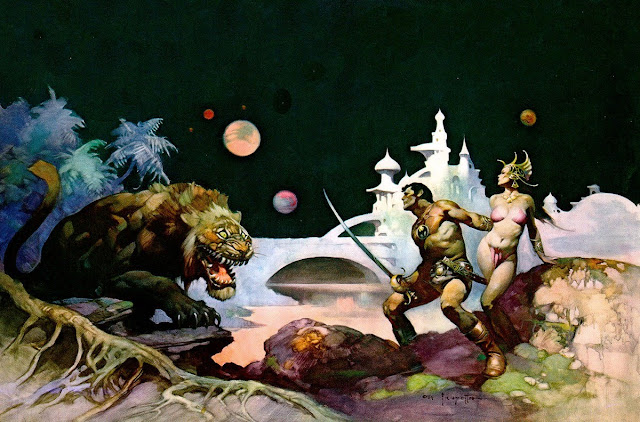
Edgar Rice Burroughs’ A Princess of Mars and E.E. “Doc” Smith’s Skylark blast off, passing Flash Gordon and Buck Rogers, skirting the Forbidden Zone where 2001 imperiously spins--and rattle to a landing in Star Wars, irresistible and silly--but a great reward to those who have ridden the spaceways, all the way to Harlan Ellison's New Wave shores, dangerous visions threatening to toss all space operas into that “tall white fixture in a comfort station”--as Kurt Vonnegut calls science fiction.

And I understand the problem--as Vonnegut pointed out, science fiction is a kind of club (a “lodge,” as he put it), where there is safety and endless discussion of itself--but also love. And I have nothing against that love--I’ve felt it myself in the dark burrows of Weird Tales and heard it in the shiny whizbangs of Astounding--and sometimes my favorite, the hybrids of The Magazine of Fantasy and Science fiction having it all, from werewolves to robots--to Vonnegut himself, fifteen years or so ago.

And so I was simply thankful that George Lucas--who put together a “real” SF movie for his first outing, THX 1138--has found both artificial gizmos and real computers--the first to keep the story going, the second to make it happen on the screen. And it may be enough to say that Star Wars just “gets it right”--if “it” is princesses and mechanical men, young upstarts and space pirates, the plot incidental, the relationships juvenile--but still: Isn’t it cool that Han Solo’s spaceship is a wreck, scarred and beat-up, like one of those hot rods in American Graffiti--because man, they go! no matter how dented the bumpers.

Lucas has opened a door that until now has worked only in my head, where I can fill in embarrassing gaps. And he could care less that the gaps are still there, as long as he pleases the guys back at the lodge--and arranges a little Open House for everyone else to take a peek, not into “childhood’s end” but its hyper-driven beginning.

Sunday

May 20, 1977 [Cria!]

The little girl from The Spirit of the Beehive is a bit older--but she is still solemn and waiting, her partial understanding giving her the patience to hold on and see. Cria!'s original title, Criá Cuervos, opens the window a bit more, so that we can see the little ravens learning to fly, raised in the quiet house--the dim sounds of Madrid barely a whisper. But in that silence the house also whispers, haunted by childhood. This is the dark flank of the little growing bird, feathered, punctuated by rough cries that sound deeper as the ravens grow, the little girl and her littler sister and her bigger one, the three of them together, from childhood to adolescence to almost-grown--with Geraldine Chaplin as the mother's ghost, still brushing hair, a "beckoning fair one" in the mirror.

When the needle drops and the raucous pop song sends them dreamy-dancing, the middle girl considers the value of poison--a little for each grownup, helping them along. Once more, Shirley Jackson's world asserts itself, way over there in Spain--except now it's merely bicarbonate of soda; death itself comes in by its own door. The only thing that really ends is summer, and the little ravens join the other children at school, the strange glowing glory of childhood fading into common daylight. My own girls also walk alone, stepping on the ledge--not careful, but possessed by their own desires. I don't pretend to understand them, but I can feel their sleek little feathers brush my cheek when I'm asleep as they plot to be free.

Tuesday

April 3, 1977 [Three Women]

A little more than mid-way through Robert Altman's Three Women, I felt a moment of cinematic déjà vu ("I've seen this movie before") that seemed gray and grainy, something lying in the attic long enough to leave a silhouette in dust when I picked it up--and saw it was a silent film, The Female of the Species, a strange little thing made stranger by my dim recollection of it. I believe it was a tale of survival in the desert, the men dying, the women left to fend for themselves. It may have ended with a dust-storm, the three women--one holding a baby--pushing on, disappearing into a cloud of sand.

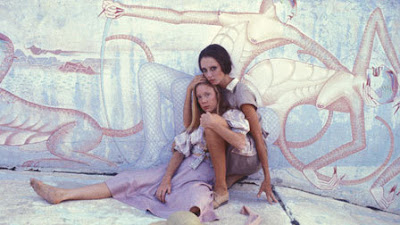
--And they finally emerge from the desert, decades later, to change themselves--not only into Shelley Duvall, Sissy Spacek and Janice Rule but also each other, the women swiping and borrowing to piece together their own version of womankind, alone at last in the perfect American wide-open space, hot and dry and safe. Like the women of that silent picture, they have to decide whom they will trust--even if that means denying themselves. But both pictures do not end in dissipation, let alone annihilation--not so unusual in the desert, where the Big Bombs and dry scrub make threats, not promises; no, as they move into the storm, they calm it, claim it--were those earlier three miners' women?--and settle themselves, like real pioneers.

Monday

January 26, 1977 [Harlan County U.S.A.]

Harlan County U.S.A., Barbara Kopple’s documentary of a 1973 miners’ strike in Kentucky, takes us deep into the woods and down into the mines, where good country people do not spread checked tablecloths for covered-dish suppers while breezes sway the willows and cicadas sing, with a county fair in the distance sending up the thin tootle of a calliope--no, that is another country.

Here in Harlan County it’s a long hard push, the United Mine Workers of America trying hard--and they have their own troubles--while the miners themselves stand in the dark, company thugs firing off a round or two to clear the way for scabs.

--And often it’s the women who stand tallest, the miners’ wives keeping things organized, the kind of plain-faced ladies that Flannery O’Connor warned us about, Jesus in their hearts and the Devil in their mouths, packing a little iron themselves, tit for tat. While the film’s discussion of troubles in the union is illuminating, a record that needs setting straight, it’s those women who remain with me, a little self-conscious, playing for the camera a little--but I won’t argue: it’s their show, and I’m just a city boy safe in my air conditioning, watching them sweat--while their husbands, coughing as they always have, wait on a miracle.

January 14, 1977 [Stroszek]

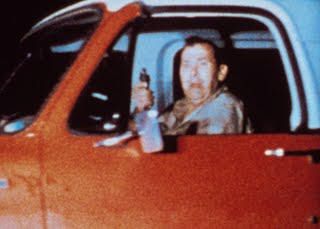
I watched Stroszek, but I'm not sure what I saw. Was it Werner Herzog's elaborate home movie about relatives who otherwise would never have been remembered? Was it a surreptitious documentary, secretly following a strange man--"Der Bruno Stroszek," "played" by one "Bruno S."--and a prostitute who travel with an old man interested in "animal magnetism"--the literal kind, if that makes sense--all of them tired out from Germany, hoping America is still the New World--but ending up in the worn-down frozen reaches of Wisconsin?--and isn't the country getting rustier, the edges raggedy, the trash always swirling at our ankles? It's as though "Keep America Beautiful" left with Lady Bird Johnson, and all we have left is these sad foreigners holding up the mirror to our threadbare nature--until we're the foreigners, like Valentine Michael Smith in Stranger in a Strange Land--except in reverse: Stroszek and Eva and Scheitz are not famous enough to become pawns, just marbles in a cigar box, tilted one way, then the other.

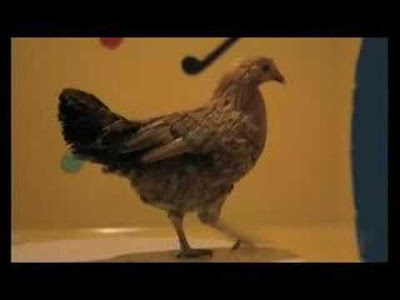
The movie is almost sad--but something about Stroszek's determination to be himself moves things--I almost wrote the word "transcendent" to describe what happens--but that word, too, is getting worn out these days, its shining teeth and clean breath in need of attention; so I'll forget the bigger world, out there beyond the Wisconsin tundra, and watch Stroszek and his frozen turkey ascend--not, in the end transcend--while dancing chickens and ducks and whatnot frenetically play him off.

Sunday

December 3, 1976 [Rocky]

I’ve stood up there at the top of the steps Rocky climbs, the art museum behind him--but he turns his back on it and faces the city, spread out along the Ben Franklin Parkway--and it’s hard to tell if the city is daring him to succeed, or if Rocky is daring the city to try to stop him.

Not since Brando in the ‘50s have I seen a beefy guy so thoroughly bowed down that he has to murmur, so he can blame himself--because no one else is listening. The fact that Rocky’s triumph is not winning but finishing justifies this hunched-over performance, a man humbled by his failures--and inspired by them, in the end reveling in struggle, victory incidental. It’s a completely endearing performance, from that silly hat he wears to his sudden metaphors--he calls the little birds in the pet shop “flying candy”--to his gentle touch, a brawler always trying to make peace.

Among the various nostalgia-crazes the ‘70s has been stirring up--for the Roaring ‘20s, the “Happy Days” of the 1950s, the Old West, even the Depression--Rocky is the strangest entry: It does not re-imagine a historical past, but a cinematic one, reviving Old Hollywood, the endless string of third-act uplifts, the girl who stands by her man, the grizzled mentor, the eccentric sidekick. But Sylvester Stallone drags them into the present, the smoke-and-rain-filled streets of an American city worn out and waiting for a Bicentennial Moment--and he delivers, giving all those South Philly street corners something to doo-wop about.

I admit it: Tears welled in my eyes at the end, Rocky laying on thickly the salve we need, two hundred years later and feeling cheated out of a good time, trying to stand up--and Rocky does it for us, never KO’d, going the distance. For two hours on my birthday I’m given the feeling, like the other Rocky--Marciano--that somebody up there likes me.

November 30, 1976 [Network]

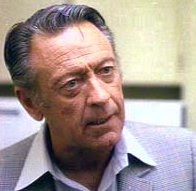
Some old hands here in Network--especially Sidney Lumet, directing for a long time, all the way back to You Are There and The Alcoa Hour; and William Holden--was he really Joe Bonaparte in Golden Boy back in the late '30s, before Sunset Blvd. and Born Yesterday and Stalag 17 and a guest-spot on I Love Lucy, watching her putty nose catch on fire--you can see it on rerun even now--let alone The Wild Bunch, reminding us not only of the long-gone West but of his own past? He's doing that again in Network, making us see what's been lost as he kneads Faye Dunaway's white white skin and makes more mistakes any way he can.

As a satire of TV, the movie doesn't push any further than Harlan Ellison's The Glass Teat--except for the almost-SF alternate-universe programming decisions--but they're only slightly more cynical than The Price Is Right or Hee Haw in their estimation of their audience. Even Peter Finch's pop-eyed impression of Charlton Heston's Moses, as monumental as it is, pales before the simple sight of Holden broke in two like a stale loaf of bread, the last pleasant memory of our friend the TV gutted by folks who helped build it, then hated themselves later--oh, they'll tell us it's TV they hate, but the violence of Network turns inward, no matter the incursions of actuality, the on-camera snuff-outs, the fatal seizures.

And in the end, it's just business, so who's to complain? Well, the gadflies nip and goad, but the big dumb junk-wagon horse just flicks its tail and shivers its flank and clip-clops along, kids following it up and down the street.

Friday

September 28, 1976 [The Spirit of the Beehive]

The weather’s cooler now--but I saw a sluggish bee float by, as though the air had become viscous, a transparent, thin syrup--or maybe the bee had been hypnotized, and had not yet emerged from the trance. The glass beehive in The Spirit of the Beehive crawls with them, mesmerized, buzzing; it sits in the room, a tunnel boring through the window so the bees can pass, as if René Magritte had designed the house. Maybe in another room a pair of bare feet rests in a corner, above the ankles melting into boot-tops, the living and the made things meeting.

--Which is the little girl’s occupation: She sees Frankenstein and her older sister tells her a story, just enough for the girl to look for Karloff as though he were an Answer to some dim question, something hiding behind her solemn, beautiful face--and she takes me on the search, the two of us wandering on the open Spanish plain, the light lasting long but dying anyway.

And in the dark, by the water, the Monster appears, extends his hand, and takes her into her own dream, out there behind the desolate barn, asleep and safe--despite the false deaths (and a real one, the little drops of blood remaining for her to see). The Monster moves briefly into a little pool of light, then rises and fades, like the movie itself, into the little girl’s head, where she walks to the empty theater--not a chair, not a person, not anything but the little screen waiting with us for the show to start.