Tuesday

June 15, 1976 [The Tenant]

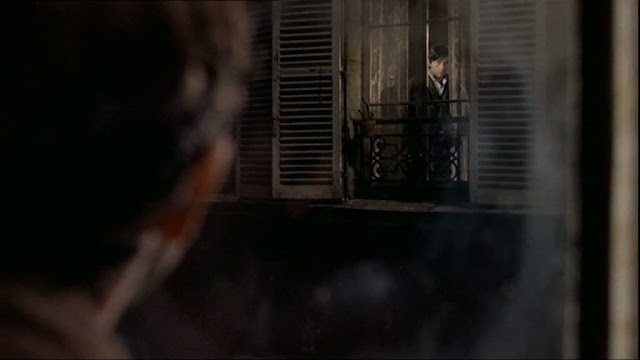
Roman Polanski’s The Tenant is a surrealist sick-comic remake of Rear Window in which the guy watches himself--Polanski also stars, so the director can also watch himself go mad in an apartment building whose inward-turning, everybody’s-watching courtyard provides the best opening-title sequence I’ve ever seen, a serene implosion that's at once tense and melancholy.

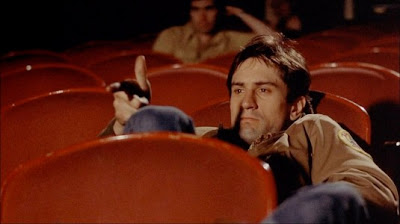
Like Taxi Driver, it’s a movie about a smallish man who stops for death--but Travis Bickle turns the pain of isolation outward, while Trelkovsky ingests it, dresses it up to escape it, to turn it into another person--a different kind, a woman; but he chooses unwisely, since the woman is already dead, the two of them losing their teeth as rapidly as their minds. Then again, Trelkovsky’s contacts with the living provide their own madness: Isabelle Adjani’s Stella a disheveled sexy mess, those lips waiting for him, but in the end of no real use--like his friends from work, who bully him--but it’s nothing compared to what he does to himself--or is it done to him, his neighbors plotting like the witches in Rosemary’s Baby? It’s hard to tell; the story works its way out from inside Trelkovsky’s head--and every minute it gets tougher to trust him.

--And also like Taxi Driver, it’s a young man’s nightmare, his uncertainties regarding where he stands, who he is, worrying at him until he makes a choice--a really bad one--and he shaves off his hair or puts on a wig. Again, though, Bickle walks away from the mirror and aims and shoots, while Trelkovsky drags himself over the edge into the shattering glass, twice, to get himself all the way through, an Alice-mummy small and trapped, waiting for himself to show up to let her know how thoroughly he's succeeded--and how deep the failure, the camera plunging into her dying mouth, seeing him only when it’s dark.

February 12, 1976 [Taxi Driver]

I don’t know if the stink of Taxi Driver will ever leave my nostrils--and I’m afraid it’ll spread, the greasy filth of New York City smeared all the way to the Pacific; and it sticks to the President’s cuffs, and splashes a little on the street drummer, his eyes raised up, as blind as the other taxi drivers hanging out with Robert De Niro’s Travis Bickle, shootin’ the shit in the coffee shop, not quite hearing everything the little guy says--so the little guy goes home, and takes stock of his loneliness, and stocks up, and cuts a deep trench for the black-and-red-stained apocalypse to flow into the gutter, where his cab hunches under the punishment of Bernard Hermann’s score.

Paul Schrader’s screenplay engraves this evil scripture in wet stone--but Martin Scorsese’s direction jangles the story, jumping and sliding his camera as though it’s being forced to watch, to keep a record no one wants. And the help he gets is remarkable: Jodie Foster as the child prostitute, her smile easy, just waiting for the right tornado to blow her back to Kansas, Mr. and Mrs. Steensma relieved at last; and Harvey Keitel the pimp, posing just so, the tough cookie who thinks he’s figured out his end of the deal; and Cybill Shepherd, the Wellesley girl getting out of the way just in time, her own smile easy--too easy, maybe; and Peter Boyle, the clueless Wizard, rocking back on his heels and lucky he doesn’t have to stick around; and Albert Brooks stuck in there like the only survivor of a catastrophe he didn’t know is cutting loose right at his shoulder. And once more, New York itself, its hair a wreck, its suit rumpled--no, shabby, clotted with whatever mess it had slept in the night before, standing at the counter and eating like a pig, ripe for Travis’ alien appreciation of its neck stretched out, waiting for his knife. And yes, it’s lookin’ at him, all right, and he looks back.

Friday

December 19, 1975 [The Man Who Would Be King]

John Huston makes Kipling's The Man Who Would Be King--and lucky that he waited twenty-five years, just in time for Sean Connery and Michael Caine to grow up and stride with false but irresistible bravado across a fairy-tale so immense that I had to double-check to make sure that the source was a short story, not a novel. From teeming train stations to stretching plains to snowbound peaks, from fakirs to fakers, hidden kingdoms and gold-stuffed palaces--and every variety of human one can imagine, even Kipling himself popping in, the only sane man in an Empire built by martinets and mercenary dreamers, the whole lot of them surging forward with a snap in their step but making it up as they go along, trying hard to be--well, I'm reminded of Orwell's "Shooting an Elephant," in which the "young and ill-educated" Orwell finds himself having to shoot an elephant that had killed a man--and he surely didn't want to shoot it, but at his back is a crowd of about 2000 Burmese--and, as he puts it, "I could feel their two thousand wills pressing me forward, irresistibly." It's an essay on the tyranny imposed by Empires--but it's the white man who is enslaved, who "becomes a sort of hollow, posing dummy, the conventionalized figure of a sahib." As Orwell observes with bland horror, "He wears a mask, and his face grows to fit it"--all "to avoid looking like a fool."

In The Man Who Would Be King, Peachy and Daniel set themselves up first as civilized conquerors, then--at least on Daniel's part--as gods. And these "hollow, posing dummies" rule as tyrants--better than their predecessors, to be sure, but still nothing more than robbers. Huston grants us the luxury of loving these cast-off Tommies--and he does not punish us for this; no, he punishes them, Peachy and Daniel having to "brass it out" and let those Post-Colonial mountains fall on their heads--Daniel's crown still intact, but more of a portable grave-marker than a symbol of rule. It began with Alexander the Great but ends in a mad Cockney whisper, with the last Masonic King wrapped in dirty linen and staring, like Orwell's elephant, with the "enormous senility" that overcomes when a shot hits home.

Wednesday

November 23, 1975 [One Flew Over the Cuckoo’s Nest, Chinatown]

Jack Nicholson staggers out of the grave of his ACLU lawyer in Easy Rider, chopped in the neck and buried by the roadside--the guy who mourned the loss of freedom, and didn’t live to see how right he was: The 1960s really are gone--and maybe he helped.

As private eye J.J. Gittes (wearing a kind of mask because he's a nosy guy, kitty-kat) in Roman Polanski’s Chinatown--a movie put together like a faded-gold novel--Nicholson lets us in on a secret: the Depression started it, dealt a knockout blow that we’re still reeling from. And it all plays out in Lost Ang-a-leez, where the inbreeding leaves them sobbing in the street, both millionaires and rumpled-suit gumshoes, stunned by gaping wounds.

Ken Kesey’s One Flew Over the Cuckoo’s Nest helps to dispose of the body, the movie a rough sketch of the victim, cold and raw--except for brief respites: the imaginary World Series, a little bit of fishin’ and grinnin’. Randall Patrick McMurphy, head of the bull-goose loonies, is now the center of attention, while the big Indian--who'd "been away a long time"--in the movie is handy as a metaphor but silent as a narrator. In any case, the authorities have definitely been alerted, and Louise Fletcher’s Nurse Ratched--a name straight out of Dickens--folds her hands and bears down, hard.

And both end with innocents slaughtered, the counter-culture a shill for squares. So maybe we already knew it was all gone when the kids in The Brady Bunch flashed a peace sign; it’s just that Nicholson twists it home with more charm.