Monday

August 5, 1970 [The Human Condition III]

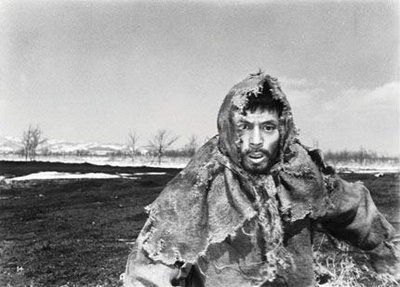
Why has it taken almost a decade for us in the States to see the third installment of Masaki Kobayashi's monumental The Human Condition? Of course, the vagaries of international distribution must be to blame--but the delay is also fitting: It seems that the film's hero, Kaji, has lived long--the actor Tatsuya Nakadai, still young, plays him with eyes old as a haunted house. Kaji has been purged of his Marxism and his sense of justice--all he has left is an instinct to survive--but more than that, in a movie titled A Soldier's Prayer: the hopeless desire to return home, to be with his wife--in the second film, when a nurse asks him if the woman in his photo is his sweetheart or his wife, he answers, "Both." He is deep in Manchuria, and tries to return to her on foot--but is captured and enslaved by the Soviets, who teach him a lesson about the universal will to enslave, and he becomes like the Chinese laborers he had reluctantly overseen in the first picture. His prayer is necessary, but soaked and spattered with despair.

When I'm stupid enough to think there is a "greatest film," I'm tempted to name Kobayashi's trilogy. It seems to have found the true shape of cinema: the human form, a human life--like Citizen Kane, it wants to examine every scrap of evidence. But The Human Condition refuses to dazzle us, as Welles' movie insists--and it disdains our own desires: for purpose and pattern, a kind of cinematic rhetoric that argues for one shape or another for this human form; no, it's a "condition," a chronic malady. And those who are chronically ill--or care for one who is--understand that it's not just low moans and bowed heads. There is a passion in illness that does not abate, the sufferer in love with the hope for a cure--or at least the occasional good day, marked by a satisfied sigh or comfortable grunt, the small things mingled with the chronic human condition marked by both enervating descent and glimmers of hope. Yes, the condition is fatal--but for God's sake, what isn't? Just ask all the short-timers in Vietnam, waiting out their last weeks--which stretch longer and longer, like painful, unnecessary treatments for a disease they've done nothing to deserve.

Wednesday

June 19, 1970 [Beyond the Valley of the Dolls]

Russ Meyer keeps abreast of things, topping the mound and swelling with pride every time he finds a young woman who stands out, and so on and so on. Meyer asks for it, and somehow so do I. He makes easy reads for eternal adolescents, churning out the lesser titles of the cinematic comic book stand--James Bond on the top shelf, bouncing boobs below.

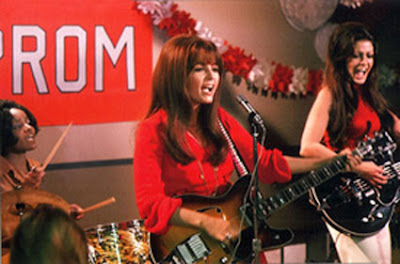
But then he goes Beyond the Valley of the Dolls, smacking Jacqueline Susann's missed-mash novel on the bottom as he scoots by, slapping together a movie freaked out by itself, amazed it's still standing--even when it falls flat on its own full behind, Edy Williams and her big broad face filling the screen like a happy shark, the rest of them swingin' and singin' in some invented L.A.--just like the real one, its own novelization, the stolen title the last thing packed into a haphazard suitcase for the ride west, out to the ocean and hermaphroditic high jinks.

It's not so much a movie as a can of novelty peanuts with a springing snake inside, just like half its characters--the other half topless and happy to see you--when they're not running in terror from their own fey psychedelia. I stopped counting after ten movies-in-one, certain Meyer and his cohorts were going to run out of film before they ran out of steam--and then the Epilogue, with a narrator straight out of a Quinn Martin production (I half-expected David Janssen to breeze in, searching and running), who rattles off the lessons learned as though he's making them up as he goes along, distracted by the memory of parabolic bosoms and random demises.

Every once in a while I figure I've seen the end of cinema. This isn't it--actually, it does a better job of ending the '60s, goosing those of us foolish enough to stick around to see how it turned out.

Friday

April 7, 1970 [Patton]

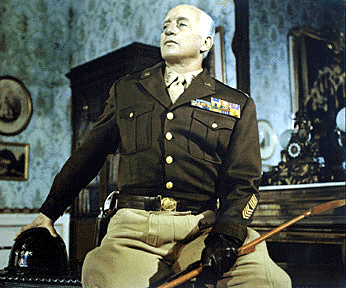
George C. Scott’s Patton fights everyone in World War II, allies as well as Axis. Reincarnated from every soldier who ever died properly, Patton juts out his bulldog chin, his silver helmet gleaming, his garish pistols at his side--a tall Napoleon stuck somewhere in the middle of the front, having to gripe his way to victory.

The movie jumps back thirty years to give us a War we can watch with diminished discomfort. But when Patton slaps that soldier, the audience takes sides. Patton was a ferocious man, and the War demanded ferocity. And even Ernie Pyle tacitly forgave Patton his excesses--because the war was on, and Pyle had his mind on countless other soldiers, preoccupied with the misery of it--and the dogged need to keep up unit morale.

But in 1970 our War doesn’t invite forgiveness. Maybe more than MASH, Patton indicts Vietnam by looking not down there in Pyle’s foxholes but up at the top, and seeing contradictions and vanity, cruel unconcern in the midst of unflagging zeal. It’s a snafu, and Patton almost becomes a hero--if only because there’s more eulogy than fanfare here, more a sense of gracious departure than emergence. Scott will not peek from beneath those brows to wink; he aids and abets his General’s ambiguous glory by keeping his eyes averted--after he stares us down at the beginning, the giant flag backing him up, the two of them instructing us. But I’m not sure what we learn; the movie lays a kind of mist--often literal--on the field, one campaign melting into another, until we are uncertain where we are, and what Patton means.

February 22, 1970 [Au hasard Balthazar]

I watched Au hasard Balthazar in a kind of stupor, found myself not blinking, my mouth open a little, my motionless hands falling asleep. It was as though I had been cursed--or was it some new ecstasy, the first numbing step away from my body and the need to pay attention to anything but what is necessary?

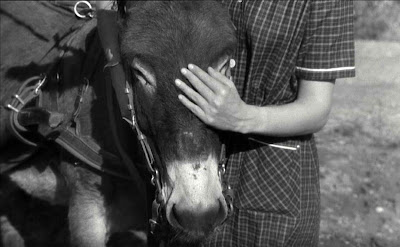
And what is necessary? Is it suffering? Balthazar the donkey suffers the whims of demons, punks and madmen--and the girl who grows with him, her love promised, her mercy unfulfilled. What else is there? Yearning? For what? To be left alone, to spend a day un-harried? Or to be loved, despite all other miseries? It’s almost a joke, this movie, punctuated by braying and close-ups of the animal’s eye—and Christ how I wished I could be looking into other eyes, Mr. Ed’s or Francis the Talking Mule. But no: Bresson reaches farther back, to Pinocchio and Pleasure Island, and Lampwick the bad little boy twisted like something out of Ovid, punished for next to nothing--his own whim is all, a boy’s indulgences, for God’s sake--and forced down on all fours to hee-haw like a damned thing, the shadows rising like the sound of his new voice.

And is that what set my tears to flowing at the end?--the movie done for a good ten seconds before suddenly I couldn’t stop myself, and I sat there like a kid, my hand over my mouth, my eyes closed, while the audience slipped away and I cried for--I know, I know: me, like poor Lampwick also now a donkey.

And is that all I was going to take away from this? Pity for poor poor me? I shook my head and opened my eyes and thought about the girl, grown up and hoping for love--but getting rough lips swiping at her mouth like a shove to send her backward into a gone childhood, an empty room that isn’t even hers anymore--but she has to live in it, forever.

And is that what Bresson wants me to have? A good look at the girl, and inside of that the donkey, and inside of that the rest of us? I was the last one out of the theater, and found the car and drove around for a while so I could go home and hold this stone in my hand, the one with my name on it, the one I coughed up in the theater, and put in my pocket so that both hands were free to type these letters, one after the other, with a period at the end