Monday

November 5, 1958 [Mon oncle]

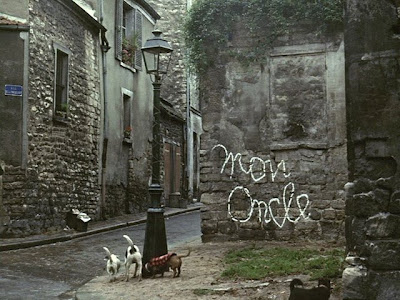
Jacques Tati's M. Hulot of Mon oncle stands in a slight breeze; he leans, his hat still firm--but his pipe a bit off-center in his mouth, while his umbrella stays tucked under his arm, safe from stray winds. He is in the street--and although it is Paris, he is safe, since the traffic is gone in his corner of the city, where the year is inexact but beautifully pale and streaked, an old photograph one can live in.

This is Hulot's Paris--lucky for him, a silent-movie character otherwise stuck in the Modern Age, a Paris of Tomorrow, all gadget and screech, bright and flat and cold, like poured concrete and plastic, life viewed from the comfort of an Eames chair--except without the comfort. And Hulot flees from this as quickly as he can, taking with him his young nephew, who can't wait to climb over the low crumbling wall with his oncle to get to the Old Paris, where scruffy bushes and ramshackle houses sit in soft dust, while the noisy neighbors argue without rancor.

There's a nice bit at chez Hulot: He swings open his window, hears a bird burst into song; swings the window in, notices the abrupt end of the twitter; opens it again, hears the song--and notices that his open window reflects the sun onto a bird in a cage. He leaves it open, so that the overjoyed little fellow can make his noise. It is, no doubt, Hulot himself, in a small world getting smaller--a cage he does not notice, except when he travels to his well-to-do suburbanite relatives, and sees with some concern that they, too, are trapped by their own excess.

But Hulot still has a little time left, a small corner where he can jaunt along, part owl, part stork--a bird himself. Tati has lovingly crafted a fantasy-memory, a Paris I'd live in right now, as long as it could hold the real world at bay, umbrella raised like a sword, pipe jutting in half-smiling defiance.

Friday

July 20, 1958 [I Bury the Living]

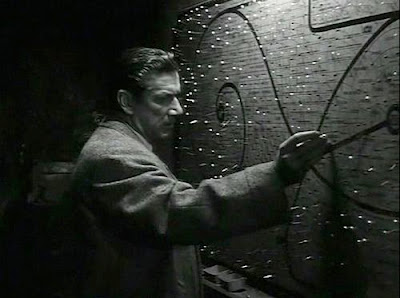
The big man at the center of I Bury the Living, Richard Boone, seemed at once familiar and out of place--I know I've seen him before--a Senator in The Robe?--no: Pilate himself--but I didn't quite buy it then, and still don't, not all the way, with his big frame and heavy features, more Raymond Burr than Monty Clift--or Victor Mature without a trace of vanity. In I Bury the Living he's a small-city department store executive--part of a group that takes turns managing the local cemetery--all of it odd, from Boone squeezed into a business suit to the giant map of the cemetery itself, dotted with little pins--white for the living owner, black when they die--and Boone starts to believe that, if he puts a black pin on the plot of someone still alive, they die--and he believes this because they do.

It's a story as contrived as the TV shows I know I've seen Boone in; but the director forces it to work, thick expressionistic layers laid on like bricks. And he does a solid job of it, keeping us in the dingy room at the cemetery where the map hangs, large and pulsing, almost alive, the pins gigantic in closeup, spread out on a Salvador Dali plain--while the room itself shrinks, fills with fog and smoke and shadow, as though the 1920s had never left the screen.

And Boone handles himself well, wrestling some real panic out of his bulk, a big man undone by, as he put it, a strange feeling he has carried with him all his life, that he is reliving things--or making them happen. The resolution is at first more Hardy Boys than Jung, but the sense of a ghost-world lingers, as Boone, his overcoat lost, wanders off, speaking softly: "I think I can find it myself."


What's going on here? Why all these pictures filled with Forces--psychic, supernatural, science-fictional--that compel otherwise sturdy folk to shamble around like zombies? Is the American Dream just that, the constant New Model and backyard bar-b-que innovation things in our sleep? I like my charcoal grill and Dodge, and I'm glad for the March of Dimes that led right up to Jonas Salk's door; but these movies--and isn't it funny that most of them blare away at the drive-in, where the kids play and the teens go exploring--whisper that we don't have what we've assumed is ours, and that some price will need to be paid just to keep us dreaming.

July 7, 1958 [Curse of the Demon]

Jacques Tourneur drags his drooping frame to England, foggy tendrils from Out of the Past trailing behind him--but this time it's not a melancholy gangster daring to look back at Something gaining on him--as Satchel Paige has warned us against--but a Man of Science, Dana Andrews sticking out his chin with confidence.

But this is Tourneur's picture, so there are no comforting straight lines, right angles--it's like the sudden wind storm at the frightened wizard's estate: a children's party scatters while the wizard in his clown-face smiles, brushing off empirical certainties like cake crumbs.

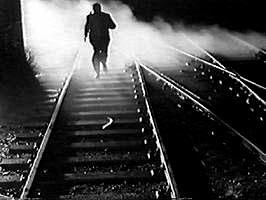
It was dismaying, the way that little scrap of paper with the spell fluttered at everyone's ankles, looking for purchase, hoping to crush someone and be passed along to start it all again. The wizard is nothing, Satan's stooge, as much a victim as his victims--in Tourner's world eliciting sudden sympathy as he scrambles along the cinders at the train station, the chiaroscuro of night and fiery demon almost pretty, like sunshine after a storm--but without the sunshine, just lightning after all, sharp as Occam's Razor, a simple curse handed along--and doubled back--without malice.

Tuesday

May 10, 1958 [Horror of Dracula]

Bela Lugosi slipped away a couple of years ago, the gossip columnists running their ghoul's fingernails over his dope-fiend corpse like the rotting hosts of a horror comic, clucking their tongues--but also cackling a little, kiddies, relishing the irony of the vampire impaled with a tiny needle.

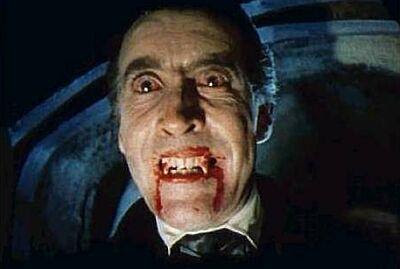
But they should've known better than to have assumed the Undead could die. Hammer studios in England has taken a cue from The Vault of Horror and all those other seducers of the innocent that have since arisen from their own graves as one cockeyed fiend, Mad magazine--still dangerous, still seducing children with Starchie and Mickey Rodent and Howdy Dooit--but in Horror of Dracula it's not Batboy but a Tale from the Crypt, the blood as bright as fresh tomato juice, trickling from the smiling mouth, Dracula no longer an oily charmer but wide-eyed and snarling, Christopher Lee speechless--but his mouth always open.

One constant remains: the women, all of them eager to bare their necks--but sexier than Lugosi's pale vamps, their bodices heaving with melodramatic heartiness as their souls drain down the thing's throat. There is some uncomfortable grudge being settled here, the tall man leaping on the women, clutching at them not with desire but in fury--while they rise to be taken.

The rules are bending in this musty Victorian corner of the horror film toward a predatory instinct--and annihilation, Dracula's end a drawn-out dust-to-dust extravagance of agony, the daylight like an H-bomb leaving only ash and a wind to blow it away.

Thursday

December 28, 1957 [Paths of Glory]

One of three hapless men marked for execution in Paths of Glory seemed ready to step out of character and speak to--no, harangue--the audience, or the other actors, or God himself, for trapping him in such a screwed-up situation. He plays a lunkhead, but with a simmering passion--no, that’s not right; I don’t know how to describe it. Stumbling exasperation? Conciliatory ignorance? Desperate exhaustion? It’s like some weird word-game: pick any adjective, any noun--just make sure you’re describing a state of being, not a person, not a thing--although the actor, Timothy Carey, certainly looks like a Thing, a real movie-monster. But that is incidental to the impression he leaves, which begins to elude me as soon as I stop trying to describe it--even as I try. I may be making more of this than it warrants, but I’ve never seen a performance quite like this.

Carey does a great service to Paths of Glory by concocting this poltergeist of a character. The picture itself can barely be endured, it breaks your heart so thoroughly. Not even Kirk Douglas can give it any strength: It will collapse into horror, no matter how deep the cleft in his chin, no matter how many times he adjusts his uniform or delivers reasonable speeches.

At the end--so beautiful, so sad--the director, Stanley Kubrick, will not let us leave. He takes us to the little café, and the German girl singing, and the men in tears before they go back to the front. This is a war picture like the Last Supper is a Passover meal. Both change the thing they begin so utterly that one cannot help but be changed in the act of taking it in. Oh, I know it’s just Carey at work here--and Kubrick, and Douglas, and Ralph Meeker trying to play tough, and Joe Turkel blinking like an unwise owl--and even Adolphe Menjou, still the most charming fellow in the room, smiling as he gives the devil his due--all of them mercilessly driving me to this spiritual excess, this needless, sorrowful ecstasy. All I can confess is that I needed such excess, after the credits rolled and I had to make my way home.

August 29, 1957 [A Man Escaped]

Somewhere in the middle of Moby-Dick Ishmael describes for us the daily business of a whaling ship. Afterward, I was convinced that, all things being equal, if I found myself at his side tomorrow, I could do my job, I could manage the steps required to turn a sea monster into lamp oil.

The same occurred while watching A Man Escaped, the meticulous examination of the urge to be free. From the first moments only that urge matters--the prisoner in the car, the closeup of his hand approaching the door handle, waiting for his chance, taking it--and immediately caught--but off-camera, the audience remaining in the car, the man's failure respectfully unobserved.

Because that was the last time he'd fail. In his cell--throughout the rest of the film always wearing the same blood-stained shirt that marked his first attempt at escape--the man bears down on the logistics of freedom with a calm French melancholy, an existential acceptance of two things: (1) his hopeless imprisonment and (2) his desire to escape. That is the film's universe, the rest of us outside the wall incidental, far from his mid-War dilemma, Paris a step away but completely invisible, the prison itself like the sea in Stephen Crane's "The Open Boat," simply there, a blank, indifferent menace.

But it is not mere mood: It is instruction in fashioning a reinforced rope, a small sharp tool, a jigsaw-puzzle door one can dismantle--and reassemble--in seconds. And the only impediment is other human beings--they're unpredictable, their allegiances difficult to ascertain--while the prison is almost an ally in its solid, honest intention. The man uses this to his advantage, as he creeps step by careful step toward the moment when he can trust at least one other and be a man escaped.