Friday

October 17, 1953 [The Big Heat]


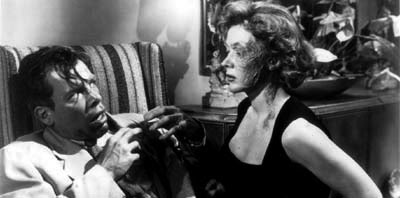
In The Big Heat, Fritz Lang draws such a thin line between “civilization” and “savagery” that I begin to feel hoodwinked as I strain to keep it clear--and why should I? Glenn Ford’s Det. Bannion does not hesitate to step forward and rub out that line, his shoe marked with it, his voice as level as his little cleft chin thrust in the hood’s face like hot coffee, his mouth curled in a Creature’s grin--because everything he needs is gone, and all he has left is the cold comfort of something that looks like justice.

And just to make sure we get it, there’s Gloria Grahame, still alive but on the brink.  I must confess I’ve been in love with her since It’s a Wonderful Life, her own chin sticking out, her mouth also curled--but like a little bow--the kind that shoots arrows.  In The Big Heat she is more than a damsel in distress--I don’t know if Grahame could ever allow herself to be merely so--she gets close, yes, but her voice, as much as it almost whines, never surrenders her to idle tears.  She becomes our surrogate--not Ford, who doesn’t need us, whom we must watch at a distance; get too close and he might take a swing at you.

And then the strange ending, as though God flips a switch and Ford becomes human again, the workaday cop keeping his paperwork in order.  Lang wants us to walk with Bannion right into the den of thieves, with one big lug--played by someone named Lee Marvin as though he had no bones, loose and lank, his rubber-mask face swinging around the camera’s frame--reminding us what it looks like to be unrepentant.  I’m not sure if Lang is warning us or simply observing; as George Orwell writes somewhere or other--describing some atrocious attitude only a tyrant’s minion could manage--“I am not commenting, merely pointing to a fact.”  Either way, though, it looks like we’re all alone, while the worst stick together--which comes in handy only when the good guy lobs a grenade.

Thursday

May 1, 1953 [The Hitch-Hiker]

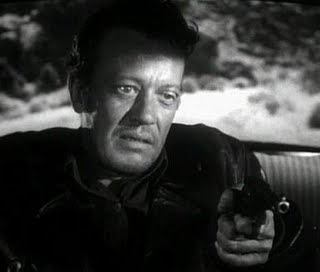
The last time I saw Edmond O'Brien, he was already dead--in D.O.A., hopped up on atomic poison, running through the city, looking for his last answers.  In The Hitch-Hiker, though, he's waiting, biding his time, the tell-tale eye of the hitch-hiker always open, even asleep--despite its "hideous veil"--compelling him to look back all night long.

Ida Lupino directs without sentimentality: the Mexican wastes look like Greed's Death Valley, while the Mexicans themselves peer at the three Americans--two married men gone fishin', one mad-dog killer--and decide either they're not worth troubling over, or trouble enough--and the hitch-hiker murders quite a few kind souls before meeting our heroes--and those deaths, despite the horror-movie grind of brass and tympani, occur so casually we begin to see them as the killer does: easy pickings.

--Oh, and "heroes" may be too strong a word: The finale at the dock is played out in cool silence, the policia timing their move efficiently, no need for sudden lunges and amateur rescues--and, although our two gringos are veterans, and one assumes have learned how to handle themselves, they are no match for the post-War villain, with a code as unforgiving as a hungry bug, terrified in the end that he can't do anything right.  No, cooler heads--like Lupino's--must prevail, and so it is almost an anti-climax, with no room for sloppy work.

Friday

April 25, 1953 [Invaders from Mars]

Yes, Invaders from Mars sidesteps itself with an it-was-all-a-dream finale—but William Cameron Menzies really does make his picture move like a dream, like so many of the low-budget saucer-movies of the last few years—but Menzies knows that kids are the ones most likely to see this—in fact, I was surrounded by little ones; and while they rustled around as they always do, I think they were drawn in because the plucky hero is a boy: They were loudly appreciative, screaming at the Martians and their Mutants, all sickly green and dull gold.

And maybe it was me who grew quiet inside, but the din of my fellow moviegoers seemed to fade during the scenes when the boy finds himself surrounded by possessed parents, police, neighbors, the certainty of their authority and protection, their love and aid, literally slapped down in the service of underground invaders. I wondered how those moments would sink into the children’s heads, the knowledge that they cannot depend on those dependable figures, that the lessons of civics class and Sunday school can so easily be dismantled, replaced by stalking fiends, false smiles tacked on without conviction.

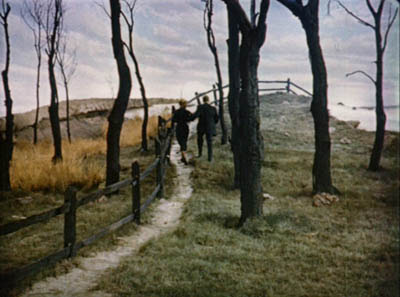
And while so many of the interiors—the police station, the observatory—seemed unfinished, as rooms are in a dream, it all came down to the landing site, the fence at the edge of the hill, the sand pit into which the Martians—and worse: anyone who wandered too closely—sunk, the ground swallowing them, leaving no trace. The landscape is beautiful: the hill rises, the fence stands against the sky. But climb that hill, stand too close, and the diseased green light will get you, and you’ll emerge marked and determined, ruthless in your efforts to conquer. It’s an invasion, all right, and the monsters are all grown up—and all the roaring ordinance we can throw at them can’t erase the thought of Dad hating you, knocking you to the ground, dragging you off to the same place that turned him into a thing.

December 10, 1952 [Forbidden Games]

We have a number of loved ones out back, tucked away under a rock, wedged between the stretching roots of the big pine, straight along the edge of the shed: dog, cat, and bird--and maybe a fish or two, and I think a small jar of lightning bugs, motionless one morning on the nightstand, little yellow mortal coils noiselessly shuffled off--the pet cemetery unmarked and sometimes forgotten--but out there all the same.

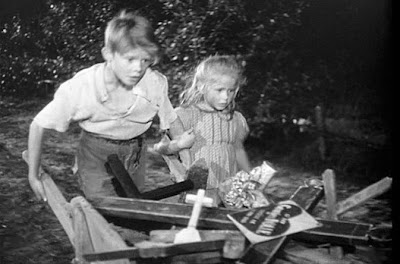
But Michel and Paulette in René Clément's Forbidden Games know that graves must be marked--and more: that the markers fade, and the names are forgotten--but it doesn't matter: Her parents and her dog have been gunned down by the Germans, and the old owl at the abandoned mill blinks slowly--each little turn of its head a metronome ticking off the last little heartbeats of every chick and mole they bury, breaking hard French ground, their prayers like slurred little songs.

Could we ask for a better funeral for all of them, Mama and Papa, and the brother trampled by the horse-cart, and their own hearts, broken and tossed like crosses into the mill's corners, while Paulette hears someone call "Michel!" and she runs into a crowd that looks like nothing else but Kane's crated Xanadu, a maze of useless figures, the little girl weaving like a sled down a wooded hill, her cries swallowed up by plaintive song and the tears of all those abandoned children.

I'm going out tomorrow, as cold as it is, and look for our Patty's grave, the little black dog with a white star on her chest who once managed to pull my son on a sled--as small as she was, but full of joy at the chance to run in light snow with her adopted brother at her back, laughing.

Wednesday

October 9, 1952 [The Flowers of St. Francis]

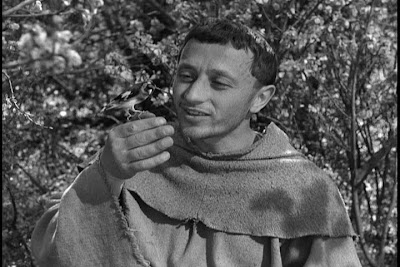
The prologue to The Flowers of St. Francis informs us of the history of the Franciscans, a tale of emerging hope and love--the narrator's voice calm, as though he were describing good weather--but on the screen the images were all Hell: agonized naked figures with creatures rummaging around in their innards, the wrinkled monkey faces of devils glaring at us--how dare we interrupt their busy day?--the Last Judgment in cracked Medieval brushstrokes, thankfully dimming, but still there.

So imagine my surprise at the movie itself: ten little backyard skits, the monks scampering around the fields, their bare feet fearless on thistles and rocks, or standing in the pouring rain like pacific cows, or huddled in their hand-made huts, flimsy as a child's puppet-show cardboard-box theater. And their faces--these actual Franciscans, happy to play-act the first of their kind, little half-smiles on their faces, as though they had a little secret they were about to tell any minute, to give it all away.

Most of the picture felt like a holy silent comedy, pratfalls and mishaps Ad maiorem Dei gloriam, the little numbskulls in on the joke--the Italian title is Francis, God's Jester--and they are in the end more than clowns, but true royal fools, the only ones allowed to sit at the feet of the King and tell Him the truth, with a grin.

And what is this truth? Two "little flowers" from the movie will suffice:

Francis lies on his face, happy to think of the Cross in the twilight--and hears a leper approach, ringing his warning bell--so sad and beautiful, a literal upside-down echo of the little arch of bells they had been given earlier, which they carried in jingling glee across the field to their altar, running their hands over the bells to make a little music and call them to satisfying prayer. But now, for a moment, Francis hesitates, then slowly approaches the leper, placing his hands on him, softly embracing him, then letting him go. The leper looks back briefly, then continues, neither of them speaking. And Francis makes one of two gestures with his hands that he repeats often.

The first is a gentle version of Edgar Kennedy's old face-wipe, exasperated at the recalcitrant world, busting his derby and thwarting his plans. But when Francis does it, his hand moves gently down his face, and he shakes his head a little in indulgence, and instead of Kennedy's bug-eyed rage his lowering hand reveals a small smile.

But the second gesture, the one he makes as the leper disappears, is profound: both hands cover his face, the fingers pointing up--the nuns told us children to keep our fingers up when we prayed, so that the angels perched on their tips would not fall--his head bowing a little. In these moments he knows it's more than a hilly-field camp-out, that the joy he feels in suffering must be paid for, and that he cannot suffer for everyone. This is the joy: the humility to do whatever is needed, to love like a gift, not a transaction.

And one more: Brother Ginepro at last allowed to go out and preach--but Francis commands him to first say, "I talk much, but accomplish little." And Ginepro comes upon the camp of the marauding barbarians, and he stands near roaring waters, and speaks as he was commanded--but we can't hear him, the waters scolding him--no, urging him, to approach the savages, and let them pummel him and pretzel-twist him and toss him like a ball and swing him like a human jump-rope--I kid you not--that same Franciscan half-smile on his face, glad to be of service.

OK, one last little flower: As they leave forever, the town showers them with gifts--which they give to others, their staffs and sandals included, free at last, barefoot and spinning like dizzy children at a crossroads, eager to have the best conversations they can imagine: not a word about themselves, what a relief.

Rossellini--writing once more with Federico Fellini--has found a way to express devotion without solemnity--because he keeps everything simple, like Francis' prayer. No one seems to be taking to this haphazard little movie--and I can feel Francis looking at me, warning me with his kind eyes not to puff up too much because I stand alone in admiration--so I will defer to him, and shrug--the quintessential Italian gesture--and maybe spin around a little, some day.