Tuesday

May 7, 1952 [The Narrow Margin]

Charles McGraw’s cop in The Narrow Margin walks around like he’s at home--except something’s always ready to turn on him. His voice sounds like his name--or vice versa--and I could listen to him all night long growl at everybody--because nobody gets it, he has to handle everything himself, and you’d growl, too, if you had to take it like he does.

He has to protect the witness, get her from Chicago to L.A.--and along the way proves that this is one of the best-named movies in the history of cinema, a knowing title, nodding to the train tracks themselves, the passageways and sleepers--and the escapes: all narrow, almost too cramped to let the camera in: There’s a desperate brawl that threatens to poke the audience in the eye, we have to get so close, the lens a fist, the two men grunting in silence--while the train clacks along, the only sound--no music this time around, just the train, with us jostling our way, flinching at the close calls and final payoffs--and the usual double-crosses, the cop getting the business even from other cops. Richard Fleisher directs with the kind of genius the movies sometimes rewards: a visual imagination, a cool boldness that doesn’t permit him to think he can’t pull it off--because he does, and not narrowly.

Monday

April 14, 1952 [Singin’ in the Rain]

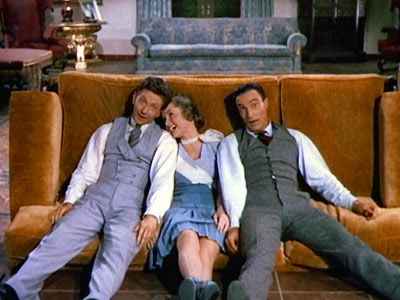
The more I think about Singin’ in the Rain, the more I realize that such a garishly exuberant--sometimes even jarring--development in the look and sound of the movie musical is less a response to audience appetite than a reflection of cinema's strongest inclination: toward "that which is unconscious," the dream-state of the expressionists and the surrealists/Dadaists. Technicolor is the Pleasure Principle’s revenge on the crime movie’s insistence that life is but a dream--about falling. The dancing bananas and toothy grins of Busby Berkeley have given way to the aggressive athleticism of Gene Kelly--which seems to capture the giddy assertions of the ego, just as something like Force of Evil charts the fear-frozen withdrawal of the superego. (Good old Freud; as an analyst, he can get on your nerves, so to speak--but as a movie critic he’s a pip.)

So how do we go from the mad lunge-and-lurch of the 1920s avant-garde to Gene Kelly and Donald O'Connor insisting that they gotta dance and be a clown? Simple: Watch Kelly's nonlinear approach to a dance number, as he shifts unexpectedly from tap to ballet to flat-footed clowning. And even more so, the frenzy of O'Connor's entire persona, literally from tip to toe an unchecked pastiche of every involuntary tic and reflexive jerk, tumbled together like Goofy on a basketball court. When Dali and Bunuel assembled Un Chien Andalou, they agreed that no individual scene should have a logical connection to its predecessor, nor serve as a transition to the next. And although Singin' in the Rain’s storyline sticks to boy meets/loses/gets girl, its insistence that it be a movie about making movies—they end up starring in a movie called Singin' in the Rain--makes the picture turn inward, until it finds the dream-state, fulfilling wishes with chaos, to be sure, but of a flamboyant variety, pop-eyed and self-conscious, aspiring to glory.

Kelly, O'Connor and Debbie Reynolds--and the silent, stupendous gams of Cyd Charisse--throwing the furniture around and bathed in Techni-reds, greens, blues fueled by the hardest-working feet in show business--serve as reminders of Technicolor's doorway to a frisky primal world, one whose atemporal shrugs shift its pastel sensibilities any which time it pleases—I’m thinking of The Adventures of Robin Hood back in 1938--talk about your time-defying hues, staves twirling like high-stepping batons, medieval Tarzan-swings--in a propelling arc toward the suspension of disbelief--the graceful but impossible flow of Cyd Charisse's scarf--and oh, I suddenly remember those tinted frames, so long ago, of Annabelle's Serpentine Dances--big-budget sunny-smile versions of Ezra Pound’s “accelerated grimace.”

February 3, 1952 [The Small Back Room]

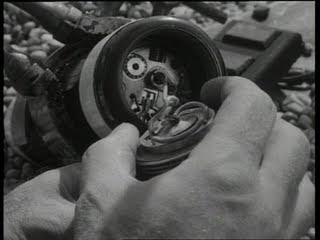
"The Archers" reach back to the War and find it in The Small Back Room--where David Farrar and Kathleen Byron--Sammy and Susan--dare the whiskey bottle to stay in his hand, the unexploded bomb easy to pick up and ruin them all. Sammy has a puzzle--trapped not only by the booze but the bureaucracy of the War, the back-room research gummed up by fools and interested parties. But out there in the open, on the slippery shingle, the sea at his feet, the gulls above, Sammy's hands steady themselves as he tries to defuse the situation.

Michael Powell and his colleagues know that black and white photography can reach deeply into the dreams we don't remember and slip them into the parlor, almost silently--but also nightmares, the bottle rising like one of those standing stones on Salisbury Plain, where the faulty gun tries its best, the ancient stones benches for chilly English hindquarters hoping something will come along to keep them from heil-ing right in der Führer's face. And it's Sammy and Susan to the rescue--sick of each other, almost, and fighting their own War long enough to surrender, reconcile, and stare back at that bottle. I didn't think the War could be told as a love story--it was too scattered and panicked--but here it is, with just one explosion averted--but that's enough to keep them going, standing up from the small sofa or little declension on the beach, just like Churchill said they would.

Tuesday

November 10, 1951 [Detective Story]

Kirk Douglas in Detective Story is all agonized twists and cramps--mixed with slanting satires of ease, his legs stretched like his grin, almost lanky and lithe--if he weren't so tightly wound. At times he even wears reading glasses, encasing his face in a weird grimace--or something like that; I’m not sure: he is mesmerizing and bizarre, confounding my best efforts to hold him still. His performance veers from coherence to incoherence to give his cop humor and fearful resolve, strength and little-boy-lost panic--and above all bitter madness as he makes his way through a dark day at his precinct house--alarming us with the spectacle of his fury, guilt, and disintegration, his iron-fast moral code swallowing whole his job, his marriage--and his life.

It is terrifying, but I have a rueful affection for this movie, for Douglas’ detective as its tight-fisted heart, and for its supporting cast--especially William Bendix as Douglas' counterpoint and conscience (a million years away from his brutal henchman in The Glass Key, in love with Alan Ladd but devoted to the rough stuff, sweetheart), and Joseph Wiseman in a surreal, unhinged performance--almost in a matchup duel with Douglas--and most of all for its finale: The fatally wounded Douglas, who has walked into Wiseman's four-time-loser hail of gunfire, grinds out half of an Act of Contrition before dying--so that Bendix can finish it for him.

That last scene stands for every lasting virtue of Douglas’ career so far: suave in Out of the Past and tightly clenched in Champion, and bound and determined in Young Man with a Horn and flaying at greed just a few months ago in Ace in the Hole--but I think Detective Story is the moment when he does not blink, and hits dead center.

September 30, 1951 [The Day the Earth Stood Still, The Thing from Another World, The Man from Planet X]


I was relieved by Murray Leinster’s story, “First Contact”: Way out there by the Crab Nebula, we and the aliens figure out how to get home without bothering--let alone blowing up--each other.

The movies know better. The Day the Earth Stood Still does not trust us--after all, the nicest non-imperialist nation on Earth, us, had the ultimate weapon and let loose as soon as possible. And we seem unsure of our niceness, and how far it will get us, opting instead to frown and mistrust, to mistake “American” for “absolutely correct,” and to make damn sure that if you don’t believe that you must be a Red. Our options are narrowing.

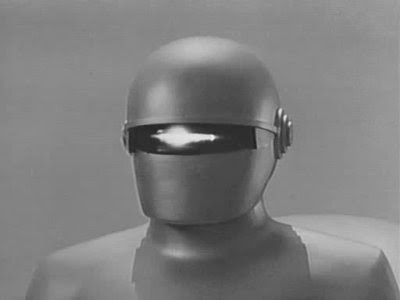
Again: The Day the Earth Stood Still knows this, offers us a nice guy, a calm guy, Klaatu--and he and his friends have looked in on us and decided we can’t be trusted. And there stands Gort, the impassive robot--calm, too, calm as a ticking bomb--it’s everybody else who’s nervous--and they’d better be: One false move and its blooey! and our first contact becomes our last. Earlier this year when I went to see The Thing from Another World, that giant carrot, like a lumpy Gort, bore down on us as well. It stood there, framed by the door, the unwelcome guest--like the vampire who can't enter unless we invite him in. And we were just children, clumsy and stupid--not dangerous, not the monster. At the end we were told to keep watching the skies--but after the Earth stands still, we know we have to watch each other--because Gort is watching too, and his eye cuts deeply.

The Man from Planet X can serve as a melancholy coda for this scientifictive apocalypse. Edgar Ulmer, the low-rent Michelangelo who gave us The Black Cat, Strange Illusion and Detour, takes us to the Scottish moors--presented in miniature, both charming and unsettling--to confront the unknown: the man from out of space whose gigantic, chalk-drawn face, lit from inside his space helmet, manages to evoke both Halloween and the Mexican Day of the Dead, at once a spook-show and memorial. Yes, the Man from Planet X is invading--but it's because his own world is dying, and his friendly overtures were met with greed-driven brutality. He turns the locals into zombies, digging away at his trapped ship, while the military prepare to blast him--which they do, like a Méliès magic trick, in the wink of an eye and a cloud of smoke. And while the characters spend too much time announcing themselves and their actions, they get out of the way every once in a while so that Ulmer's camera can move across the little fog-swept sets he's made, his gaze drifting slowly, almost lovingly, as we foolish Earthlings make yet another bad decision.

June 20, 1951 [Ace in the Hole]

I haven’t thought of Floyd Collins, lying there in his glass-topped coffin in Crystal Cave, for many years. We all went down there once, driving to Kentucky, and stood in the cool hush before Floyd, the accidental mummy. Ace in the Hole digs him up so that Billy Wilder and Kirk Douglas can scold us for looking.

The theater was almost empty; I guess nobody wants to go to the movies to be chastised--well, more than that: hated and scorned, rubes that we are, gawking from our cars while the earth squeezes the life out of somebody. I thought the picture was fun, though: Douglas is a wonderful heel, his face constantly squeezed in bitter recognition, his hands curled beneath the weight of his ambition. And it’s a great picture to look at, dry and open, the sky watching too, without blinking.

The movies want to keep us happy, so it’s no wonder that something like Ace in the Hole is failing. But I watched it, and thought of von Stroheim and Tourneur, and Griffith and even Edison at times, thrusting the mirror in our faces, like Diogenes with his lamp, searching doggedly but vainly for one human being.

January 25, 1951 ["Gerald McBoing Boing"]

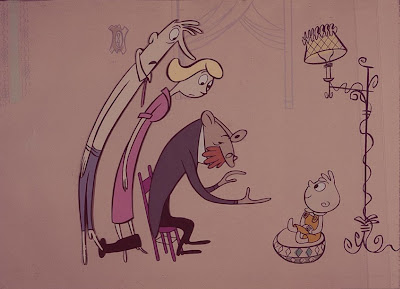
The “Gerald McBoing Boing” cartoon is New Modern, all see-through swirls and question-mark backbones, the perspective at once flat and cheerful, like a jazz record cover--for a strange little fable, the moral of which seems to be, "Every blessing begins as a curse"--and that is reassuring, as we knock ourselves against the communists, boinging whatever sense we may have--panicking. I hope the cartoon is right: If we hang on, someone will turn this dross into gold—but I wouldn’t be surprised if we didn’t slip up, somewhere around the 38th parallel.

Monday

August 14, 1950 [Sunset Blvd.]

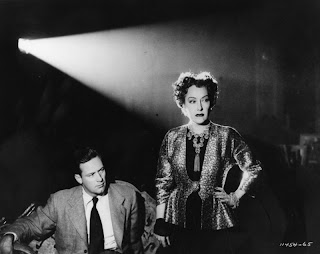
The mansion of the silent-era star, Norma Desmond, is all Gothic--with a monkey in a coffin, an automobile like an filigreed block of lead, spreading ferns and rotted lace--and ghosts--one in particular: William Holden’s Joe Gillis the screenwriter, his humor dry as old bones, his face wet in the pool, our humble, drowned narrator. But Desmond is also a ghost--Gloria Swanson the bravest actor of all time widening her eyes and chittering like an old scorpion--and so is her chauffeur--and believe it or not it’s Erich von Stroheim, still packed into a uniform, a blood-sausage with a cynic’s monocle’d grin.

The director, Billy Wilder, seems to enjoy his work--reminded me of Double Indemnity, the unhesitating gesture that pushes his hungry little heroes to their deaths. But in Sunset Blvd. he knocks off most of Hollywood, barely missing Buster Keaton as he plays cards among the ruins of a world so harrowing Cecil B. DeMille looks like a creampuff. As Joe walks us through the Hollywood horrors, hating himself as much as every bum who ever touched one word of his scripts, I kept hearing beams groan, like the crumbling movie-set in Nathanael West’s The Day of the Locust--but the sound grew more and more high-pitched, until Norma stood up there on the stairs, cute as Dracula--and again I thought of West’s novel, Tod attending the apocalyptic première at the end:

He was carried through the exit to the back street and lifted into a police car. The siren began to scream and at first he thought he was making the noise himself. He felt his lips with his hands. They were clamped tight. He knew then it was the siren. For some reason it made him laugh and he began to imitate the siren as loudly as he could.

Around him are “those wonderful people out there in the dark,” as Desmond calls them--and it sounds almost like a threat, her mouth open as though it, too, wants to scream, the light unforgiving on her voodoo-doll’s face. Wilder has it in for Hollywood, all right--and his vengeance is so brutal and mortifying that I want to stay home from now on, no more movies for me--except maybe Sunset Blvd., just one more time.

May 19, 1950 [The Third Man, Quicksand, House by the River, In a Lonely Place]

Not since the early 1930s has so much crime been committed on screen. But it's driven by more than sheer greed--or even egotism, the little tenement Caesars making it as big as the legit crooks sitting on top of them. No, some kind of Narcissism is at work here, coupled with post-war shrewdness--everything political now, even the heist, the sudden murder--and something else: not self-love, but self-loathing, the mad love collapsing on itself.

In The Third Man, director Carol Reed won't let the world right itself: virtually every frame is tilted, the characters standing on a slippery slope, Valli as Harry's girl patient with Joseph Cotten's Holly Martins, calling him "Harry" every once in a while, just to keep the ball rolling down that Viennese hill, the streets and sewers curving toward one another, changing places. Harry has no conscience, and Orson Welles plays him so easily I get nervous that it's all real--and of course it is, Grahame Green's screenplay notwithstanding--so ironic, so ready to let us see him winking at us--with that zither playing throughout, cheerfully hysterical--but also beautiful, like the wet streets Holly wanders through--and up to the top of the Ferris wheel, looking down at Harry's moving dots--that's us, at his service.

Quicksand is also pretty slippery, dragging down Mickey Rooney--grown up now, but not turning into Jimmy Cagney--just getting in deeper, so far down he runs into Peter Lorre, the penny arcade dim in the shadows, the two little men playing smiling tug-of-war with the handkerchief that could hang Rooney's grease monkey--and I think that scene was improvised, Rooney and Lorre almost smiling at each other as they decide to be crooks. And while there's some kind of bottom to the pit, Rooney can't do much by himself, his sure footing of little use, his glad-hand and grin failing him in the dark.

As I watched House by the River, I kept noting how professional it was, put together like a fine watch, the strange story of a turn-of-the-century madman--well, mad for himself, his pleasures: His maid takes a bath, he stands outside, hears the water gurgle down the drain, smiles as though he's there with her, soap on his hands. And the river itself, like the Thames in Great Expectations, a black snake that tempts--but saves, in a way, the place where everything comes back. And it is a haunted movie, curtains swirling like the hair of a drowned woman. I hadn't caught the director's name in the credits, and hurried to the poster outside: Fritz Lang, who has known for decades about insanity as the loss of morality, the inhumanity that marks us so often as human.

--Oh, and Bogart goes insane too, In a Lonely Place, where Hollywood snarls at itself--relieving us of those duties so we can watch Bogart's screenwriter give in to rages, frightening Gloria Grahame so deeply she cannot stay--and there's insanity for you: driving away Grahame, with whom I am in love--my wife forgives me, understands I cannot resist a small chin and a clever brain, so smart; you can see it in her eyes, looking through you, keeping her own counsel--but devoted to a dangerous man, whose own eyes are drawn down so far in sadness he can't see straight, and falls down into a well he'd dug himself--

--or did he? The crime film ends here, in a place that once more feels like Caligari's cabinet, off-center and ruled by compulsions, a dream-within-a-dream, everything going out like candles when any one of them wakes.

Wednesday

January 30, 1950 [Gun Crazy]

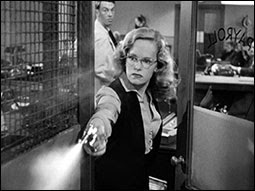
The Bonnie-and-Clyde couple in Gun Crazy are crazy all right, but “guns” certainly are mere stand-ins for what they’re really crazy about: each other. How close can Hollywood get to sex itself? Only to the nickel-plated tip of a firmly held pistol. But that is enough in this movie: John Dall, the scrawny kid with the restless mouth, widens his eyes and licks his lips, always moving toward Peggy Cummins’ Annie Laurie Starr, full of sweet-eyed smiles and ripe promise, playing at something a little to the left of Veronica Lake--and soaked in mad love, the vamp who in the end doesn’t want It All, just her boyfriend, their steady hands grasping, sure-shots all the way.

Funny thing: I didn’t realize at first that I was watching John Dall, the best friend without a conscience from Rope. He seemed so lost as Bart, Young Man with a Gun--his childhood played out in an efficient first act, the dead-eye who can’t kill, whose hands curl in terror at the thought of it--but those hands also obsessively clench the gun, his youth shaped along the length of the firearms he covets. When he isn’t taking aim, Bart is never sure where to look, his uncertainty relieved only when he sees Annie--and with all the force of distracted youth he grabs her, again and again, happy to take the big death just as long as they have their little deaths, on the run, in the fleabag hotels--and most dreamlike of all, in the high-altitude marsh, shrouded in mist, the light rising just enough for them to crawl in the mud and embrace one more time.

Earlier, when they rob a bank--a scene offered as a generous gift of genius by the director, one Joseph Lewis, the camera in the back seat of the getaway car, everything happening elsewhere, the tension great--but the two of them like any old married couple, wondering about parking spaces, traffic--“Watch out for that rock,” Bart warns Annie--the loot in their hands, the law fading behind them; it’s here that I can see their end as they stand on it and take off, heedless of the best way home--which for Bart is back to his childhood, up there in the mountains where he can’t kill a thing, so he has to be killed, a kind of instruction he has been waiting for all his life--and Laurie, too, giving up all those fine things she kept saying she wanted, in it for the dough--but staying for Bart, grimy and doomed, but oh so much in love.

December 14, 1949 [Ladri di biciclette/The Bicycle Thief]

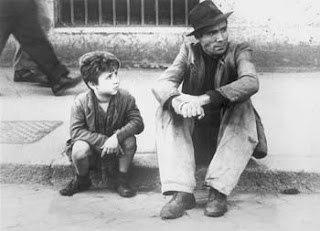
We went to see The Bicycle Thief. For my wife, the center of the movie is the scene in which the father, Antonio, in his anxiety and desperation, strikes his son Bruno. They have been scouring all of Rome--the movie is a bittersweet travelogue of that city, grey and stained, battered by the war--and so a small thing is enough to make the father--a kind, soft-spoken man--briefly turn tyrant. The little boy cries, recriminates, keeps his distance from the immediately regretful Antonio. They walk along, the father both half-heartedly defending himself and attempting to reconcile with Bruno--who informs him, "I'm telling Mama." It is sad and sweet, the two of them maintaining their dignity--and finding a way back to each other, swallowing pride because they love each other, and have only that.

For me, it's the two of them trying to forget the loss of the bicycle--the only thing keeping them from abject poverty--and eating mozzarella on bread in the restaurant, a big bottle of wine to share. Bruno keeps glancing at his well-to-do counterpart, another little boy tucking it in, his own cheese-topped bread eaten daintily--while Bruno's string of mozzarella refuses to part from the hand-held bread as he gobbles it, a little self-conscious. His father has Bruno do the math, figure out how much money they would have made if the bicycle had not been stolen, and for a moment they have the money, there in the restaurant--for that brief space no longer in terrible trouble--and a million miles away from all bicycle thieves.

A famous family story: My father's employer lied to the bank about my father's income--hiking it just enough for us to buy the house I grew up in. And they hung on to that home desperately--always in debt, always on the verge--both my parents working, my father taking me with him sometimes just so we could be together. So what else can I do but call Vittorio De Sica's Ladri di biciclette the greatest film ever made, as it tells me of the constant need for love and pity, at the end the father and son in defeat but holding hands, going home together.

November 19, 1949 [Adam's Rib]

Not since Chaplin ate his shoe in The Gold Rush has the inedible looked so satisfying: Spencer Tracy eats his pistol in Adam's Rib--and that is no euphemism: It's a licorice gun, brandished in false jealous rage, Katharine Hepburn scared half to death--personal lives mirroring their professions: married lawyers on opposite sides of an attempted murder case--and no need to cherchez any femmes--she's right there, Judy Holliday as Hepburn's client, the uncaring husband the victim; and so Tracy is understandably disconcerted--enough to get even any way he can, even if it involves candy.

There's a Thurber cartoon: Husband and wife in bedroom, husband sound asleep, pleasant smile on his face, sitting up, pointing his finger at his startled wife and saying those simple little words, "Bang! Bang! Bang!" Adam's Rib tells us (a) not to to be so surprised and (b) tit for tat. And while Hepburn's Amanda turns the courtroom into a literal circus, I'm not sure Tracy's Adam understands her--oh, he knows how to cry on cue, turning tables and so on. But there is something smug in Adam's certainty--and something heroic in Amanda's desperate maneuvers in the face of licorice gunplay.

October 26, 1949 [She Wore a Yellow Ribbon]

John Ford dusts John Wayne's temples with gray: Capt. Brittles, a few days away from retirement in the Centennial year of 1876, a Cavalry soldier on a last, failed patrol.

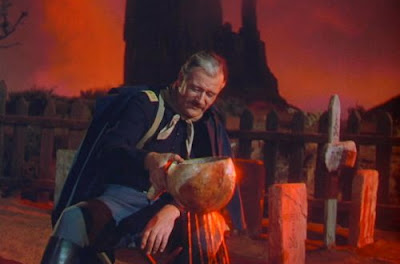
She Wore a Yellow Ribbon is a eulogy of sorts--for the Western, for the last man standing--and how long can he stand?--for the old hard rules that Brittles (a name straight out of Dickens, both emblematic and ironic) lived by. He keeps saying, "Don't apologize; it's a sign of weakness"; but his successor apologizes to his girl. And when Brittles is given a watch, it is engraved "lest we forget"--and I will not worry too much that the phrase comes from Kipling some twenty years later, because Ford's beautiful movie, the most painterly Technicolor movie I've seen, works as a Recessional, asking us to draw away from the noise of the world--even the brutal facts of the Cavalry's presence--fighting a war against the country's original inhabitants, spreading corruption and hatred--even this somehow fades: Brittles smokes the peace pipe, fails to keep younger men from--well, being like him and his, united against an enemy--and devises a plan to scatter the Natives' horses, avoiding war. We do not even get the obligatory savage battle. It's all aftermath.

Still, Brittles retires--but becomes chief of scouts, the Boy's Adventure continuing. I'm not sure, though, that the Ford Western will ever be as much fun again--like the bit with Victor McLaglen--the perennial Oi-rishman--hornswoggled by Brittles into civilian clothes and amiably violent drunkenness, just so he can make his way toward his own impending retirement in the relative calm of the stockade. As much as the scene makes us laugh--and as much as I admired Wayne's performance--sitting on his horse, bespectacled and teary-eyed, reading his pocketwatch--or better yet, at his wife's grave, talking quietly with shy affection, watering the flowers he's planted--despite all this, She Wore a Yellow Ribbon is more a film about recollection than experience: The latter is for younger men, who act, it seems, only so that they too can stock up memories.