Monday

March 23, 1921 [Das Cabinet des Dr. Caligari/The Cabinet of Dr. Caligari]

At last: Robert Wiene’s The Cabinet of Dr. Caligari opens, as it were, in the United States. Self-consciously “expressionistic”--and I was going to apply some clever negatives here; but seeing those two ideas next to one another--self-consciousness and expressionism—dissuades me from insulting this movie. For without the Nietzschean ecstasy, the Apollonian cry of intoxicated disintegration, self-consciousness is a merely tactile thing, fit only for guiding the hand along life’s surfaces without recognizing the grimacing eruptions that mark expressionism’s sharp-edged, shadowed progress from deep inside to the world we suddenly make. And so, despite all its eyeball-rolling, stilted silliness, Wiene’s picture struck me deeply.

And it isn’t simply Corad Veidt’s Cesare, the inkwell somnambulist (although he is a spidery marvel, a crippled dancer doomed to keep moving), nor Werner Krauss’ Caligari (despite the cracked-saucer glare of his eyes, his full-to-bursting features, like a glutted tick).

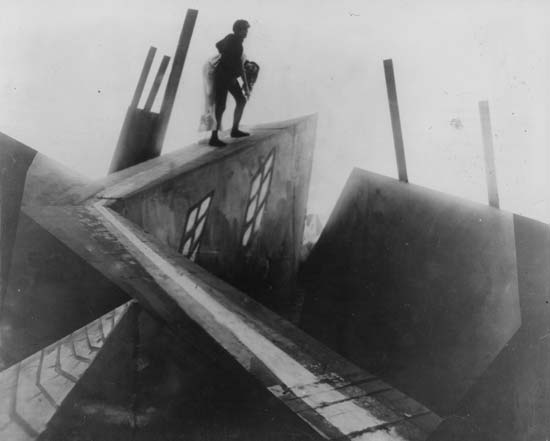
It’s the sets. They have obviously been designed to evoke expressionist paintings—which they do with mad conviction, tilting in Freudian architecture, their slopes a leer or a swoon. The characters walk in those paintings like the woman behind the yellow wallpaper in Charlotte Perkins Gilman’s story, trapped like a Poe victim, buried alive. This is a spirit-world as a nightmare, in which too many figures have the wide eyes of Goya’s ghouls and witches and helpless victims, where white-clad figures emerge from the woods to tell an old story, so old it makes no sense, unless you leave it alone, and let it be itself.

And what is the story, then, this awkward mechanism? It is steeped in murder and inevitable loss, a talking-cure without catharsis--aside from the awakening of the somnambulist, only to descend into gloom, through churchyard gates in the darkening night. Again, it is a dream from which one cannot escape--and in which one pursues a fiend that reveals itself to be, of course, the self. On this murky plot Wiene hangs his images, the silhouettes, the pale hands, the town a mountain of triangles, the postures all tortured, the somnambulist’s “bed” like the chimney sweep’s “coffin of black” in William Blake.

I had been looking forward to this film, but now I’m not so sure. As stylized and strange as it is, as off-putting in its aspirations, I was drawn in by the individual images, as though presented with a string of muddy pearls but unable to see the whole. My eyes could fix themselves on but one of these globes at a time, cloudy--then growing translucent, until I thought I saw Something in each, and each worse than the previous. Would Gilman and Poe be--should I write “happy”?--to see their ecstatic fears as moving images? And more to the point: Would Munch, or van Gogh, or Kirchner? Like their paintings, The Cabinet of Dr. Caligari is almost beautiful while in its presence--but afterwards, in one’s memory, almost horrible.

February 13, 1921 [The Kid]

Chaplin understands the movies: a space in which aggressive sentimentality will always be forgiven--and more: where it is encouraged, and partnered with anything else--genuine pathos, broad comedy, social commentary--that will put up with it.

Or maybe it's just Chaplin's brand of sentimentalism. After all, he is the master of the small touch: In the midst of catastrophic merriment he flicks a cigar-end or pauses and stares, with just enough dexterity to surprise or just the proper stillness to register the moment--and to engage us in that moment, as sappy as it might be. The Kid brings this tendency closer to perfection. Between Chaplin's Tramp and Jackie Coogan's Kid, I wasn't sure which was which, and didn't care.

Again, I'm enamored of the little things:

The Tramp entering his abject hovel--but not before daintily wiping his feet.

The Kid aiming a window-destined rock--and stopping in mid-swing as he realizes a cop is standing behind him.

The Tramp eager to stop the Kid from brawling--until he sees that the boy is winning, and he switches without a beat to applause and encouragement.

The Kid making a formidable stack of flapjacks--and tearing off a tiny corner of one of the drooping fried disks to sample the flavor, delicate as a master chef appeasing a miffed soufflé.

And I will not ignore the pathos, surprisingly affecting. Coogan cries magnificently, and Chaplin reveals himself as a philosophical clown, inclined to moral musings and all-but-tragic heights of loss and regret--while not ignoring our need for flight and capture, with nimble rooftop-hopping tossed in--mingled with a Tramp-Kid reunion that had the audience sobbing.

What hath Chaplin wrought?

December 11, 1920 [The Mark of Zorro]

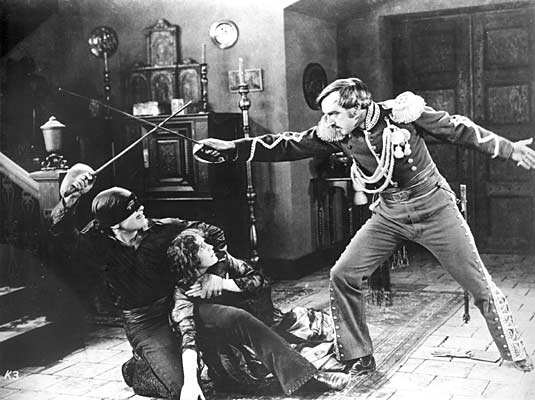
Douglas Fairbanks as Johnston McCulley's Zorro seems positively spring-loaded, as much a comic as a hero. He grins and gambols, clambering like a monkey, capering from rooftop to window to the thick of things, the flashing arc of his sword curved in a constant smile, shining like clean teeth.

The film commits early to ambitions, solemnly announcing at the start, "Oppression--by its very nature--creates the power that crushes it." And in this dialectical proclamation the "force" is individualized as a "champion"--that is, Zorro as the storm-bird of this particular revolution, stirring up the caballeros to join him in gleeful justice. Even the villains can't resist the fun, Sergeant Gonzales tossing natives and clerics like jugglers' balls, menacing everything in sight--until all of them eventually choose sides, either Latin Keystone Kops or Krooks, slathered with faux-swarthy greasepaint ferocity.

Don Diego/Zorro presents us with an odd bipartite personality that amuses and flabbergasts. As Diego, he is all handkerchief-tricks--parachutes, puppets, and disappearing knots--and yawns, partly bored, mostly sleepy, a definite disappointment to both parent and potential señora. As Zorro, though, his slapstick joy and charming, even eloquent exuberance is irresistible to those around him, jolting friend and foe alike, as if their Spanish passions were merely waiting for the proper catalyst.

The climactic showdown does not disappoint, an embarrassment of gravity-defying riches, as ridiculous as they are remarkable. And let me write again: "ridiculous" to the end, Diego-Zorro unmasked, bounding like a big dog, relieved at last that both of him could be himself, tickled like a kid that he can tell the secret and carve Zs into evil cheeks without the bother of a costume. But if this is justice, it seems a tiring occupation, chaotic and brazen; not for a sedentary viewer like myself. By the end I was as worn-out as Diego, eager to turn from the tumult and sleep it off.

Thursday

November 6, 1920 [The Saphead]

The New Henrietta with Douglas Fairbanks becomes The Saphead with Buster Keaton. Despite their shared athleticism, the two seem cut from different cloths--with Keaton the odder remnant, as it were. And his Bertie is more than "passing strange," with the quality of--I don't know what; a solemn, self-possessed toddler, his movements--such as they are (he is often all but inert)--precise, mechanical--and his passivity almost philosophical. It's funny, but like nothing else. I did not laugh out loud even once, and felt always off-kilter inside, as though my laughter had turned inward, like a sudden gulp of solid air, thick inside and heavy.

Do I exaggerate? I'm not sure; all I can write with certainty is that, with his bland demeanor, his near-tragic stance--thwarted on his marriage-day, standing in the Stock Exchange with his morning coat and cane, his beloved boutonniere (attached by his fiancée) clinging to his breast, buffeted by the traders--he becomes, for a space, the idiot rag-doll of Wall Street, ignorant of its double-dealings--so much so that, in true cinema fashion, he prevails, his greatness not so much thrust upon as pummeled into him. Keaton always promises--threatens?--such characterizations; here, despite the usual over-cooked story, he reveals without apology his freakish approach to--I must, I suppose, call it "comedy," although again it does not allow me to respond with any normal sign of having been amused.

In short, Keaton is a kind of genius--like Chaplin in his rubber-framed capacity to take a severe beating--but all the screen comics are boneless wonders. No, Keaton's greatness (and I know others note this--but I cannot note anything else) is his sad-Buddha serenity, tattered and bloody as he literally is by the end--but driven by the urge to survive, and the will to love. --And oh that last seems itself over-cooked; but Keaton engenders such outbursts. It is slapstick administered with distress and pity, driving him to do the right thing and reclaim his due. Of course, he gets his girl--but with Keaton it seems more a necessity than a surrender to form. I feared for his life, he looked so love-sick, unblinking amid the tumult of commerce. He is an acrobat-invalid, seemingly doomed until in the climax he springs, shouting "I'll take it!" over and over. And he does take it, over and over. Funny business.

Wednesday

October 25, 1920 [Just Pals, An Eastern Westerner, The Toll Gate]

Harold Lloyd may seem to be the tenderest tenderfoot ever to engage in Western horseplay--but I shouldn't let the owlish glasses fool me. All year long I've watched as the Frontier Male has softened like butter in August, dripping human kindness on the innocent and the unprotected--the Western myth, cinema-style, a sentimental wish that all those sand-blasted, prairie-broken cowboys and desperadoes are merely waiting for the opportunity to rescue children, court schoolmarms, and settle down.

True, William S. Hart, whether in The Toll Gate or any other of his pictures, looks like a wood carving of a recalcitrant mule--but whaddaya know, 'pears like all he was waitin' for, I 'spec'late, is the lovin' arms of a good wumman. --and I'm not sneering, not exactly, if only because Hart's world seems perched at the edge of a precipice of damnation--his bandit gang at his heels, thwarting his efforts to go straight, until that long equine face of his falls into something very much like anguish.

Despite such efforts at pathos, The Toll Gate never loses its epic-melodrama trappings, even when Hart gazes with unashamed affection at the curly-haired tot he simply refuses to leave in the lurch. But, while Just Pals also indulges in--how can I put it?--a narrative of unnecessary bulk--embezzled funds, a manhandled schoolmarm, the climactic near-lynching--it makes room for a number of genuinely affecting, small moments. The director is Jack Ford, and while he appears to understand the need for a certain scope in the Western (he positions his actors in tableaux, before a low sun, on a high hill, back-lit and elegiac-epic), he seems equally interested in (comparatively) subtle gestures. Bim, the town bum--Buck Jones, as always perfectly relaxed, his hair tousled, his face unconscious of its potential for heroism--"adopts" a young hobo; in one scene, they are presented with the opportunity to eat their fill, if they kill a number of chickens. Of course, neither can face the moment--Bim, it seems, even less eager to slaughter than the boy--and they walk away, their stomachs empty but their delicate sensibilities intact. This kind of thing is indulged throughout the picture, giving respite from the ridiculous extravagances of the plot. As in The Toll Gate, there is anguish over endangered innocents--but Jones and Ford seem more ready to bend their knees without condescension and see things as the children do.

Meanwhile, in An Eastern Westerner, Lloyd thumbs his nose at the Sagebrush Saga, slapping it silly with his absolutely unstoppable forward progress through all its tropes, from rope-tricks (faked, of course) to poker games (cheating, of course--and unsuccessfully, of course), from masked marauders (innocent shades of the KKK?) to the inevitable love interest--with, along the way, horses' tails doubling as clothes-brushes and pickpockets double-crossed. It is a bracing curative for the sugary heart-aches of the Western, as ready to leave frontier ruggedness behind as it is to revel in that same rough-and-readiness we have come to demand of life at "Piute Pass" (Lloyd's Western hamlet); in the end, though, whether comedy or epic, they are all of one mind, their freshly scrubbed faces turned to the sunset of a decidedly tamed frontier.

Friday

April 19, 1920 [Dr. Jekyll and Mr. Hyde]

While it appears the German and French cinema--with exotic crime chapter-plays such as Spinnen, Les Vampires and Judex--have been preoccupied with globe-spanning epics, the American delirium turns inward, to a Gothic solitude where secrets wait--and I suppose the same could be said of the European serials--but again, it is the whole wide world these vampires stalk, while over here, as the day darkens and the streets narrow, John Barrymore hunches into a corner and self-contains the epic within the divided Jekyll and Hyde, multifaceted--and multifarious.

I am one of those silly people who are unnerved by insects, especially the ones that creep, or dart, or simply lie in wait. And watching Barrymore as Hyde, I understand my aversion: With an insect, as someone has noted, we do not see a face. The many legs, the shiny carapaces, the bizarre, wandering trajectories of their movements--yes, these add to the effect. But I cannot “read” them, I cannot--or will not--see myself in them. To an extent, this also may be true with reptiles and fish, but the insect adds a kind of amoral disregard. When you try to strike one, it will as often as not lurch toward you, not so much out of fearlessness as simple blind purpose. In a sense, we do not exist for them. Their lives appear untouched by our presence; even their bite and sting seem mere responses to their hidden desires. There is so little malice that--if I may indulge in an unhelpful paradox--it becomes nothing but malice.

And thus the genius of Barrymore’s Hyde: He is an insect with a face attached. While his grin has the feel of a shark (a fish, I will assert, whose features are insectival in their detachment), and his skin the pall of a drowning body, he is more arthropod than anthropoid. Even as Jekyll, we first see him avidly peering into a microscope with kinship-joy at tiny wriggling things. (Another doctor looks into the eyepiece, and exclaims, “Damn it, you’re tampering with the supernatural!”)

Jekyll becomes Hyde, not merely to play at doppelgänger, to separate himself from himself--but, in doing so, to “fear nothing,” to have “full liberty.” And as soon as I saw him as Hyde, I recoiled: Here is the human insect, giving in to every impulse, bent forward in constant predation, hands like twin spiders (eventually carrying poison in the “Italian ring” he appropriates), and as willing to step on a child as to beat to death his beloved’s father. And the streets Hyde “squeaks and gibbers” through are as dark as any I’ve seen filmed, opium-laced and lascivious--but even such moral reprobation seems out of place: his lust is as cold as his stare--that human face pinned to the insect like a mocking mask--and his rage is without satisfaction. This is not sadism but sheer assertion.

As I sat in the theater, I was troubled by my impression of Hyde: Had I once again revealed my own sorry self, rather than what was actually on the screen? It was with some relief that I watched the scene in which Jekyll lies in bed and becomes Hyde via a dream-image: A giant spider enters his bed-chamber, and clambers onto him in smothering transformation. Add to that the poor opium-den inmate who claws at “red ants,” and my entomophobic response seems not entirely of my own doing.

I was glad to see Hyde/Jekyll die--at least so that I could be soothed (more or less) by the final shot: “the Great Profile’s” profile, distinctly human in its Narcissism. I can easily imagine Barrymore insisting on that final self-image, photographed in clean, bright light, and I welcome the display of ego--something easily recognizable in the features of our own species.


(I have read of a German film, Das Cabinet des Dr. Caligari, that seems to be traveling the same nightmare-path as the Barrymore movie. I look forward to its release here. I haven't seen Europe in a year, and no opportunity for travel presents itself, so I will, with Miltonic patience, "stand and wait.")

Thursday

December 12, 1919 [Victory, Male and Female]

I am exhausted; thank God this year is all but finished with us. The flu, the mess at Versailles, the almost-nervous jokes as the Volstead Act looms (that strange, sometimes amazing, sometimes damnably frustrating, man, Woodrow Wilson, unsuccessfully attempting to veto the thing), John Reed’s exhilarating (I dare to write) account of those “ten Russian days”--and the dark-Red ones that have followed, both for him and in this country--everyone, it seems, once again relieved to have an arch-fiend at the ready to load all ills on its scaly back--but into which wilderness will we exile our fears? I must be careful what I wish for: As 1919 wanes, there still will be 1920 to contend with. As a consolation, it appears that women’s Suffrage is all but ensured; maybe their addition to the electorate will make a change. We men have had our run--cold-eyed Queens notwithstanding--and I hope the ‘20s will thrive under a feminine hand.

I feel like Axel Heyst in Conrad’s Victory--filmed by Maurice Tourneur with horror's honest eye (even if his script softens some of the final blows)--seeking peace in isolation, only to suffer under--as Heyst puts it in the film--“a feeling of something slowly closing in on us.” He lives in a menacing world, fire-lit and humid--invaded by Conrad’s Unholy Trio: Mr. Jones, his white suit and smoked glasses giving him the air of a Futurist cipher, an oiled automaton of inscrutably deep cruelty; Pedro with his mercenary air and Svengali smile, like tiny grappling hooks; and Lon Chaney as Ricardo, Death as an affable simpleton--and again, Chaney hides himself to expose the intimacies of his character--as nauseating as they may be. It is, for long stretches, a remorseless gaze into the pit, dreadful and filled with fire. Tourneur expends a great deal of invention, perhaps even genius, in the service of psychotic doom.

Meanwhile, J. M. Barrie’s The Admirable Crichton also scatters its characters to a far corner, where the butler rules as King, and the lady--Gloria Swanson, more like a ripe and pendulous fruit than a person (lolling at the opposite pole from Theda Bara and her burnt-silk languor)--his, well, slave--DeMille cannot avoid the lure of the Ancient, and supplies a Babylonian interlude--I must admit, when I write about the cinema I sometimes feel I have become completely unmoored from not only all taste but sense--and I also must admit I do love it so. Where was I? Well, either about to contemplate the plot, or babble on like a dizzy schoolboy over Swanson. The scene of her morning, ahem, ablutions is orchestrated as unadorned erotica, from the dressing-gown slipping as she enters her bath to the cold sparkle of her rose-water bath. It is at such moments that my wife shows the most patience with my love of this liveliest art.

But I digress. Perhaps.

The wilderness island in Male and Female is infinitely more Enlightened than Victory’s literally volcanic setting. It is Peter Pan's Neverland as a Rationalist’s dream, waiting to serve Man—while Woman waits to do the same, it appears. “A male fantasy,” my wife observed, "as much as Peter's is a child's"--and she was not speaking of Miss Swanson’s toilette. And perhaps it is: When they return to England, followed by their social positions, High and Low, the Male is not cast into exile for his dream: In a cinematic postscript, Crichton finds hearty American solace on a farm, his fellow former servant, Tweeny, at his side, the two of them glowing with western bounty. Not the “impassive” ending of Barrie’s original, but an assertion of maleness, square-jawed and triumphant.


And I must admit I enjoyed the sight--almost as much as Swanson’s dainty foot slipping into her equally dainty slipper. Perhaps, then, the worst of the century is behind us, and the next decade will be more cheerful, at least in the area of the ankles.

Tuesday

June 4, 1919 [True-Heart Susie]

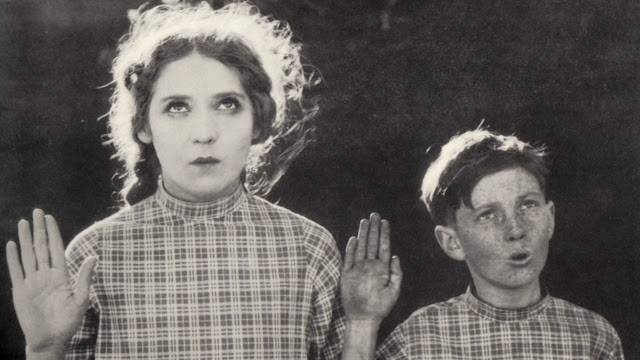
Claptrap among the Hoosiers, the boy and girl, “poor simple idiots”--who somehow strike a chord, at least because Lillian Gish stares quizzically into her future, tilting her head, gazing almost blankly (blandly?) at her wished-for Beau, William (Robert Harron perfectly playing him as a fresh-faced fool), who has been taken in by a painted girl, leaving Susie in the farmyard dust--bereft of livestock, sold so that he can go to his “country college.” Everyone learns hard lessons--some, fatally--and Susie gets her man.

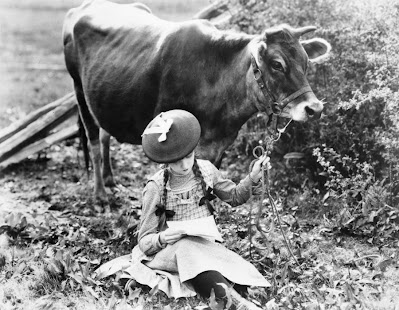
Along the way, though, various echoes sound. In her affectionate moment with her cow, about to be sold, Susie reminds me of the little girl, Sylvia (ah, the symbolism of it, the “sylvan girl”) in Sarah Orne Jewett’s “The White Heron,” whose only playmate was the wandering cow, “Mistress Mooly.” And the money she raises for William is given in secret, so that he believes it comes from a stranger passing through. And so Great Expectations also peeks in, just long enough so that William, who becomes “a punk country minister” (as the painted girl calls him), can learn, almost too late, the true source of his good fortunes.

And another pleasure: the scene where Gish cries, knowing William will marry another, but keeping up appearances. She smiles when observed, weeps when unnoticed, shifting rapidly from one to the other, in a scene that is almost clownish, but grows poignant.

And another: the glowing simplicity of the country landscape, the sun-dappled roads, the sense of quiet. I wanted those scenes to linger, to meander along their dust and green myself.

Oh, all right—and another: the wealth of dairy-imagery. Much is made over milk, butter and ice cream--and I perhaps catch a wink from Griffith as he slathers on all that creamy wholesomeness.

And perhaps one more: the satisfying depths William descends, his foul-mouthed wife “a little unfaithful”--but worse: a bad cook. This made me grin, if only because my own culinary skills leave little to be desired; but who am I to sneer? I leave that to Susie, who certainly does know her way around the stove--there’s an amusing scene as William, in the midst of his neglected marriage, sees the roasted-chicken glory of Susie’s table.

But where does it all go? I’m afraid my own wife saw it too well: She complained of Susie’s desire to educate her future mate (“I MUST marry a smart man!” she exclaims, after William loses to her in the one-room-schoolhouse spelling bee), the simpering sacrifices, the straining nostalgia and sentimentality (the final caption reads, “And we may believe they walk again as they did long years ago”). When we went to the “Armory Show” a few years ago [1913], we were both deeply affected by the explosions being set off on the canvasses. But it also seemed somehow familiar, cinematic as well as “expressionistic.” Was it because of the dreamlike quality of film images? The serpentine dance and electrocuted elephant, the camera’s gaze sliding slowly along the skyline, the subway journey through light and shadow, the animated magic-tricks?--and perhaps even further back, all the way to Muybridge's studies of locomotion, his own nude descending her staircase? It is indeed all "film," an invisible layer on on every image, every frame, the urge to make internal emotions visual through light and shadow, camera movement and the sequencing of scenes. It’s likely we can grow dissatisfied with something like True-Heart Susie because we have seen glimpses of cinema's true face--but what is that? A high and pure profile, a clownish gape, or something else? Once again, I remain both uncertain and expectant. Nevertheless: We were convinced Susie could’ve done much better.

May 15, 1919 [Daddy-Long-Legs/Broken Blossoms]

Between the on-screen version of Jean Webster’s epistolary novel/stage play and Griffith’s latest exploration of otherness, the cinema these days seems full to bursting with sentiment and strange turns. Mary Pickford in Daddy-Long-Legs does her Chaplin impression--at least as a child--while Lillian Gish in Broken Blossoms suffers despair and cruelty. Both performers stand at the top of their careers—but I cannot help noticing the weirdness of the worlds they inhabit.

Orphan Pickford resides in the “John Grier Home”--an obvious reference to the president of Princeton University, who himself is dedicated to supplying scholarships to deserving Westerners, cajoling the frontier to bloom among the ivy--and, after typically bizarre but humorous orphanage high-jinks (as always, I relish any moment that captures, no matter in how contrived a manner, the hidden lives of children, confronting the adult world—its bounty, its constrictions (even its inebriations)--especially in the netherworld of a surprisingly untended orphanage, in which all manner of revolution appears possible), Pickford finds herself educated and loved--but by whom? She is flabbergasted to discover: her adult benefactor, gray at the temples but ready for marriage.

As the father of two daughters, I must admit the whole thing seemed a bit, well, untoward. But that’s standard in the cinema--where the solid middle of things is blandly asserted--home sweet home and all that--while the oddest narrative loops circle the characters--and the audience--daring us to object--or to acquiesce. Either option makes for a mysterious journey.

As compelling as Gish and her made-up Oriental may be--and let’s not forget Battling Burrows--Donald Crisp screwing up his face in half-guilty rage, the brutish father who beats her, in scenes of disquieting sadism (Griffith energetically loading his trowel, building improbable edifices--here East and West ne’er meeting--if so, always tragically); and as touching as are some of the scenes--particularly when Richard Barthelmess’ “Yellow Man” presents himself as not so much inscrutable in his downward gaze as he is immobile in his despair--and no matter how attractive is Griffith’s love of visual language (even his captions are often more narration/description than (as in Daddy-Long-Legs) dialogue--in the end I felt as though I had stumbled into some strange Poe-like dream of love lost so deeply it becomes darkly obscure, something a bit clammy and, ah, cerement-al. The plot steams and clanks along, but what remains for me is the willingness I feel to take it in--or is that be taken in?

And of course this is the fun of it: part Ashcan portraiture, part Stravinsky audacity (although that fine Russian, even when he is silly, is still majestic)--each movement a surprise, whether sweet or churlish, a kind of narrative prank one sees coming a long way off, but--if the cinema is to be endured--is willing to wait and see.