Tuesday

March 18, 1918 [Amarilly of Clothes-Line Alley]

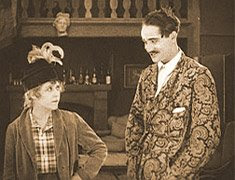
Artists high, low and in-between cannot resist Pygmalion and his living statue. If Shaw's play a few years ago seems the most recent height the tale has reached, it finds in Amarilly and her Irish brethren a grinning line of resistance: Amarilly moves as easily from her washer-woman life to the High Tea of a Society that sees her merely as an "experiment." It is, of course, eventually a failed one. But Amarilly--Mary Pickford, once more part spitfire, part sweetheart--remains non-plussed, her Irish sensibility--as the film is quick to remind us--eager to find the joke in class scorn. I'm reminded of my Irish uncle, a wry one to his Celtic bones, a gentle cynic who expects the worst, but shrugs at every mess with semi-feigned unconcern. Like the American Negro, the Irish see America from--how should I put it? Not a unique position--Woman, as the suffragists inform us, feels the sting of her own Lower Depths as much as any (ex-)slave or Huddled Mass--but perhaps it is a position particularly marked by birth, as slave or slave-laborer. (Someone, it appears, needs to ponder with more depth than I can manage, the "particular positions" of women among the Negroes and the Irish.)

Sometimes, though, that bravado is not enough, as when Amarilly's face freezes in pity for her mother, sneered at by the "ladies" who gingerly handle her bonnet. But I am more reminded of the all-but-comic blow-up when the mother discusses with one dowager the woes of a washer-woman's life--and the Fine Lady rises in outrage, exclaiming, "How dare she bring up my past?" It seems the film-makers share in their Irish surrogates' sense of humor, one that understands irony, and the joy of reversal.

As usual, the film is marred with unnecessary plot developments--Amarilly's Beau, Terry, is arbitrarily wounded by "Snitch" McCarthy, the gossip who, despite his eye-patch, sees everything--except where he's aiming a pistol. Terry, of course, recovers, his girl his prop and best pal; but Amarilly's level head and love of her life and their already-Romanticized rough-and-tumble neighborhood most certainly was all the motivation she needed to stand by her man.

Well, it appears the picture drew me into its outlandish liberties: You know you've lost when you begin arguing for more realism in a movie like this. I'd be more honest to admit it does just fine without me--maybe a too bit obvious, too ready to theatrically plant its hands on its hips and crack wise; but it's a little late in the day for me to start complaining. As always, the cinema does as it pleases. And with a solid little contraption like Amarilly, I'm better off in acquiescence to its charms than disdain for its rough edges.

(I'll save for another day any scorn for the mercenary cynicism that seems to lie behind such pictures, alarmingly quick to play by the rules of easy sentiment--and even easier caricature. Poverty, one might note, is not prone to merry endings. Tonight, though, I will indulge, and remain content to leave Amarilly with her Terry, far from the meddlings of the hard truth.)

Friday

February 16, 1918 [The Unbeliever]

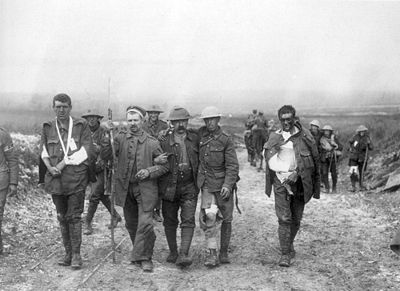
The War as class war--and as the First War, between God and Satan: The Unbeliever, "produced with the cooperation of the United States Marine Corps" by Edison (and I'm surprised he's still making films), sees the battlefield as a forge to hammer shining souls--and to overcome barriers between the hoitytoity and the hoipalloi. A mother-and-son-and-fiend tale, it details the transformation of aristocratic Phil, "firm in his unbelief"--in direct contrast to his mother, whose "kindly feelings for 'the masses'" lead her to disdain all war--as does her German gardener, who loses a son--whom Phil does not mourn: "a nation of vulgarians glorified by brains."

So the young man, inspired by his father--who fondly remembers the Civil War (ah, the romance of dismemberment)--goes off to war himself--and is brutally educated, slowly casting off his class-prejudices--and his unbelief:

The sharpshooter fires, hits home, then turn to his Bible.

The Germans, fearing their inspectors, send a message to the enemy: Bomb us to keep the inspectors away!

A vulture pecks at a corpse.

A rabbi ventures into open terrain to fetch a soldier's Bible--and they are both killed.

The camera flashes from the hesitating firing squad to its victims to the villain.

The night-time cannon-fire bursts like electric concussions, almost audible in their bright flash.

The old woman's face is beatific, ready to be a martyr for Belgium.

The Iron Cross is cast down and the Crucifix uplifted.

And then the villain: Erich von Stroheim as Lieutenant Kurt von Schnieditz, happily smashing a conscripted man's violin, manhandling the grandmother and her little grandson--and then more: having them shot, the little boy saluting ("Vive la Belgique!"). And the granddaughter, mourning, excites him. And of course he is dealt his comeuppance--but not before various heroes, military and civilian--and Jesus Himself--do their part.

And Phil, wounded and bent in humility, seemingly approaching reconciliation, limps home with faith and resolve.

It is almost a great picture in its manipulations. I was moved by its urge to find virtue--and taken aback by its relentlessness, its insistence that the mother's pacifism is beautiful but a luxury, its assertion that it must become a love story, its easy acceptance of the terms of belief. Unanswered questions do remain; the picture is impressive in the sheer bulk of issues it considers. But it seems almost too ambitious, as though Edison were gasping his last, and wanted to ensure nothing was better left unsaid. As so often, the War imposes the proper response--and dizzies one with contradictions that course just below the surface, in private doubt and hidden sentiment--late at night, when no one else can hear you.

Thursday

October 29, 1917 [Coney Island]

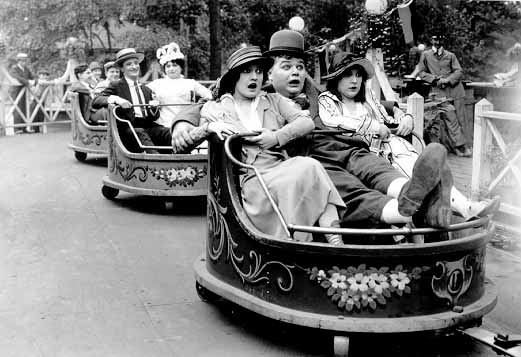
I will never tire of Coney Island. There is something almost sad about it, always on the verge of collapse--not physically: It is still a wonder of light and machine-ratcheting pleasures--but even the times I've been there, it seems a half-memory--even more so watching it on the screen, as Fatty Arbuckle, Al St. John, Buster Keaton--and Alice Mann, a genuine sweetie-pie, ready for a dip--undergo various trials during a typically chaotic Comique Film Company holiday. And while Fatty eventually dons his usual female garb--this time a bathing-suit--the camera demurely rising (at his insistence) as he changes--it's Keaton I again noticed more, his rubbery frame and resigned demeanor at odds with each other--yet forming a comical whole, as though the last thing he expects is to be in a knock-around comedy.

And again, as backdrop and prop, Coney Island does its best to indulge their most outlandish, cork-popping stunts, spurred by the promise of romance, from the Steeplechase to the Witching Waves, in midair or the briny deep. What a relief this Island still stands, in another world--built by a child, it seems--that hasn't a clue it's perched at the edge of a dangerous expanse, whose far shores are burning. For twenty minutes or so, there was nothing but Coney Island, a nostalgia-device--like the cinema itself--inventing a past, an imaginary home we want to believe we can find again--true, veneered in ridiculous shades of Fairy Floss, but no less enticing for all its little lies.

Wednesday

August 30-31, 1917 [The Little American]

It's been almost a decade since F.T. Marinetti spat out the Futurist Manifesto, a millennial curse--for him, though, a defiant Italian glory, bright around the whole world. (Just thinking about Futurism makes one fall into hyperbole.)

And it looks like they're getting their way: Their "atavistic ennui" led them to "shake at the gates of life" and roar off in their automobiles, crying aloud, “Let’s break out of the horrible shell of wisdom and throw ourselves like pride-ripened fruit into the wide, contorted mouth of the wind! Let’s give ourselves utterly to the Unknown, not in desperation but only to replenish the deep wells of the Absurd!”

And so they did; and their Manifesto flies like blind birds shaped like exclamation points. They "intend to sing the love of danger, the habit of energy and fearlessness"; the "essential elements" of their poetry will be "courage, audacity, and revolt," and they will "exalt aggressive action, a feverish insomnia, the racer’s stride, the mortal leap, the punch and the slap"--and in that last, things grow prescient, for they assert, "Except in struggle, there is no more beauty. No work without an aggressive character can be a masterpiece. Poetry must be conceived as a violent attack on unknown forces, to reduce and prostrate them before man." And then, finally, at last in brutal honesty, they proclaim, "We will glorify war--the world’s only hygiene--militarism, patriotism, the destructive gesture of freedom-bringers, beautiful ideas worth dying for, and scorn for woman."

There's more--ecstatic yelps about "the multicolored, polyphonic tides of revolution in the modern capitals" and infatuation with factories and bridges and "deep-chested locomotives." I'll admit, the language attracts me--I too am prone to ejaculatory prose--there goes some now!--but the years have passed, and now such bellowing not only alarms but dismays. Again: The world has acquiesced, and has smeared the Futurist Manifesto across the globe, with the guts of--would these rabid motor-men ever admit it?--innocent souls, from French farmyards to Moscow boulevards.

But is anyone innocent in the Futurist holocaust-orgy? I have a terrible feeling their lust knows no boundary. As Marinetti shouts, "So let them come, the gay incendiaries with charred fingers! Here they are! Here they are!... Come on! set fire to the library shelves! Turn aside the canals to flood the museums!... Oh, the joy of seeing the glorious old canvases bobbing adrift on those waters, discolored and shredded!... Take up your pickaxes, your axes and hammers and wreck, wreck the venerable cities, pitilessly!"

Is it mere words by drunken youths, justly sick of their parents' bourgeois hypocrisy and bawling their frustrations? It would be a relief to think so, but two years ago Marinetti, reveling in the War, announced, "The red holidays of genius have begun!" And indeed, the War--and now, the revolution in Russia, the Czar too much to bear, the Communists already the bloodstained inheritors of palace and pomp--feel too much like the--well, the Manifesto's manifestations. No one is innocent, and so innocence becomes a fiction--suitable, it appears, only for the cinema.

--Such as The Little American's Angela, in love with a German (ironically playing with her little brother, teaching him to "goose-step")--and loved by a Frenchman, both of whom depart when war breaks out--the German with natural reluctance, his fiancée left behind. Mary Pickford is surprisingly natural in this unnatural role, her home literally draped in flags, her kerchief a flag, the candy-stick she munches white and blue--as are the flower arrangements; even her birthday--the 4th of July--conforms to her loyalties. Her Frenchman notes that the French colors are the American's turned upside-down--and thus the chain of events is forged.

She travels to France--to live with her aged aunt--and her ship, the Veritania, of course!--is sunk by a merciless U-boat--spectacularly, the night-scene lit with ghost-lights, scanning the black water, all but sneering at the small struggling figures sliding off the deck. People boo'd and growled at this scene of Futurist revel--we all felt powerless rage, comfortable in our seats.

But the Little America finds no such safety. Eventually she is, of course, reunited with her fiancé, "cheating death--with stubborn grit"--but first there is the inevitable "scorn of woman": rapes, boot-licking, jeering--all horrible, the "splendidly drilled beasts" as drunk as Marinetti himself, in love with their explosions, a "Kultur" of annihilation.

The surviving couple, the Little American and her last-moment-defiant fiancé, sleep beneath a silhouetted Christ; and their wounds are healed by dawn and a return to America--the French gift, the Statue of Liberty, the film's final shot. And we cheered--and I had to bow my head for a moment, chastened by my own capitulation to sentimentality--as always in the cinema, hammered into us like railroad spikes. But the Futurist's war-cry, as attractive as it may be, even (perhaps especially) to Americans, encouraged as we are to remain in perpetual youth, sure of ourselves and prone to exaggeration--that cry also rose in me, and threatened to obliterate the Little American--and just as assuredly to prop her up, the last defense against "the world's only hygiene."

I may, then, disdain the simple-minded lessons of The Little American--but I cannot participate in its "cleansing." As dangerous as the Jingo's screed may be, the Futurist Manifesto holds its own peril--one that does not bode well for the past, the present, or--how did I know we would end here?--the future.


August 31

My vacillations yesterday may have been all but incoherent, but I notice they refused to be distracted by yet another Futurist Manifesto: that of the cinema itself, my avoidance of which was a great convenience, since I find myself impassioned by their assertions; for instance:

"The Futurist cinema will sharpen, develop the sensibility, will quicken the creative imagination, will give the intelligence a prodigious sense of simultaneity and omnipresence." And more: cinema characterized as a "polyexpressive symphony"; and even more: "It will be painting, architecture, sculpture, words-in-freedom, music of colors, lines, and forms, a jumble of objects and reality thrown together at random." A new art is promised, exciting simply to read about--to copy onto this page--and as farsighted as anything Marinetti and his followers have expressed. He announces a language built on visual analogy, of simultaneity and juxtaposition. If the Futurist accuracy in predicting human wickedness, grinning in the slaughter, chills me, its cinematic vision stirs me--yes, perhaps just as would a fall from a great height--but I see this cinema approach, Wagner's gesamstkunstwerk--aha: Kultur triumphs again!--wrestled onto the flat screen, moving like a fluid machine, its engine raucous, its purpose unclear.

Monday

April 6, 1917 [Teddy at the Throttle]

The United States has formally declared war on Germany. Wilson's been blinded by the lightning of history. I listened to Mozart's Clarinet Concerto in A Major. It would be presumptuous of me to mention how beautiful it is, so I won't. My children are sleeping, as is my wife. It's too late to write anything--although I did see some damned thing--Teddy at the Throttle, in which Bobby Vernon, Wallace Beery and Gloria Swanson--by auto, bicycle, train--attempt either to hoodwink, love, chase, or crush each other. In the end, the survivors, like so many before them--but how many from now on?--ride cozily on a cow-catcher, the wind and rain long forgotten, the villain thwarted, easy as drowning kittens. Once again, what fun the cinema provides!

Friday

Janaury 4, 1917 [Joan the Woman]

They're tearing each other to pieces in Europe. I don't know what to do: The anguish of it cuts like a knife--right through my anger, those moments I'd like to find the villain and--what, I hesitate to write. It is a fantasy I have to hold away from myself, like a squirming thing, before it coils too tightly.

And as the months pass it becomes more difficult. I write in secret that I am opposed to our getting into it--and at the same time I want us to do something. Wilson is keeping us out of it, I think; but what else can we do? This is all but unbearable.

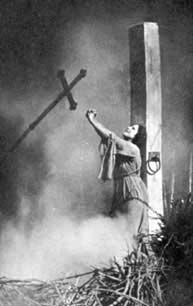
Cecil B. DeMille, of course, labors mightily to relieve me of the burden of uncertainty. An English soldier digs his trench and finds a sword--and Joan of Arc appears, and takes him, dream or no, into her story. She prays and grows adamant, she takes up a coward's discarded sword--a sharp edge if ever there was one!--and dons a fallen soldier's gauntlet. God Himself commands--and in turn Joan exhorts the English soldier in our century to atone for his nation's sin--her martyrdom--by carrying on. She burns--a horrible, beautiful sequence, as the flame dies slowly to a candle in the trench, the battlefield tinted a royal blue, heralding new kings: Every martyr--like her soldier, visited in his own martyrdom. He joins her in Heaven, his duty fulfilled.

At the start of the film, Joan raises her arms in an attitude of crucifixion--and the fleur-de-lis appears behind her: France her cause--and the cause of her martyrdom. But I cannot be Joan, no matter how strongly DeMille--and Geraldine Farrar, appropriately operatic as the Maid of Orleans--may insist. There is no clear cause in the mess they have made of themselves--but they may force us to help clean it up. More diabolism in the name of peace.

Tuesday

December 4, 1916 [The Rink, The Pawn Shop, One A.M.]

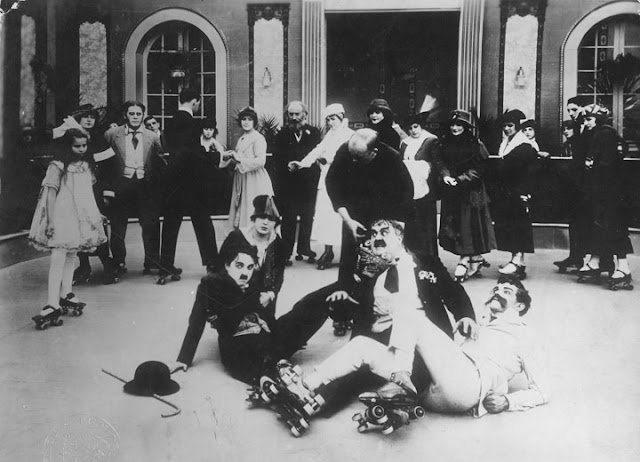
It seems every time I go to the cinema, there's Chaplin, tossing himself--and often Edna Purviance--at us with heedless grace, always new-born, and (so far) unbreakable. He is a wonder on roller-skates, atop ladders, or up and down staircases, drunk or sober, in love or a pickle. And he is anything he needs to be: the flirt, the innocent bystander, the combatant, the gentleman--and above all the consummate self-preservationist. Even his cane functions variously, from support to prosthetic to weapon. The hat, the moustache, the cane, the out-turned, over-sized clowns' shoes: They are everywhere. And yes, Arbuckle and the Keystone Kops are just as ubiquitous as the little Englishman; but it's Chaplin I have yet to tire of.

And while I might admire his increasingly "delicate" touch (that insistence on small gestures punctuating the greater explosions), I'm becoming more aware of a sense of balance--and not merely physical (although his essay of the double staircase in One A.M. would impress the Alpine Club). Chaplin knows that the trick to riding a bicycle is to keep moving, and his films, while not matching the headlong rush of the Kops or Arbuckle's rapid-fire pummeling, seem to know when to move on to the next gag--and more: the gag becomes the picture. Chaplin is a legendary roller-skater; however, in The Rink the skating is not so much a display of skill as it is a means of transportation of the plot, one that can be told only on wheels. His inebriate in One A.M., determined to settle down for the night, is thwarted not by his environment but his own drunkenness. And the flimsy articles of The Pawn Shop may remain commodities--but their capital is comic, not monetary. A new rhythm is being introduced to the screen comedy, anticipating our restlessness and seeking always to keep something new at our disposal.

I'm a little concerned that the search for constant novelty will eventually jangle us into numbness, that we will desire the new even before what's before us is fully formed, let alone "old." The world, it seems--at least in the cinema--is spinning more quickly; and while the giddy rush is exhilarating, it may one day cast us off with centrifugal unconcern.

Monday

September 15, 1916 [Intolerance]

It appears The Birth of a Nation has itself given birth. And if the earlier child had grown into a burden for Griffith, he passes it along to us, in three hours of (partial) retribution for the sins of the father, self-consciously ambitious and heavy-handed--but like its predecessor, impossible to ignore. From its Whitman-inspired transitional captions to its Cabiria-esque excesses, from its dictatorial "reformers" and Pharisees to its riots and massacres--and Crucifixion--the film refuses to surrender. I was exhausted, at some point even eager to leave--but Griffith managed to hold me in my seat as he carved some beauty from this lumberyard of sets and situations.

Everything piles on top of everything else, including the narrative, jumping from era to era, plot to plot. Babylon may have been more spectacular than the modern "western city"--but the former's biblical depravity barely matched the ruthless egoism and greed of the latter. And while the moments of spectacle remain most in my head--the "colossal hospitality" of Belshazzar, the horror of Golgotha--I cannot forget the image of the straight razors slitting the cords as they test the gallows, the mother's hand approaching the lost baby's bonnet, the poor-quarter "Musketeer" wrongfully accused, Jesus writing in the sand as the adulteress is spared--Griffith insisting at every moment that the definition of "epic" lies not merely in size and engrossing scope but depth--and while he hammers this sense of "deep thought" with his usual extravagance--distrusting his audience's intelligence, I fear (or perhaps too rightly judging it?)--he finds a visual language that captures both High and Low in the same lens. Other filmmakers surely embrace this "epic" perspective--but few will be given the kind of money it takes to traverse Western Civilization--$200,000, I read, and can barely believe it. But perhaps the modern epic of high and low will not always need unlimited funds, and will instead watch the little world in front of them, and see that it, too, moves in interesting circles.

Thursday

August 1, 1916 [A Natural Born Gambler]

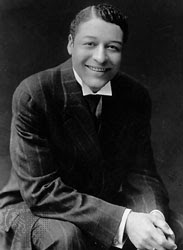
I must confess, walking out of the theater I began whistling "Are You from Dixie?" Bert Williams, "Mr. Nobody," may shuffle and grin, but I am reminded more of Chaplin and his imperturbable fool than the grotesques of the minstrel show. Still, with his blackface and no-account gambler persona, Williams seems suspended somewhere between caricature and character. Despite this tightrope he must walk, he manages a nuanced ne'er-do-well, all but winking at us in recognition of the way things stand for his race--but smarter than those who have imposed the caricature on him--and this invitation, at once sly and almost guileless, gives his "Walking Delegate" gambler a surprising freedom, and his solid frame encourages respect--odd, considering how disrespectful his character is.

And that may be just fine, in the world of the comedian. I'm tempted to assert Williams maintains more dignity than Arbuckle--although that may not be asserting much--and he certainly brings to his performance, if not the kind of physical dexterity we expect, a willingness to rock contentedly on his heels at the very edge of disaster. This, I would hazard to guess, is indispensable for someone in his situation: President Wilson does not seem a particularly close friend of the Negro, and the KKK appears to be experiencing a grim revival. Williams, like his brothers and sisters, will need all the pluck he can manage. I will not state much more; after all, I am just another paying customer, as complicit as any of us, safe in our skins.

But he does make me laugh--and refuses to play it too broadly, and is self-possessed enough to let us in on the joke. And that may be a good start.


A little accompaniment, whether or not you're from Dixie:

June 25, 1916 [The Waiter's Ball]

After months of (admittedly duplicitous) moral pronouncements, I have accepted the film comedy--more of a return, to be honest, my love of the Lumières' "sprinkler sprinkled" re-emerging, my affection for Méliès' acrobatic demons re-affirmed. The truth is, the more I watch these crude and brutal gags, the more I enter a typically cinematic dream; an illustration: Fatty Arbuckle and his restaurant nemesis--Al St. John, as thin as his counterpart is, well, not (and the both of them as ill-featured as Tenniel caricatures, liver-lipped and grimacing)--have at it, beating each others' backsides with brooms--and on and on the sequence grows--and just when I'm sick of it, a broom breaks, and all hostilities end so that the opponent can graciously fetch a new broom, and the beating begins again.

Everyday courtesies and frictions become rituals, and even Fatty's willingness to murder to acquire evening attire for the Waiter's Ball is merely another bending reality--social climbing as homicide--the world turned topsy-turvy culminating in what appears to be Fatty's signature bit: the gender-switch, as he dons women's clothing for some kind of gain--always thwarted, of course (the dreamer must always awaken before the moment of consummation). The fact that he looks at once ridiculous and quite at home in women's garb is not so much amusing as it is bemusing--and so here again I am at last, on the other side, once more finding my way to the cinema's far shore, another contented dope in a moving-picture palace--happier than when I cast myself adrift. Fatty, as well, seems to enjoy the experience, gussied up and mincing along, batting eyelashes and bashing noggins; so who am I to interfere?

March 19, 1916 [The Wrong Mr. Fox]

I'd like to see more of Victor Moore (now there's a publicity slogan). What surprises me is how little I was put off by his burlesque suicide attempt. Sucking on a gas pipe, one could argue, is not the most auspicious beginning for an entertainment. But when the out-of-work Jimmy Fox thinks better of ending it all, instead spitting fire everywhere he goes, I must admit Moore made the appalling humorous. There is something casual--if such a word can be applied to screen comedy--about him. He seems in some ways the least perturbed of slapstick comedians, so that even his unsavory inclinations seem more impish than grotesque.

This matter-of-fact approach to havoc serves Moore well, given the contrivances of the plot: Fox the actor is confused with Fox the minister, and he decides to play along, his larcenous eye on the collection plate. Moore takes advantage of the situation to satirize both occupations: As an actor, Fox accepts his role--he notes, "I saw Billy Sunday once"--and as a minister, he exposes the shepherd/flock relationship: While he sways before the congregation, they sway in unison with him, as regular as sea-waves--and as automatic. And although none of his thievery is rewarded, I'm left with the distinct impression he has not learned a moral lesson, but a tactical one. Literally stripped of his ecclesiastical garb, he hops on a bicycle and heads back to New York--298 miles away, according to the sign. Fox may not know how to save anyone's soul, including his own, but he does get while the getting's good.

Like Chaplin, Moore understands that comedy is not mere situation and physical noise. His Jimmy Fox is brightly aware of his surroundings, and his failures arise not through random disruptions but his own overreaching, combined with an almost-nonchalance, allowing him to keep his head--even when everyone around him is demanding it.

Wednesday

February 11, 1916 [One Too Many]

Freud tells us that jokes serve two general purposes: aggression and exposure--and so it is in film comedies. Maybe that’s why I’m sometimes unhappy with them, at least when they exhibit hostility toward what I see as undeserving targets.

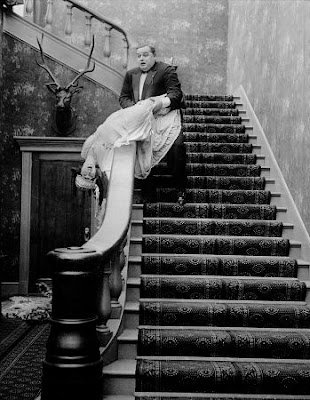
But every once in a while all judgment is set aside and I merrily succumb to violence--as with One Too Many, in which Babe Hardy demands of his lackey, “”Here’s $50. Get me a baby!”--and later, “Get a flock of babies!”--as well as “Now get me a wife!” The situation, of course, is contrived: His rich uncle is visiting, and he wants to meet Babe's wife and child. Even the lackey has to dress as a baby, as kidnapped infants howl, multiple wives arrive (with husbands following) and the entire mess wallows in crowded excess, everyone kicking, fighting, sprawling.

Again, the expected salmagundi; but I found myself relishing it, laughing at Hardy’s vigorous panic, the hapless lackey’s rough treatment, even the pitiably crying babies. Has the cinema coarsened me? I’ve always balked at such cruelty, particularly toward children. Here, though, cruelty comes as a kind of relief: Everything is batted around, including Hardy; no one is safe, and so even safety itself is not an option; at least the babies are fed (from multiple hoses) and the lackey kissed--and kicked. So it seems as far as hostility goes, Freud is correct; I’ll have to return to the cross-dressing Fatty Arbuckle for humor-as-exposure.

Tuesday

January 30, 1916 [He Did and He Didn't]

Windsor McKay's rarebit fiend, like said fiend's gorge, rises again--this time rumbling within the stretched-taut waistcoat of "Fatty" Arbuckle, the jealous M.D.--and asking us to imagine Roscoe as a medical man is an even greater stretch--but never mind: The husband, his wife, and the childhood sweetheart eat--round and glistening lobsters, tinted red, promising unquiet dreams in the mere curve of their carapaces within the serving-platter--and do indeed dream: of thwarted trysts, and acrobatic burglars, and falls from high places, and fatal retribution and revenge.

But it's not until the end that we know the truth. As far as the picture informs us, Fatty did--before we are suddenly informed he didn't--kill his wife, that is--or thought he had (by strangling!), until she revived and gunned him down--after the visiting sweetie got his. Until then, it's all silly Keystone-ery, with grim-faced murder as the climax--and then it's all "just a dream," and the two men grin and jostle each other back to their respective beds.

But two uneasy questions remain:

Why is this funny? Yes, it's a variation on the "burlesque suicide"; but that's a gag I've never found particularly humorous--and not because of moral sensitivity (although that may be a part of it), but more so I am simply puzzled by the point of the joke. And I suppose it is a matter of scruples--there are other comic situations I find either simply tedious--How many times can I watch someone fall down and think it funny?--or too cruel--and murder is an obvious one. But I find even lesser violences unappealing: Last week I was witness to a prank, and was among the few who didn't laugh when some boys threw a cat into a crowded eatery, resulting in a scene surprisingly reflective of Arbuckle's usual milieu. And I'll admit that at first the squeals and overturned chairs made me grin--but I saw the cat limping away, and wondered how much harm is necessary for a chuckle. I am trying hard not to puff myself up as some scion of morality; but sometimes I simply can't laugh at random misfortune.

And the second question: Why don't we see the wife's dream? Again, in the end all the mayhem of He Did and He Didn't is revealed as products of the men's churning stomachs, while the wife sleeps blissfully through it all. Interesting: In the dreams, she shoots Fatty, so perhaps there's another dream here: the picture itself, dreamed by the wife, conjuring the erasure of husband and sweetheart. And a good job of it she does. After all my fine moral uprightness, I must admit I'm glad someone finally plugged Fatty. The more I look at his faux-innocent mugging mug, the more I'd like to see him get it. And, thanks to America's favorite Balloonatic, I can forgive myself that last sentence by asserting, "I'm only joking."

December 27, 1915 [The Cheat]

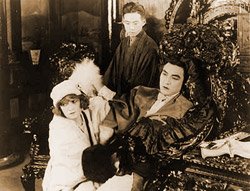
Once more--I am thinking of Birth of a Nation--an elegant gesture is executed with deformed limbs. Hishuru Tori (Sessue Hayakawa, his handsome face solemn and cruel) exacts a devilish price from the young socialite, Edith Hardy (Fannie Ward, her own face beautiful, even in its anxiety and terror), who has embezzled $10,000(!) from the Red Cross to make an investment--ending, of course, in disaster, and driving her to ask Tori for the money--which he willingly gives--then brands her, the Buddha gazing down impassively at the vague forms struggling with melodrama.

Kipling’s refrain makes its inevitable appearance: “East is East, and West is West, and never the twain shall meet.” At least not while the West insists that the East can be understood only as a combination of graceful ceremony and barbarism, a solicitous demeanor masking pitiless justice. “Inscrutable” indeed the Orient will be, under these conditions--and with greater legitimacy, given the technical mastery of The Cheat. I saw a tinted print, the blues and reds deeply evocative of night, of mystery, of horrible passion. And the screen is often darkened, the action framed within the frame by slanting bars of light. A striking effect is caused by the use of Oriental screens: Tori and Edith grapple, she shoots him--and the camera cuts to the other side of the screen against which he slumps--where her husband stands frozen—Tori’s blood leaving an accusing ideogram smear. And then the shadows of the bars at the jail--the husband accepting blame for the assault (Tori recovers from his wound)--and the trial, where the branding and the truth are revealed, and the camera scatters at us close-up shots of outraged American manhood, an uproar and near-riot--until the Occident is judged innocent, and the reunited couple, flanked by the cheering crowd, stride from the courtroom toward the camera.

It is as if the breathless headlong rush of a Keystone comedy were re-imagined as a brutal moral tale. And more: It adds the needless slap of race-hatred, in a picture that could have considered much else with its technique, instead choosing merely to titillate--but who am I to judge? Here I am, a willing customer, dazzled by the thing, hoping the producer--Cecil B. DeMille--will continue to explore the visual language of cinema. In its way, The Cheat is even more of an achievement than Birth of a Nation: In its attention to light and shadow, of camera placement and the pacing of each shot--like Cabiria and a few others--it voices its aspirations with a symphonic shout. Again, however, it is the lyrics that trouble me, not the melody.